Recording an audiobook with my daughter is the subject of this Wait What Really OK episode. Below are the episode art, the episode player, the episode chapters, the full transcription and questions and answers.
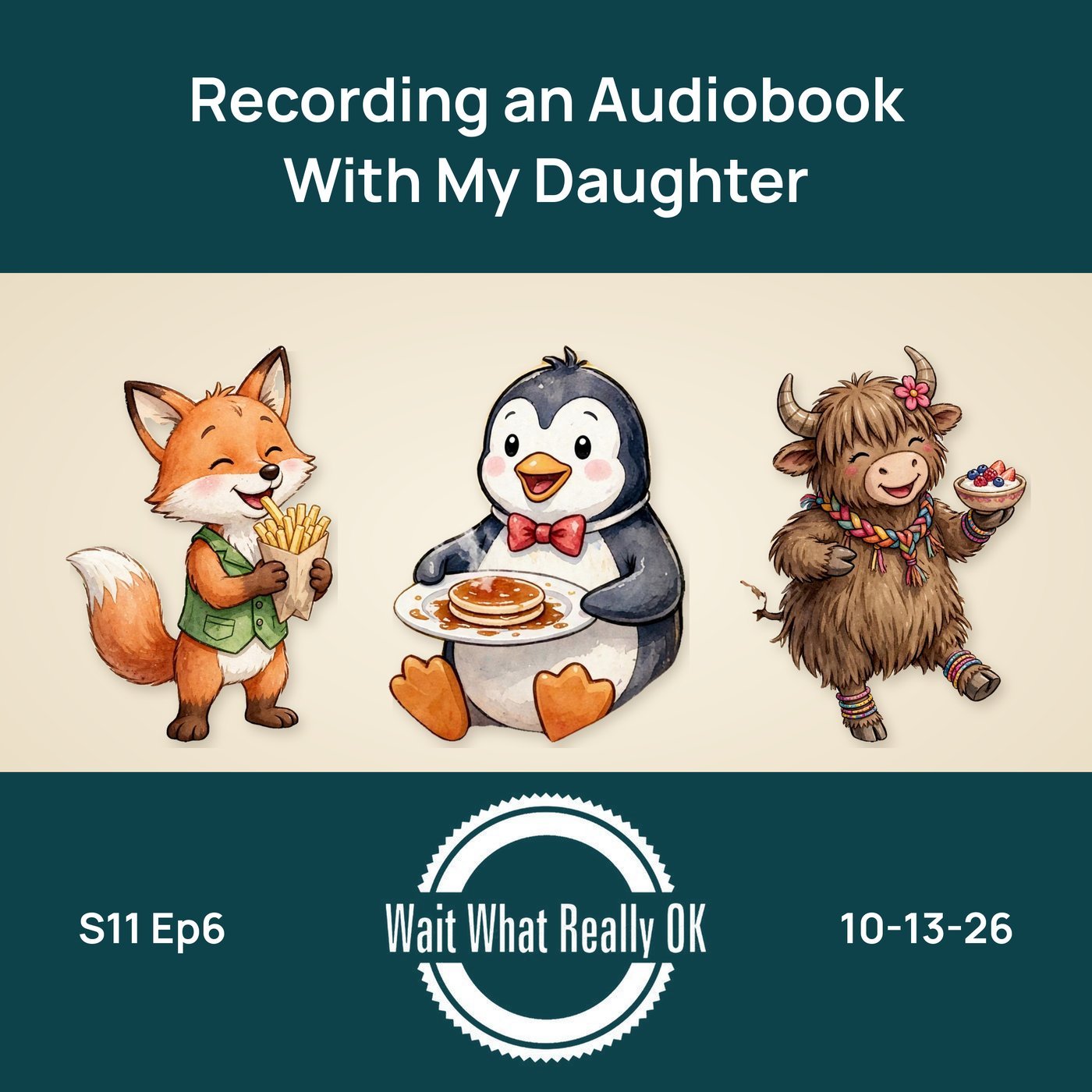
Released on October 13, 2026.
Listen to this episode here or on Apple Podcasts, Spotify, YouTube, Amazon Music, Pandora, iHeartRadio and Spreaker. The whole show, Wait What Really OK, is on Apple Podcasts, Spotify, Amazon Music, Pandora and iHeartRadio.
Recording an Audiobook With My Daughter
This is a follow-up episode to the last episode where I talked about writing a children’s book with my daughter. In this one, it’s about how we did an audiobook.
We created this little pillow fort of sorts. It’s pillows around a microphone in a certain way. We had one script between the two of us, and then we started working our way down it.
I’m very proud of what she created and what we created together and how she was able to do this.
It doesn’t have to be perfect. It doesn’t have to go into some studio. It cost us nothing.
I’ve worked on 700+ albums as a drummer and producer, and I’ve recorded and produced other audiobooks. My 11-year-old daughter was stronger at it than some of the adults I’ve worked with.
So that’s why this is a little bit more than an audiobook to me.
The audiobook was finished on October 14, 2026, passed the INaudio quality review that morning, and was submitted to ACX for Audible, Amazon and Apple Books and to Spotify through Spotify for Authors. The chapters, the credits and where to listen are on the Alphabet Animal Adventures Across America Audiobook page. The book is on the Alphabet Animal Adventures Across America page. It is available as a Kindle edition and a paperback on Amazon and as a paperback at Barnes & Noble, and it is listed on Open Library and Goodreads. It is published by Dadau Publishing.
Episode Chapters
- 00:00 Getting Ready
- 02:16 A Pillow Fort Studio
- 04:27 Four and a Half Pages
- 06:52 Taking Direction
- 09:20 One Day, Zero Cost
- 11:46 A Bookstore in Paris
- 14:30 Create, Finish and Share
- 17:41 More Than an Audiobook
Recording an Audiobook With My Daughter: Full Transcription
The full transcription of this Wait What Really OK episode, in the order it was recorded. It is also available as a text file and as a WebVTT caption file.
Song:
Wait What Really OK. With your host, Loren Weisman. This is a fully licensed theme song for the show about stuff that makes you say, Wait What Really OK.
Loren:
Getting Ready
A Follow-Up Episode
This is Wait What Really OK. I’m Loren Weisman, and this is a follow-up episode to the last episode where I talked about writing a children’s book with my daughter. And in this one, it’s about how we did an audiobook.
We Can Do It Together
I explained to my daughter the idea of how we want to add the ebook and we want to add the audiobook. And she even asked at one point, she goes, “So some people, they just have other people record it.” I said, “Yeah, but we can do it together. You and I can do it together.” And she seemed a little bit nervous. And I did add a little bit of a push.
Performing With a Microphone
And one of the things she’s been talking about is wanting to be a singer and a performer. And I explained to her, I said, not unlike the book and all the different elements of what was created, that this could teach her a little bit about performing with a microphone. And while it’s not singing into a microphone, there were aspects of how to posture, how to move words at a certain tempo, the enunciation, the volume, the flow, the read. And she began to get a little bit more excited.
The Script
In the meantime, before our sort of recording date, I went through the book and created a PDF script and making it in a little bit of an easier way so that we could decide who was going to read what. And that seemed to light her up a bit. She said, “Well, I want to read this line. I want you to read this line. We can go back and forth.” She wanted to create patterns in certain places. There were other places she wanted me to read. And in putting together this PDF of a number of different pages and large writing, a large font, it became something a little bit more obtainable.
A Pillow Fort Studio
I brought her to where I am right now, and we created this little pillow fort of sorts. And it’s pillows around a microphone in a certain way. And that’s how I’ve done a few audiobooks. My audiobook for The Artist’s Guide to Success in the Music Business, I was recording that while I was on the road promoting the book, and we were in hotel rooms making these little pillow and cushion forts and getting the tone, getting the best that we could for what it was. It was not recorded professionally in a studio, and neither is Alphabet Animal Adventures Across America, but it was fun, and the story behind it was fun. So I began to create the little pillow fort, and my daughter loved it. It was fun. We set each other up on each side, and this is going to take a couple minutes. We’re going to test our voices and we’re going to get a certain level. And then I applied Claude as my final mix, if you will.
Standards Before the Mix
And as I would have had we been in a professional studio, there are certain standards of what you want. Now, this is not a professional studio recording, but I set out the line like I would had I been in a studio or had I been with an engineer or doing it myself. I had downloaded the ACX audio standards, the stuff for what goes up on Amazon and Audible, and then a site called INaudio, which is their tech standards that goes up on Spotify, about 30 other different pages. From there, I stated that into figuring out the levels. Then I figured out the EQ that I like, the de-esser, the kind of thing that softens that sharp S sound, aspects of compression. And I found it really cool that I could lay out, not unlike what we did for the book, lay out a plan to set up a mix that wasn’t going to cost a cent, but that I could load from a microphone that I had into GarageBand, into the mix, and into the master.
Four and a Half Pages
And from there, it wasn’t sending something to Claude and saying, you know, mix this and make it sound good. It was a prompt and rules and instructions that were about four and a half pages I created prior to my daughter getting here. And again, the EQ, the limiters, the room tone, you know, moving some things around, making sure that this still had the authenticity. So, just as we used AI to create the images, we described every image and every character as if it could have been brought to an illustrator. That was the original plan. So, as we fed them in, it was organic. It was authentic. Now, at the same time, for the audiobook, same thing. It was filling in the cracks, it was creating the outline of this is what I want you to do. Can you do this? Can you use these controls? I’m going to set these certain levels. Can we work this way? And from there, it came back really quick. And it didn’t cost studio time. It didn’t cost an editor or an engineer or a mastering agent. But we’ve got all the stuff to the right standards, and it’s not perfect, but I’m very proud of it.
Recording Day
A Half Hour of Levels
At that point, my daughter came over. We had gotten our basic sounds. I explained that she was a little, I wouldn’t say taken back, but confused. And then I explained that when we used to set up for albums, the pre-production and the setup time, I said we would spend an entire day just getting all the levels. And it made it funny that it took us about a half hour to get the levels here.
One Script Between Us
She got comfortable. She got settled in. We were sitting across from each other. We had one script between the two of us, and then we started working our way down it. It was very inspiring and amazing, and a whole bunch of words that I feel like at times are overused, but I genuinely mean them to watch her commit to the work and seeing her do something like that, because there are a lot of people, and I’ve produced some audiobooks, there are some adults out there that didn’t have the organization, the listening skill, or even being able to take the criticism that I found my daughter to be able to do.
Taking Direction
She did have little bumpy moments, and it was, you know, she was flying through at one point, and other times it was, “Well, I did it this way.” “Well, you know, no, you didn’t. And let’s look at it on the screen. And this is what we’re trying to go for.” And then she would move from a more defensive place to a more relaxed place. And then she’d make the fix. But her enunciation was something. She had her little elements where we had to do take after take, but she could flow and she could hit these marks and she could hit some of the reads. She could get them straight done. I’ve worked with people where we were copying and pasting and putting words on top of words and moving words from other places.
Reading Off the Page
And yet she had a great flow. And it’s cool for 11 for her to be able to read as naturally as she does off the page. I don’t know that many that can read that way. And I’ve worked in television at times and music where we had scripts with, you know, younger children. And we’re really trying to work them through to make it feel like it’s not being read off a page. And she really had that.
“I’m Really Slow”
It was strange at one point toward the end, and we didn’t get it all done in one day. She seemed to lose a little bit of the steam. And I wanted her to know how amazing she had done. She was like, “I’m really slow.” I said, “You’re not slow.” The only thing that slowed it down at one point was a confidence thing. She felt negative and she wouldn’t hear how positive she had done. And it was a little bit challenging where I was telling her, I said, “You’re better than some professionals I’ve worked with. And this is a lot. And this is your first audiobook. And you sat up the right way. You enunciated, you used your lungs the right way, the diaphragm, the volume, the tempo.” And at times, when we had to retake things and do it a couple times over and over again, not just her, it was me too, that she was hitting it. I’m very proud of what she created and what we created together and how she was able to do this. And I think that this was probably one of the more challenging elements because, as creative and a little bit more patient over what we created with the book over time, this was a real, “Hey, let’s attack this and let’s try to get it done in a day.”
80 Percent in One Day
I mean, in that, you know, I’d say we got 80% of the book done the first day. And I just couldn’t have been more proud. And I know I’ve reiterated that.
Beyond the Audiobook
It Cost Us Nothing
And I think that in the same way of what I talked about with, you know, kids and parents doing books together or any kind of project together, this again, if you do that book, you can add that audiobook. You can read together. It doesn’t have to be perfect. It doesn’t have to go into some studio. It cost us nothing. And I’m happy to share the template that I used if it’s something that anybody wants to use regarding levels and whatnot, because you can sign up for ACX for free. You can sign up for INaudio for free and be able to distribute and put out something and put out this supplemental element so that in what’s here right now for Animal Adventures Across America, we have the paperback, we have the ebook, and now we have an audiobook.
Reading Along
And yeah, it’s a children’s audiobook and it’s something that they can read along to. But you know, a kid could have their Kindle open and read along, stop it and start it. Or, you know, reading along to the paperback and experiencing the voices, and the voice of my daughter, who it was just, it was fun to see it come off the page.
A Library Opening
And it was part of a really cool day when I picked her up before I brought her back to do the audiobook. We went to the opening of a library in the area, right near her neighborhood. And we brought one of the copies of the paperback, filling out what you’re supposed to do for local authors. And there’s a letter, you know, a lead letter, this PDF sheet you’re supposed to fill out, and then bringing that. And we were able to bring it to the guy that’s the director of these libraries across the county. And we got to go to this opening thing and we met the mayor, and it was a blast to watch my daughter experience this next phase of the book. And so it was, you know, what was created over time, then in the whole publishing part and getting it up and getting it formatted and getting it out to different places. And then the next step about the audiobook and the next step about distribution.
A Bookstore in Paris
I think it’s the number three, it’s one of the biggest bookstores in Paris. And it’s somewhere that my daughter wants to go. And they have it for order there. It’s not sitting on the shelves right now, but you can go to their site, you can look it up and see it. And I remember the other night, showing it to her on my phone of going, “Look, this is the place, and this is how far it is from the Eiffel Tower. And when you go in here and look at this in French, you can order your book.” These little elements to connect her and to show her and hopefully, you know, build her confidence in things that she can do, in small things she can do toward whatever dream she’s going after, whether it’s writing more books, whether it’s becoming a singer, whether she wants to become a dancer or a chef or whatnot, to let her feel this sense of not just, oh, I created something and popped it on the shelf, but I created something and I put it out there. I put it out there to the world. I put it out there in these different formats. And it’s not, you know, I think that as publishing has gotten easier, this isn’t something that could have been done at this level when I was younger. But on this, you know, zero dollar budget, what we’ve been able to create together and where it’s gone and how it’s gone out there, it just feels amazing. And it could be something that, you know, five people, 10 people, 100 people, it’s not about the sales, it’s about creating something together and sharing it. And that, to see it on this larger level and to talk about doing something.
Not Now Is Not Never
And, you know, at first with the book, it was a situation of certain things couldn’t happen as quick as I wanted them to. And it was not a not never, or more so, not now is not never, and that it was going to take a little bit more time. And it took a little bit more time, and it was challenging, and it was hard. And the time that I was away from her, and the time coming back. But I pray that she can see the amazing talent that’s within her, the amazing creativity and this element that when she commits, when she puts in the follow-through, what she’s able to do is absolutely outstanding. It’s beyond measure. And I’m so proud of her. And I hope that this is something that she takes pride in for a long time to come and inspires her to take on bigger and even larger projects, larger visions, bigger dreams.
Create, Finish and Share
And in the middle of all this, I want to see others that have talked about a book or maybe recording a song, not just making that song, but, you know, put it out there, distribute it, have a little copyright, put together a publishing company that’s not going to cost you a hundred bucks. Distribute it out, do a karaoke version, maybe send it to another country, let them sing on top of it. There are all sorts of ways that we can create, and then at the same time, we can share and potentially impact. And the impact isn’t necessarily in what we created, but it could be in that we create, the way that we created it could inspire other kids and parents, whether they’re one room away or 12 states away, to create and finish, format it, doing it the right way, following the certain standards to make, and yes, it makes it a little bit more challenging, and then putting it out to the world. I hope and I pray that my daughter sees this in the long run as proof of what she has the ability to do, of how much greatness is in her, of how much creativity is in her, of how much intelligence, of how much love, of how much commitment is in her. And that this impacts her and allows her to grow in confidence, in strength, in love, in just stability, and making these sort of flighty, cloudy dreams become that much more stable, that much more true, that much more reachable. And not just looking up to the sky, but more so, beginning to build a foundation and a solid ladder and beginning to climb up and achieve anything that she wants to set her mind to.
An Incomplete Sentence
And again, taking it one more step back, not saying, “Oh, well, you can do anything you want.” I’m not as much a fan of that. I feel like that’s an incomplete sentence. You can do anything you want if you truly commit, if you genuinely put in your all, if you learn, if you take the time, if you persevere in the hard times and in the easy times, if you follow through at that point, and to me, at that point only, that’s when anything is possible. And then perhaps, whether you’re sliding backwards, moving forwards, you can look back in the rear view and say, “Well, this is what I was able to do when I put my all in. Maybe I need to put my all in again.” I believe in my daughter. I believe in her dreams. And I believe that this, and I hope this is that cornerstone to show her what she’s capable of so that she can put in the follow-through and the small steps toward whatever dream that she dreams and how she can make it a reality.
More Than an Audiobook
So that’s why this is a little bit more than an audiobook to me. And as we recorded this, it was emotional. It was amazing. It was challenging. And again, watching the beauty of my daughter working through one line that she just breezed through like it was nothing. And the next line, you know, doing five or six takes, it was, I couldn’t have been prouder. I think she’s amazing. I think what is being created here for her, with her is amazing.
Create Something Together
And I think that, or I hope that maybe this could inspire some parents and kids to whatever they’re thinking of creating and whatever they’re thinking of doing together, that maybe it’s that time now to step up and do it with your child and create something together that could have that lasting long impact to show others what they can do and how they can do it right and how it doesn’t have to cost a crazy amount of money or much at all, and yet can create something inside that just can grow and grow and be nourished and build in so many different angles with so many different branches of it going in so many different directions. So, that’s this episode. That’s what I saw in what we put together in creating this audiobook, me and my daughter, and how I just feel so amazed at getting to be by her side during this and for every step that we’re taking with this book forward and for whatever the next step or dream or project is. I’m Loren Weisman. This is Wait What Really OK. I’ll shut up now.
Song:
Wait What Really OK.
Questions and Answers
How did recording an audiobook with my daughter start?
It started when I explained to my daughter that we wanted to add the ebook and the audiobook to our book. She asked if some people just have other people record it, and I told her that you and I can do it together. She seemed a little bit nervous, so I added a little bit of a push. She has been talking about wanting to be a singer and a performer, and I explained that this could teach her a little bit about performing with a microphone.
How did I get my daughter ready to record her first audiobook?
Before our recording date, I went through the book and created a PDF script in a large font so we could decide who was going to read what. She wanted to read some lines, wanted me to read others, and wanted to go back and forth and create patterns in certain places. That made it something a little bit more obtainable for her.
What did I coach my daughter on at the microphone?
I worked with her on how to posture, how to move words at a certain tempo, the enunciation, the volume, the flow and the read. I told her she sat up the right way, enunciated, and used her lungs the right way: the diaphragm, the volume and the tempo. When she was told something was off, she would move from a more defensive place to a more relaxed place, and then she’d make the fix.
What is a pillow fort studio?
A pillow fort is pillows around a microphone in a certain way, and that’s how I’ve done a few audiobooks. I recorded my audiobook for The Artist’s Guide to Success in the Music Business in hotel rooms while I was on the road promoting the book, making little pillow and cushion forts to get the best tone we could. My daughter and I built our own little pillow fort and set each other up on each side of the microphone.
How long did it take to set the recording levels?
It took us about a half hour to get the levels. When we used to set up for albums, we would spend an entire day just getting all the levels.
How did I direct AI to mix and master the audiobook?
I wrote a prompt, rules and instructions, about four and a half pages, before my daughter got here. I didn’t send something to Claude and say mix this and make it sound good. The instructions set the mix to the ACX and INaudio standards and covered the EQ, the de-esser, compression, the limiters and the room tone, while making sure the recording kept its authenticity. AI was used only after we recorded, for the mix and the master, with no AI voice, and AI did not fix our voices.
How much did the audiobook cost to make?
It cost us nothing. It didn’t cost studio time, an editor, an engineer or a mastering agent. You can sign up for ACX for free and you can sign up for INaudio for free.
Did we record the whole audiobook in one day?
No, I’d say we got 80% of the book done the first day. Toward the end of that day, she seemed to lose a little bit of the steam.
What do I hope my daughter takes from recording the audiobook?
I hope this is that cornerstone to show her what she’s capable of, so she can put in the follow-through and the small steps toward whatever dream she dreams. I hope she takes pride in it for a long time to come and that it inspires her to take on bigger projects, larger visions and bigger dreams.
Can a parent and child record an audiobook together?
Yes, if you do that book with your child, you can add that audiobook and read it together. To me, it doesn’t have to be perfect and it doesn’t have to go into some studio. I hope it could inspire some parents and kids to step up and create something together.
Loren Weisman is a Brand Communications and Optics Strategist who specializes in illuminating authoritative intelligence and amplifying authentic experts.
Weisman is the host of the brand communications and optics podcast Wait What Really OK.
© 2011 to 2026 Loren Weisman. All Rights Reserved ® ℗
Related reading
- Alphabet Animal Adventures Across America Audiobook
- Alphabet Animal Adventures Across America
- Writing a Children’s Book With My Daughter Podcast and Transcription
- How We Wrote and Published a Children’s Book Together: A Family Co-Authoring Blueprint
- A Family Co-Authoring Blueprint to Consider, the talk
- How My Daughter Changed My Approach Podcast Transcription
- Dadau Publishing