How Olivia Weisman and her dad, Loren Weisman, wrote and published their children’s book, Alphabet Animal Adventures Across America: A to Z with Friends, Foods and Places to Go (Dadau Publishing, Orlando, Florida), in the order we did it.
By Olivia Weisman and Loren Weisman. Published October 6, 2026. The short version is the 20 steps in A Simplified Version.
This is the whole plan, from the first sheet to the steps after the book came out: creating it together, print and format, protecting it, publishing and distribution, and the steps after release, then a simplified version in 20 steps. It is our experience and our approach: one set of ideas, options and strategies worth considering, not the only way. We are not attorneys or financial advisors, and none of this is legal or financial advice.
Download the Blueprint
- A Family Co-Authoring Blueprint, full PDF (87 pages, 12.2 MB): this plan, the Character Descriptions and the Background and Page Descriptions in one file
- Character Descriptions (PDF, 27 pages, 5.2 MB): every animal from A to Z, with its picture as printed and its description
- Background and Page Descriptions (PDF, 36 pages, 4.9 MB): every page and background of the book, in order
Each PDF has a clickable contents list, searchable text and alt text for every picture.
1. Creating It Together
The idea, the words, the descriptions and the pictures, made by a parent and a child together.
How we started
Olivia came into Loren’s office and said, “I want to write a book.” The same day she came back and said, “I want to write a book with you.” The idea was hers. From the first idea to publication took three and a half years.
The first sheet
On Monday, May 29, 2023 we sat down with a spreadsheet, DADDY DAUGHTER BOOK OVERVIEW, and gave every letter one row: a name, a describing word, an animal, a food, a city, something to do there, and the words that go with them.
Before a page was written, the sheet also listed what the book would be about (an alphabet book of animals, foods and places, with geography, lessons and describing words) and what it would include (a seek and find page, a map with dots, a dictionary in the back and other pieces to go with the book).
Checking every word and every place
We looked up the words and checked the facts before anything went into the book: every place against its own website, every word against the dictionary, every row against the rules below. Some things changed along the way:
- Names: Bertrand became Bertram, Charlie became Chester, Henry became Homer, and Iggy became Isabella.
- Places: each place became a description instead of a name, so the Georgia Aquarium became a big aquarium. Some changed: in Orlando, Disney World became a dinosaur hall; in Seattle, Starbucks became a busy public market; and W moved from White Hall, West Virginia to a roller rink in Winston-Salem, North Carolina.
- Spelling: Narwal, Penquin, Racoon and Waflles were fixed. Vain, Rebellious, Xtra good and xia mi stayed as we wrote them.
The rules every page follows
- One letter, one spread. The picture on the left page, the words on the right page.
- Everything from the row. Every piece of the row lands in that letter’s words once: the name, the first descriptor, the animal, the food descriptor, the food, the city and state, the place, the third descriptor and the action.
- Alphabetical. The name, the first descriptor, the animal, the food descriptor, the food, the city and the third descriptor all start with the letter. The place and the action do not have to. One exception: the X page’s third descriptor is at home.
- Places described, not named. The words name the city and describe the kind of place: a big aquarium, a candy factory tour, a busy public market, a roller rink, an orchard, a painted carousel. The real names and addresses are in the back of the book.
- The food, then the place. Every page moves from the food to the place in order, with its own joining word or turn, and no two second sentences open the same way.
- Read aloud. Written to be read out loud: no long stretch without a comma or a stop, and every page close to the same length.
- Reading age. Ages 4 to 8: read aloud at four and five, read alone at six to eight, with a word list in the back.
- No logos. No words, signs, logos or brand marks anywhere in a picture, apart from the letters.
The manuscript in Word
The sheet then became a manuscript in Word: the words for every page, a line for every character, a description of every picture, and the back pages. All of it was written before anything was put into an AI tool. We read every page out loud and reworked what did not sound right. A few of the changes:
- Drank became lapped, an eating word that starts with L.
- Wolfed down warm waffles stacked four strong beats in a row, so it reads wolfed warm waffles.
- Whoosh!, Worried! and Zany! stood alone without the animal in the sentence, so each one now carries the animal.
- A covered market became a busy public market, the way Pike Place Market describes itself.
- Where English has no eating word that starts with the letter, the plain word stayed: licked, juggled, tasted, peeled, shared, slurped, sampled, ate, spooned, crunched.
The descriptions
We first wrote the descriptions of every character and every background for a graphic designer or illustrator, as a baseline: enough detail to show what we pictured, with room for them to bring their own ideas. Several attempts with designers did not work out, and the prices were more than we were prepared to pay.
The style we worked out
We picked one look for the whole book, so every page would feel like the same book, and we added it to every picture description:
A hand painted watercolor look, like a real children’s book. Bright, friendly colors and soft, rounded shapes. A little messy, the way real paint is, and not too perfect. No words, signs or logos in the picture, only the letters for that page.
Every description also said where the words would sit, kept faces, the food and the letters away from the edges and the fold, and asked for no words, signs or logos in the picture.
What AI did, and what it did not
We uploaded the same descriptions to MyStoryBot, an AI illustration tool, and corrected anything that came back missing or slightly off. MyStoryBot sped up one of the final stages: illustrating and laying out the pages.
- The words are ours. In the AI questions on KDP the book declares Texts: None, and Images: Many AI-generated images, with extensive editing, tool MyStoryBot.
- The copyright says the same. The registration claims all the text and Olivia’s drawing, and excludes the AI-generated illustrations (Protecting It).
- Olivia’s own drawing is on page 67 of the book and on the back cover.
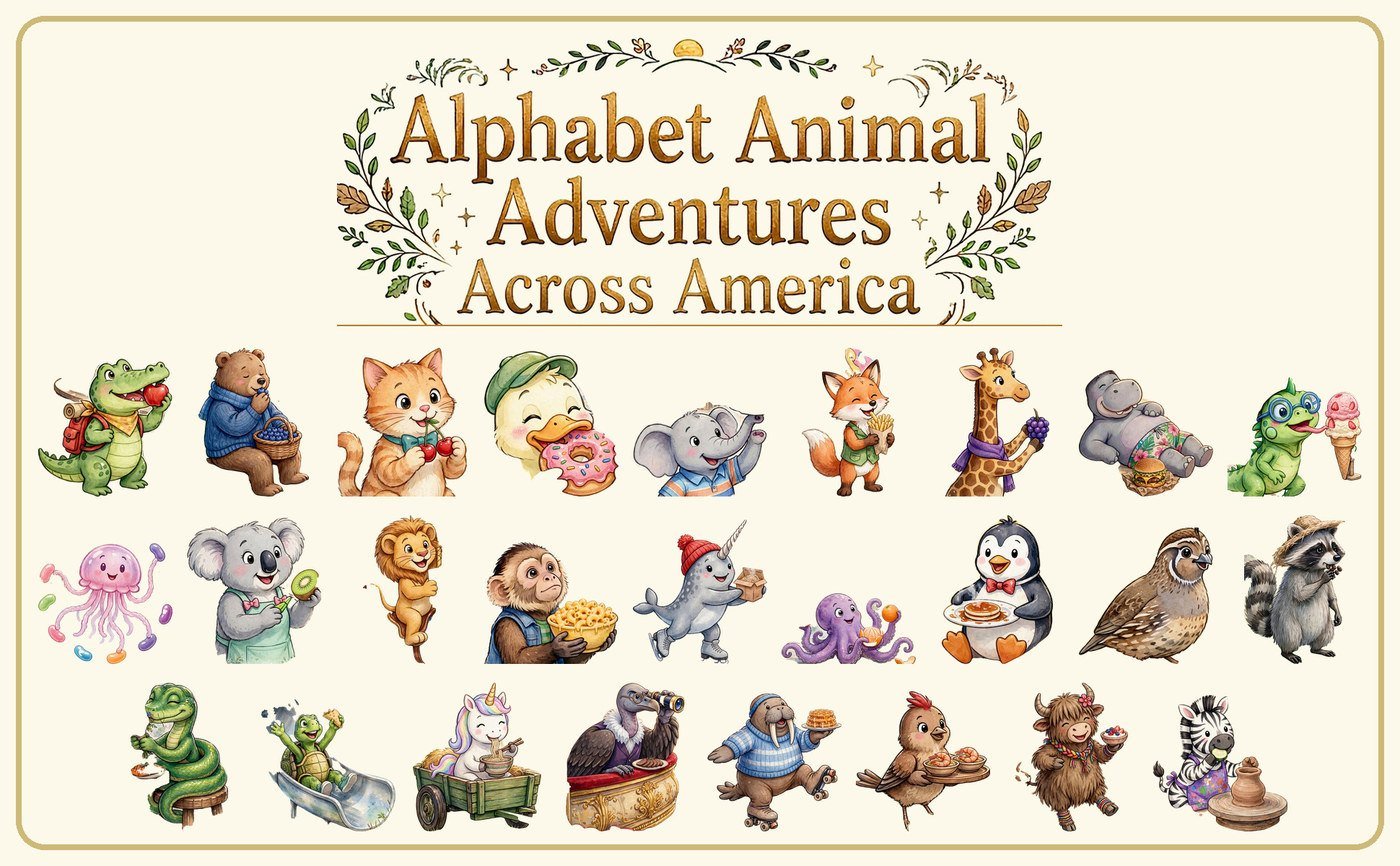
The animals
Twenty six animal friends in twenty six real cities across 23 states. On every page the name, the animal, the food and the city start with that page’s letter.
| Friend | Food | City | Where they go | |
|---|---|---|---|---|
| A | Arnie the Alert Alligator | apples | Atlanta, Georgia | a big aquarium |
| B | Bertram the Bashful Bear | blueberries | Boston, Massachusetts | swan boats on a public garden pond |
| C | Chester the Cheerful Cat | cherries | Chattanooga, Tennessee | restored train cars at a grand station |
| D | Daniel the Dreamy Duck | donuts | Denver, Colorado | a candy factory tour |
| E | Elijah the Energetic Elephant | eggs | El Paso, Texas | a children’s museum |
| F | Frank the Fancy Fox | french fries | Fargo, North Dakota | colorful painted murals at a zoo |
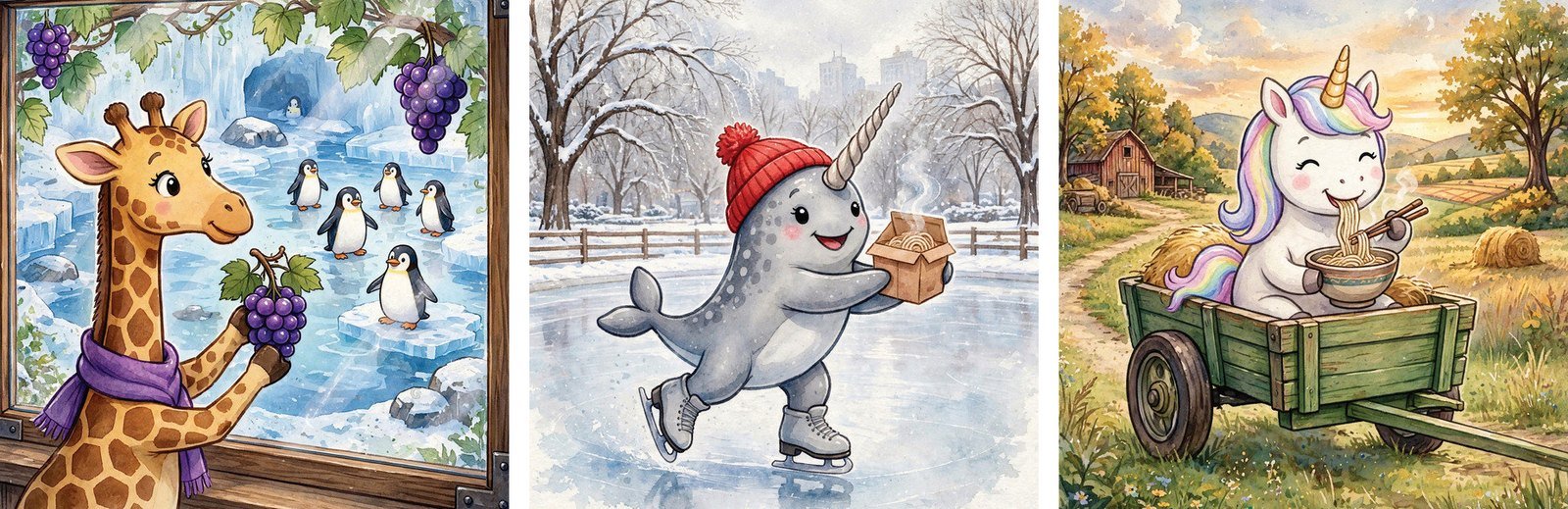
| G | George the Generous Giraffe | grapes | Grand Rapids, Michigan | penguins behind the glass in a zoo |
| H | Homer the Humble Hippopotamus | hamburgers | Honolulu, Hawaii | warm sand on a beach |
| I | Isabella the Incredible Iguana | ice cream | Indianapolis, Indiana | an impressive zoo |
| J | Jerry the Jolly Jellyfish | jelly beans | Jamestown, Virginia | a riverside fort |
| K | Kathy the Kind Koala | kiwi | Kansas City, Missouri | a science center |
| L | Larry the Loving Lion | lemonade | Los Angeles, California | a painted carousel |
| M | Matthew the Mindful Monkey | macaroni | Milwaukee, Wisconsin | a museum by a lake |
| N | Nathan the Neighborly Narwhal | noodles | New York City, New York | winter ice in a great park |
| O | Oliver the Obedient Octopus | oranges | Orlando, Florida | a dinosaur hall |
| P | Peter the Polite Penguin | pancakes | Portland, Oregon | an indoor playground |
| Q | Quincy the Questioning Quail | quesadillas | Queen Creek, Arizona | an orchard |
| R | Roger the Rebellious Raccoon | raisins | Raleigh, North Carolina | an old mill |
| S | Simon the Selfless Snake | salmon | Seattle, Washington | a busy public market |
| T | Thomas the Thankful Turtle | tacos | Tulsa, Oklahoma | a riverside park |
| U | Unique the Understanding Unicorn | udon | Urbandale, Iowa | a tractor cart around an old country farm |
| V | Vincent the Vain Vulture | venison | Vergennes, Vermont | red velvet seats at an opera house |
| W | William Wyatt Winston the Witty Walrus | waffles | Winston-Salem, North Carolina | a roller rink |
| X | Xavier the Xenial Xenops | xia mi | Xenia, Ohio | a city whose name means hospitality |
| Y | Yvonne the Youthful Yak | yogurt | Yuma, Arizona | a city full of sunshine |
| Z | Zeebee the Zealous Zebra | zucchini | Zanesville, Ohio | a pottery wheel |
How we did our characters
Every character, A to Z, is in the Character Descriptions: the picture as printed, and seven numbered lines for each one: body, face, what it wears, what it holds, any additional detail, its action on the page, and the page text. On a couple of pages, a few elements that were not in the original descriptions were kept.
How we did our backgrounds
Every page is in the Background and Page Descriptions, in the order of the book: the front cover, the front pages, the 26 letters, the back pages and the back cover. Each background was inspired by a real place across America, named on its page, and each letter has seven numbered lines: inspired by, setting, foreground, background, colors and light, additional detail, and the letter page background.
The additional pages
Around the 26 letters we added something to do for young readers and something to look up for parents: a letter hidden in every picture, with an answer key; a seek and find page; a map of all 26 stops; an A to Z list of every friend, food and city; Words to Know; the real places behind the pages; a thank you page with the places we went; and Olivia’s drawing. The title page and the copyright page are there for the formatting and best practices of publishing a book. Each one is in the Background and Page Descriptions.
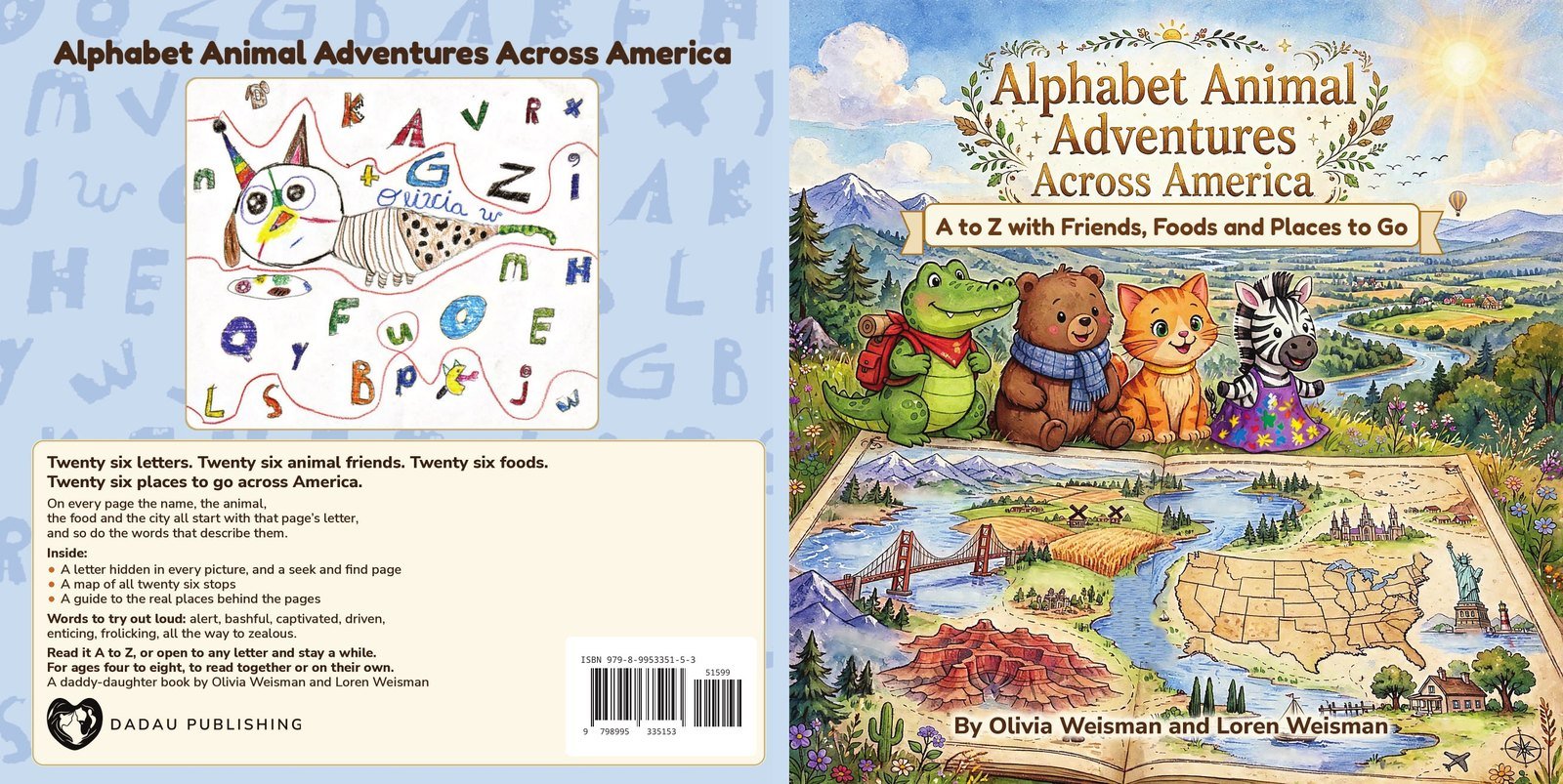
The cover, front and back
- Front: the art, the title, the subtitle, and both names with Olivia first.
- Back: the description, Olivia’s drawing and the Dadau Publishing mark, with room for the barcode.
- Both covers, with what is on them, are in the Background and Page Descriptions.
2. Print and Format
The files each printer takes, and the proof.
The print files and the proof
- The size: 8.5 x 8.5 inches, 68 pages, full color.
- The files: one interior PDF for both printers, a cover wrap for each printer, and an EPUB for the ebook.
- Bleed: the pictures run to the edge, so the interior file is 8.625 x 8.75 inches with bleed, every font embedded and no picture under 300 dpi.
- Paper and color: full color, perfect bound, gloss cover. The page count and the paper set the print cost and the spine width: for 68 pages, 0.16 inch on the KDP cover and 0.185 inch on the IngramSpark cover.
- The cover files: KDP places its own barcode (KDP Paperback Submission Guidelines); the IngramSpark cover carries the barcode in the file.
- The spine: KDP prints spine text only “on books with more than 79 pages” (KDP Paperback Submission Guidelines), and the book has 68, so the spine has none.
- The proof: the IngramSpark e-proof was checked page by page against the interior file before we approved it. Ingram adds a blank page and its printer barcode page, so Ingram counts 70 pages for our 68.
3. Protecting It
The copyright, our own imprint and ISBNs, the Library of Congress and an ISNI for each author, set up before the book was promoted.
Copyright
- What it is: a registration with the U.S. Copyright Office, filed online through eCO at copyright.gov.
- What we filed: the Standard Application, because the book has two authors; the Single Application is for one author and one claimant. Both of us are named as authors and claimants. There is a filing fee.
- What we claimed: all the text, and Olivia’s drawing on page 67 of the book and on the back cover. Excluded: the AI-generated illustrations.
- When: filed as unpublished, before the book went on sale.
- Read it back: the filed application showed text on the excluded side, so we sent a correction through the Copyright Office website.
- What goes on the book page: the registration number on the certificate, once it is issued, not the case number.
Our own imprint and ISBNs
- The imprint: Dadau Publishing, Orlando, Florida. Dadau is short for Daddy Daughter.
- The ISBNs: from Bowker (myidentifiers.com), one for each format: 979-8-9953351-5-3 for the paperback and 979-8-9953351-9-1 for the EPUB. Bowker sells ISBNs singly or in blocks, for a fee.
- Why our own: with a free KDP ISBN the imprint shows as “Independently published”, and with your own ISBN KDP checks the imprint against Bowker: “If there’s a mismatch, you won’t be able to publish” (KDP help, What is an ISBN and Imprint?).
The Library of Congress and an ISNI for each author
- Before publication: a Preassigned Control Number through PrePub Book Link, printed on the copyright page: LCCN 2026925069.
- After publication: two paperbacks to the Copyright Office as the mandatory deposit within three months (17 U.S.C. 407), and one to the Preassigned Control Number program.
- An ISNI for each of us: Olivia 0000 0005 3169 5949, through Bowker, for a fee; Loren 0000 0005 2847 0896. It keeps a child’s work attached to her name for everything she makes later.
4. Publishing and Distribution
Amazon KDP for Amazon, IngramSpark for every other store and library, and the audiobook.
Amazon KDP
KDP prints and sells the paperback on Amazon and sells the Kindle edition. It is free to publish (Loren’s words: “Amazon KDP is free”). On Amazon.com the paperback lists at $15.99 and the Kindle edition at $4.99.
Our setup on KDP included
| Field | What we set |
|---|---|
| Authors | Primary author Olivia Weisman; contributor Loren Weisman |
| Reading age | 4 to 8 |
| Categories | Children’s books on animals, on the United States, and on reading and vocabulary |
| Keywords | abc road trip travel; cities states landmarks; read aloud bedtime; vocabulary building glossary; map skills for kids; kindness manners sharing; family day trips vacation |
| AI declaration | Texts: None. Images: Many AI-generated images, with extensive editing. Tool: MyStoryBot |
| KDP Select | The Kindle edition only: “a free 90-day program for Kindle eBook only” (KDP help, KDP Select) |
| Expanded Distribution | Off, because IngramSpark carries the paperback to other stores and libraries |
| Free Book Promotion | The Kindle edition free October 8 to 12, 2026, with National Father-Daughter Day on Sunday, October 11 |
A+ Content
A+ Content is the section of pictures and words on the Amazon book page. Ours uses ten pictures from the book’s own art and runs in the 12 Amazon stores that offer it, with its own words in German, Italian, Spanish, French, Dutch and Portuguese.

Amazon around the world
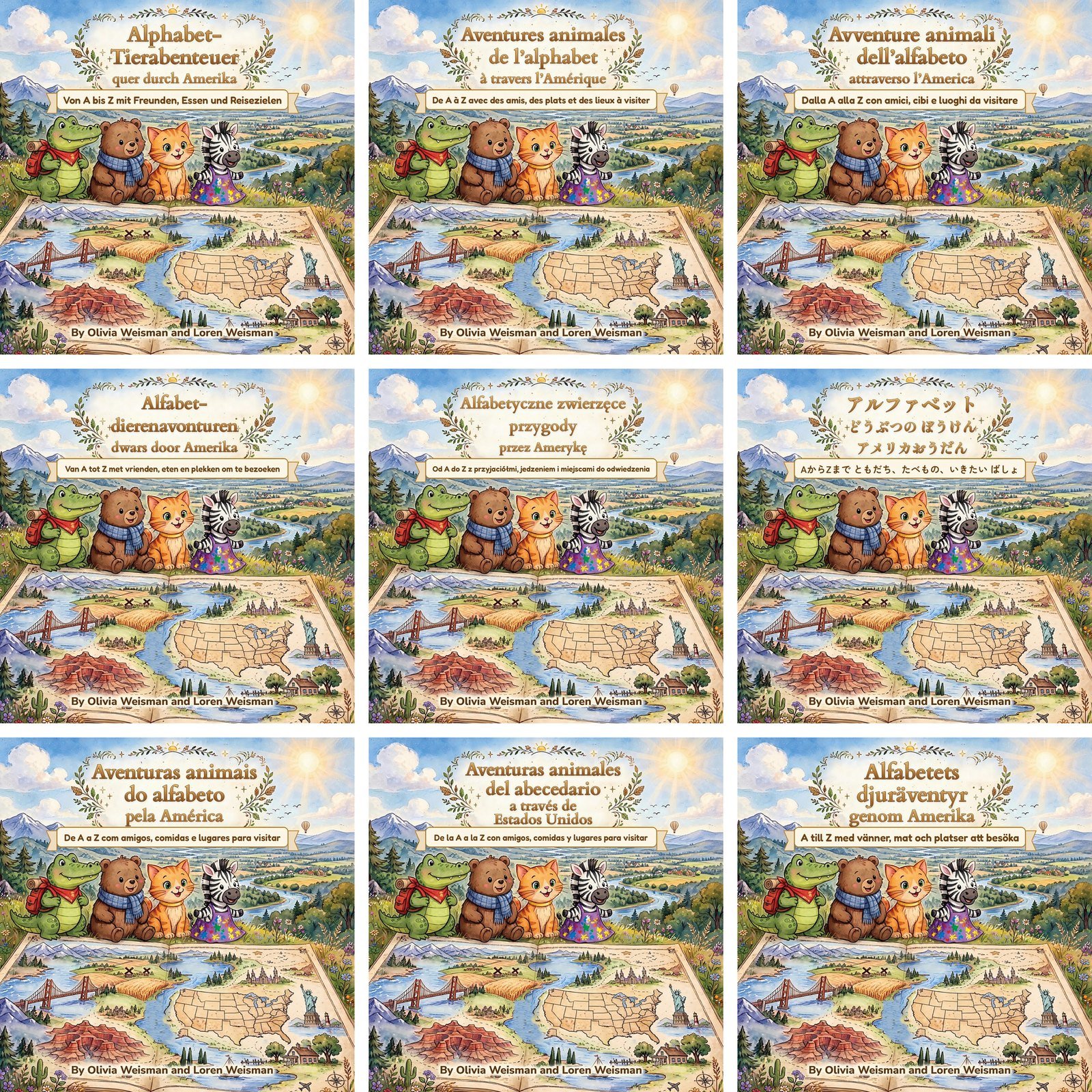
The paperback is sold in 16 Amazon stores and the Kindle edition in 13. The book itself is in English everywhere; for the Amazon by Country page on lorenweisman.com we made the cover with the title in nine languages, each translation checked against at least two sources.
IngramSpark
- What it does: puts the paperback in the Ingram catalog, where bookstores, libraries and schools order. It is free (Loren’s words: “Ingram is free”).
- What we set: the same ISBN, title, authors and description as Bowker and KDP; a 55% wholesale discount, returnable; US $15.99, UK £12.99, EU €14.99, Canada $21.99, Australia $27.99.
- The ebook: it waits on IngramSpark until the KDP Select term ends.
Where it sells
Amazon KDP sells the paperback and the Kindle edition on Amazon. Through Ingram, the paperback is available to order by:
- United States and Canada: independent bookstores, Barnes & Noble, Books-A-Million, Bookshop.org, Amazon, Walmart.com, Chapters Indigo, and libraries and schools through Ingram Library Services. It is also listed at AbeBooks and ThriftBooks.
- United Kingdom and Europe: Waterstones, Foyles, Blackwell’s, Gardners, Mallory International, Adlibris, Amazon.co.uk.
- Australia, New Zealand and the Middle East: Booktopia, Fishpond, The Nile, James Bennett, ALS, Peter Pal, Amazon Australia, Books Kinokuniya, Jarir Bookstore, Magrudy.
- Kindle: Amazon, through KDP.
The audiobook
The whole book read aloud by Olivia and Loren, so a child with the book open can read along. The Audiobook Script is the book’s own words, with a few added for listening: the opening and closing credits, “Letter A” to “Letter Z” at the start of each letter’s page, and the read-along line, “If you have the book, read along with us.” It is split into 36 files, one for each section, with the hard names looked up and how to say them written under each line.
Audio requirements
What ACX asks of every audiobook, and how ours meets each one (ACX, Audio Submission Requirements):
| What ACX asks | ACX | Ours |
|---|---|---|
| Opening credits | The title, the author or authors, and the narrator or narrators | File 01 |
| Closing credits | Show the book has ended | File 36 ends “The End.” |
| Retail sample | 5 minutes or less, from the start of the book | 4 minutes and 41 seconds, from Letter A |
| One section a file | Only one chapter or section in each file; credits as their own files | 36 files |
| File length | No longer than 120 minutes | The longest, The Real Places, is about 4 minutes |
| Human narration | No text-to-speech, AI or automated recordings | Read by Olivia and Loren |
| Volume | Between -23 dB and -18 dB RMS; peaks no higher than -3 dB; noise floor no higher than -60 dB RMS | Every file measured: RMS -20.26 dB to -20.37 dB, peaks -3.76 dB or lower, noise floor -65 dB or lower |
| Room tone | 1 to 5 seconds at the start and end of each file | 0.7 to 0.8 seconds at the start, inside INaudio’s 0.5 to 1 second, and about 2 seconds at the end |
| File format | 192 kbps or higher CBR MP3, 44.1 kHz, all files mono or all stereo | 192 kbps CBR, 44.1 kHz, all the same |
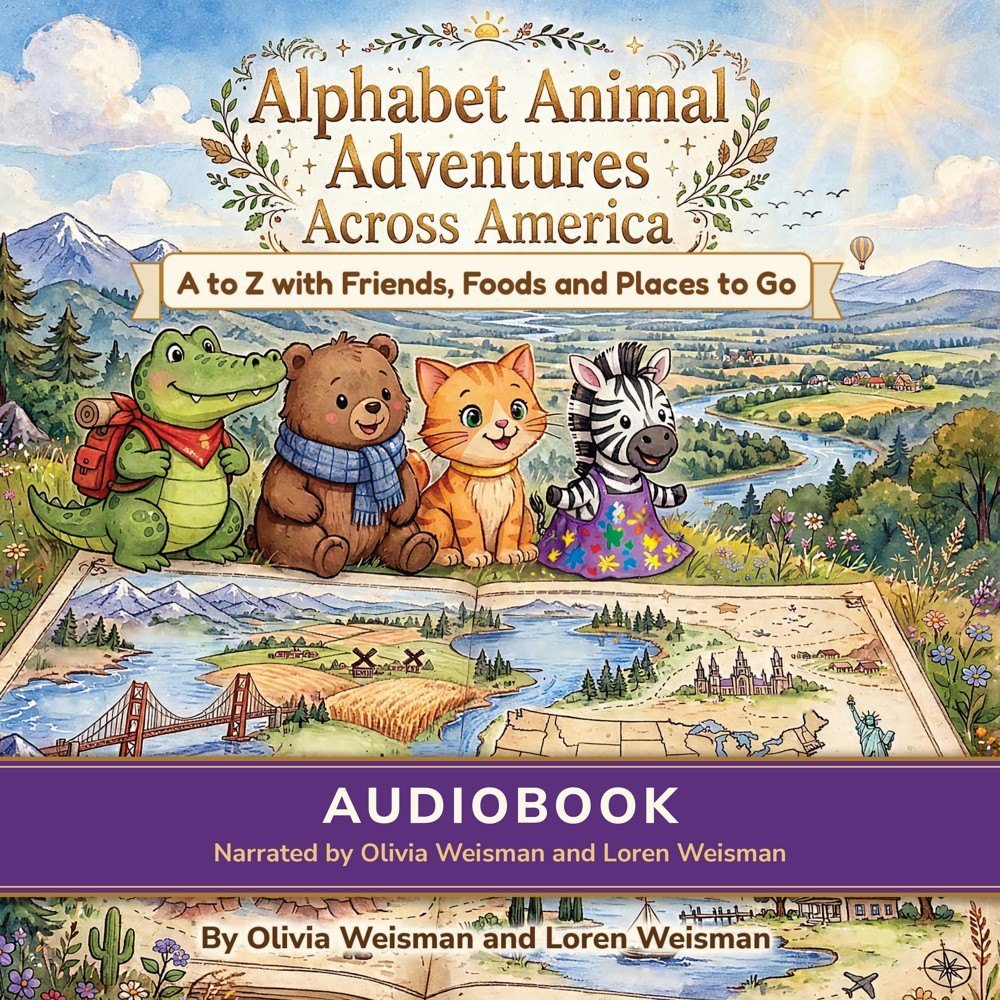
Olivia and Loren recorded the audiobook in three sessions, on October 10, 13 and 14, 2026: 156 takes, 36 chapters, 25 minutes and 54 seconds. The numbers are on the audiobook page. The audiobook cover is the front cover with a purple bar that reads AUDIOBOOK and Narrated by Olivia Weisman and Loren Weisman: 3000 x 3000 pixels, where ACX asks for at least 2400 x 2400 and 8 MB at most (ACX, Cover Art Requirements).
5. Post Promotion Steps
The stories, the Fact Sheet, a home for the book, the app, records for the book online, the printed pieces, libraries and schools, book signings and the press.
The stories to pull
Each story is one angle and the facts that carry it. Every fact is on the Fact Sheet.
“I want to write a book with you”
- Olivia had the idea and asked her dad to write it with her.
- She is named first on the cover and on the book’s records online: the ISBN record, Amazon, Goodreads, Open Library and Wikidata.
- For: daddy-daughter and parenting stories, fatherhood groups, morning shows.
A kid who followed through
- Three and a half years from her first idea to the published book, with her own drawing on the back cover.
- For: schools, parenting media, kids’ programs.
Their words and ideas, with AI for the pictures only
- They wrote every word and described every picture. MyStoryBot drew from their descriptions, and they fixed what came back.
- The copyright covers their words and Olivia’s drawing, not the AI pictures.
- For: technology stories, teachers, parents.
Published with its own imprint and records
- Their own imprint, Dadau Publishing, their own ISBNs, a Library of Congress Control Number and a copyright registration.
- Stores and libraries order it through Ingram at a 55% discount, returnable.
- For: library and bookstore buyers, writing groups.
Twenty six cities across America
- Twenty six real cities in 23 states, from Atlanta to Zanesville, each one a local story.
- For: local news in each city, travel and family media.
From Orlando
- Olivia and Loren wrote the book together in Orlando, and Orlando is the O page of the book.
- For: Central Florida news and events.
Something for kids to do
- A letter hidden in every picture, a seek and find page, a map of the 26 stops, and a free app.
- For: schools, libraries, book signings.
An audiobook read by father and daughter
- Read by Olivia and Loren, so a child with the book open can read along.
- For: radio, podcasts, Father-Daughter Day.
Promises kept, beyond the book
- Since November 18, 2023, Loren has sent Olivia a graphic and a song every day and an audio and a video every week. Dadau is short for Daddy Daughter.
- Loren grows his hair and beard because Olivia asked him to.
- For: fatherhood organizations, parenting media.
The Fact Sheet
The one source for every story, letter and post.
| Field | Value |
|---|---|
| Title | Alphabet Animal Adventures Across America |
| Subtitle | A to Z with Friends, Foods and Places to Go |
| Authors, in order | Olivia Weisman and Loren Weisman |
| Publisher | Dadau Publishing, Orlando, Florida |
| Published | September 17, 2026, first edition |
| Ages | 4 to 8, preschool to third grade |
| Paperback | ISBN 979-8-9953351-5-3, 68 pages, 8.5 x 8.5 inches, $15.99 |
| Ebook | Kindle $4.99; EPUB ISBN 979-8-9953351-9-1 |
| Audiobook | The whole book read aloud by Olivia Weisman and Loren Weisman; 36 chapters, 25 minutes and 54 seconds |
| Library of Congress Control Number | 2026925069 |
| Where to buy | Amazon, Barnes & Noble, Books-A-Million, Bookshop.org, Walmart.com, AbeBooks, ThriftBooks, and bookstores and libraries in the United States, Canada, the United Kingdom, Europe, Australia, New Zealand and the Middle East |
| Bookstores and libraries | Order through Ingram by ISBN 979-8-9953351-5-3: 55% wholesale discount, returnable, in every Ingram market |
| Countries | Amazon in 17 countries: paperback in 16 stores, Kindle in 13, English edition only |
| Author identifiers | Olivia Weisman ISNI 0000 0005 3169 5949; Loren Weisman ISNI 0000 0005 2847 0896 |
| Review copies | speaking@lorenweisman.com (the book page button) |
| Media contact | Loren Weisman, loren@lorenweisman.com, +1-850-391-8053 |
| Book page | lorenweisman.com/alphabet-animal-adventures-across-america/ |
| The talk | lorenweisman.com/family-co-authoring-blueprint/ |
| Talk bookings | speaking@lorenweisman.com, +1-850-391-8053 |
The book in 25, 50 and 100 words
25 words: Olivia Weisman and her dad, Loren Weisman, wrote this A to Z children’s book together: 26 animal friends, 26 foods, 26 real places across America.
50 words: Alphabet Animal Adventures Across America is an A to Z children’s book for ages 4 to 8 by Olivia Weisman and her dad, Loren Weisman. On every page the name, the animal, the food and the city all start with the same letter, and a letter hides in every picture.
100 words: Alphabet Animal Adventures Across America: A to Z with Friends, Foods and Places to Go is a children’s book for ages 4 to 8 by Olivia Weisman and her dad, Loren Weisman, published September 17, 2026 by Dadau Publishing in Orlando. Every letter has an animal friend with a name, describing words, a food and a real American city, all starting with that letter. Kids hunt for a letter hidden in every picture and follow a map of all twenty six stops. The book is dedicated to creative dads and daughters everywhere, and Olivia’s drawing is on the back cover.
The book’s home on lorenweisman.com
We did not build a separate website. The book has its own section on lorenweisman.com, Loren’s site, with Olivia’s page and the Dadau Publishing page beside it:
| Page | What it is |
|---|---|
| lorenweisman.com/alphabet-animal-adventures-across-america/ | The book page: the book, the A to Z table, where to buy, questions and answers, the postcard and trifold downloads |
| lorenweisman.com/alphabet-animal-adventures-across-america-trade-guide/ | The trade and library guide for booksellers, librarians, teachers and schools |
| lorenweisman.com/alphabet-animal-adventures-across-america-app/ | The app page |
| lorenweisman.com/alphabet-animal-adventures-across-america-amazon-stores/ | Alphabet Animal Adventures Across America on Amazon by Country, every Amazon store with the title in its language |
| lorenweisman.com/olivia-weisman/ | Olivia’s page: Dadau Publishing for her books, the app, her music publishing names and her ISNI |
| lorenweisman.com/dadau-publishing/ | The imprint, and Dadau Music Publishing |
| lorenweisman.com/family-co-authoring-blueprint/ | The talk, with its talk sheet at /talk-sheet/ |
The app
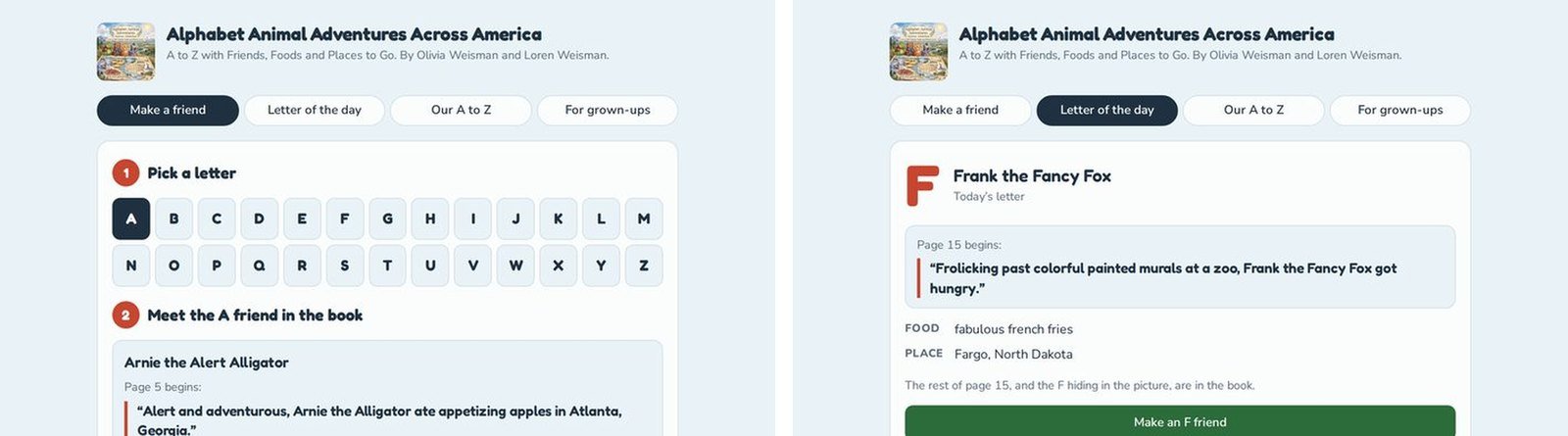
A free app that goes with the book, at lorenweisman.com/alphabet-app/ and in the Microsoft Store. A child picks a letter, meets the friend from the book, and makes a friend of their own for that letter.
What the app had to meet
- Children’s privacy: it asks for no personal information (no sign in, no account, no ads, no analytics, nothing to buy). Saved friends stay on the device. The privacy policy on lorenweisman.com has a section for the app.
- A grown-up gate: every link that leaves the app sits behind a grown-up question, following Apple’s Kids Category guideline on parental gates.
- Age ratings: the International Age Rating Coalition questionnaire gave E for Everyone (ESRB) in the United States and Canada, PEGI 3 in Europe and USK ab 0 in Germany.
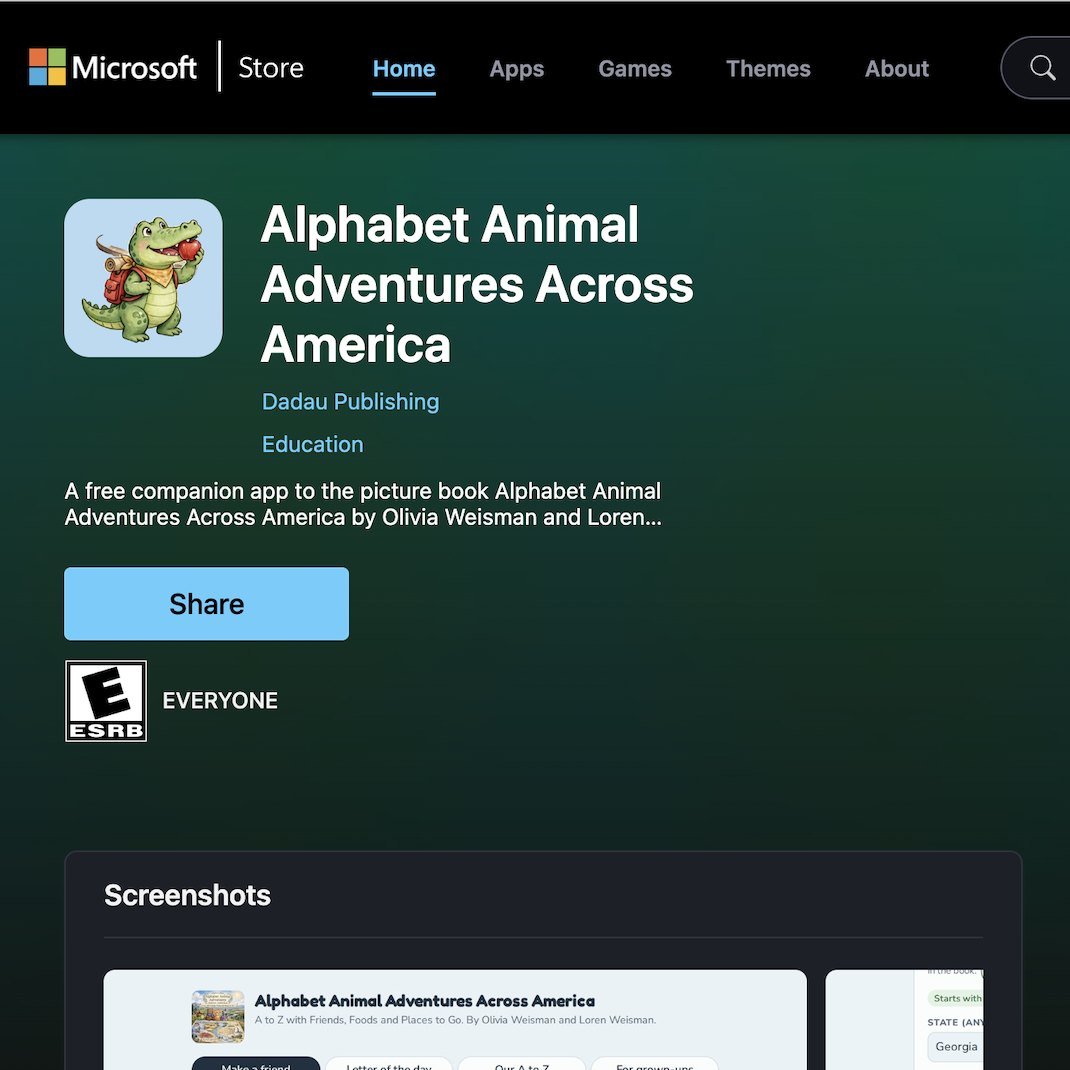
- Microsoft Store: a Microsoft Partner Center developer account with an ID check, the app packaged with PWA Builder, a privacy policy address, the age rating, and certification by Microsoft before it went live. No registration fee for a web app through PWA Builder.
- The icon and its name: Arnie, with no words in the icon (Apple’s app icon guidelines), the round version kept inside the safe area (web.dev), and the short label under it, A to Zeebee.
- Testing: Google Lighthouse accessibility, best practices and SEO at 100, and axe with no accessibility violations on phone, tablet and computer, light and dark.
- Not used: the Apple App Store and Google Play, which both carry developer fees.
Records for the book online
Where the book and its two authors are listed online. All 26 page lines are also saved as quotes on Goodreads, LibraryThing and AllAuthor.
| Record | Number or link |
|---|---|
| Library of Congress Control Number | 2026925069 |
| ISBN records (Bowker Books In Print) | Paperback 979-8-9953351-5-3 and EPUB 979-8-9953351-9-1, by Olivia Weisman and Loren Weisman |
| ISNI, Olivia Weisman | 0000 0005 3169 5949 |
| ISNI, Loren Weisman | 0000 0005 2847 0896 |
| Goodreads | goodreads.com/book/show/259411690 |
| LibraryThing | Work 37333711 |
| Open Library | Work OL46023919W |
| Wikidata | The book Q141560056; Olivia Weisman Q141650771; Loren Weisman Q141392259; Dadau Publishing Q141611141 |
| StoryGraph | The book |
| BookBub | The book and both authors |
| AllAuthor | The book and both authors |
| Amazon | Olivia’s author page; paperback B0HKJ7J83F; Kindle B0HKF2GMR4 |
The printed pieces
The postcard
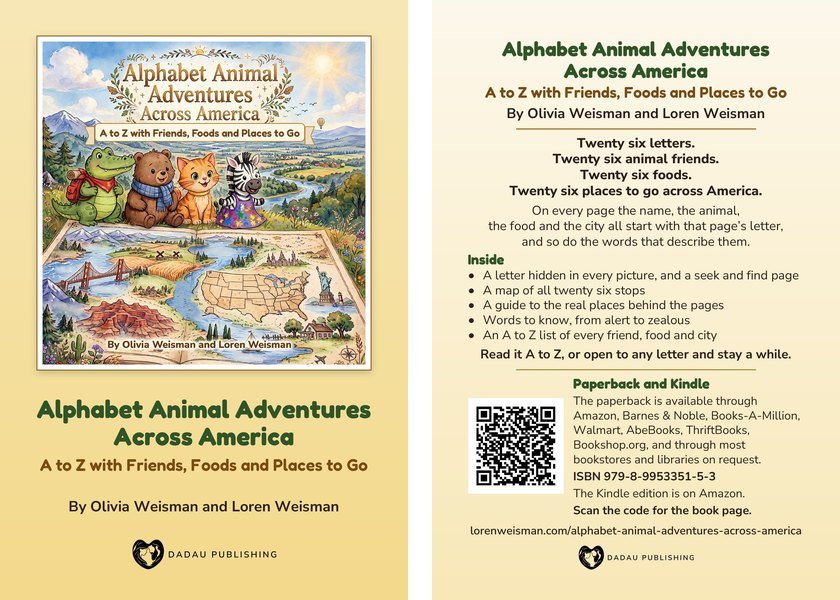
4 x 6 inches, in color and in black and white. The back carries the description, where to buy, the ISBN and a code that opens the book page.
The trade and library guide
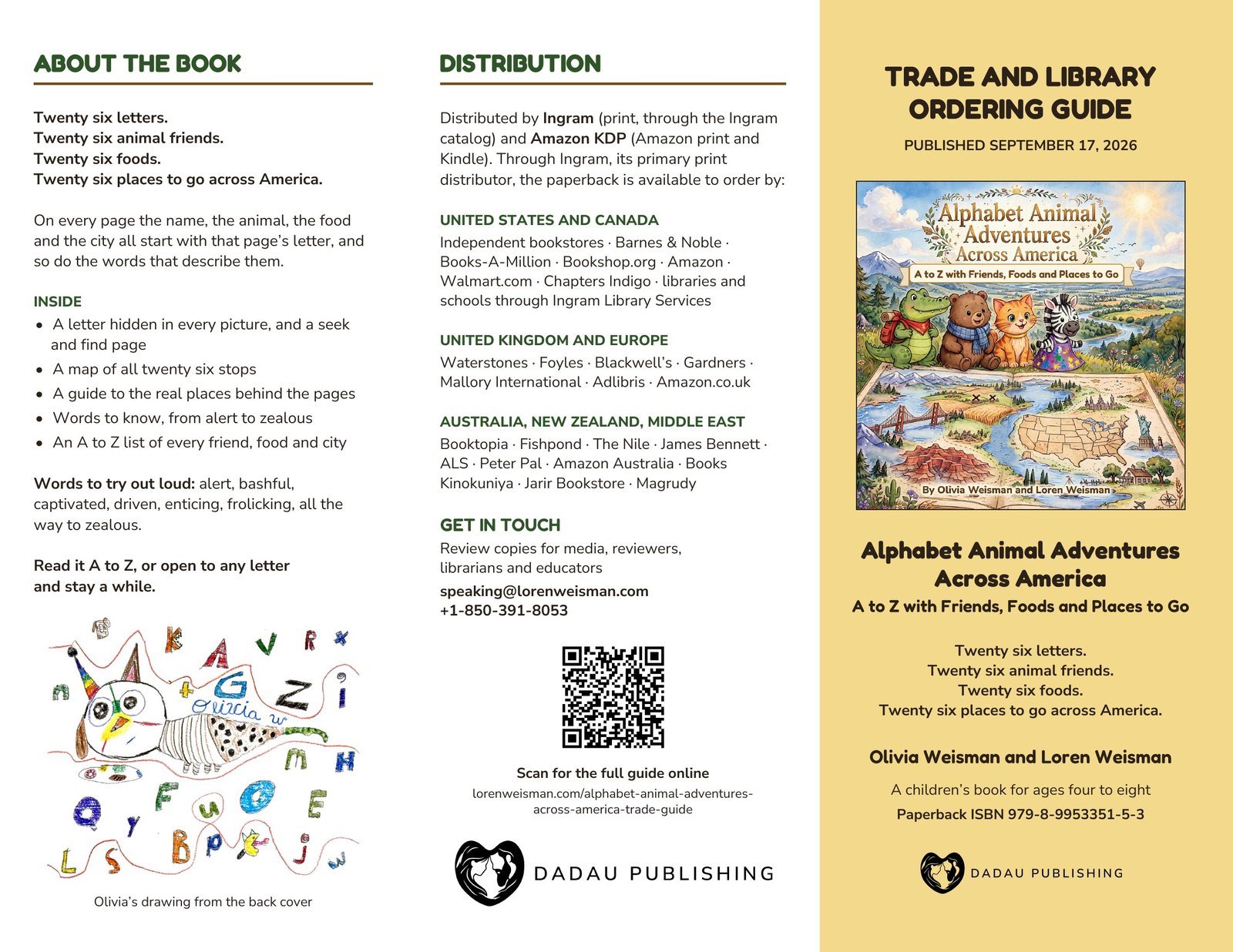
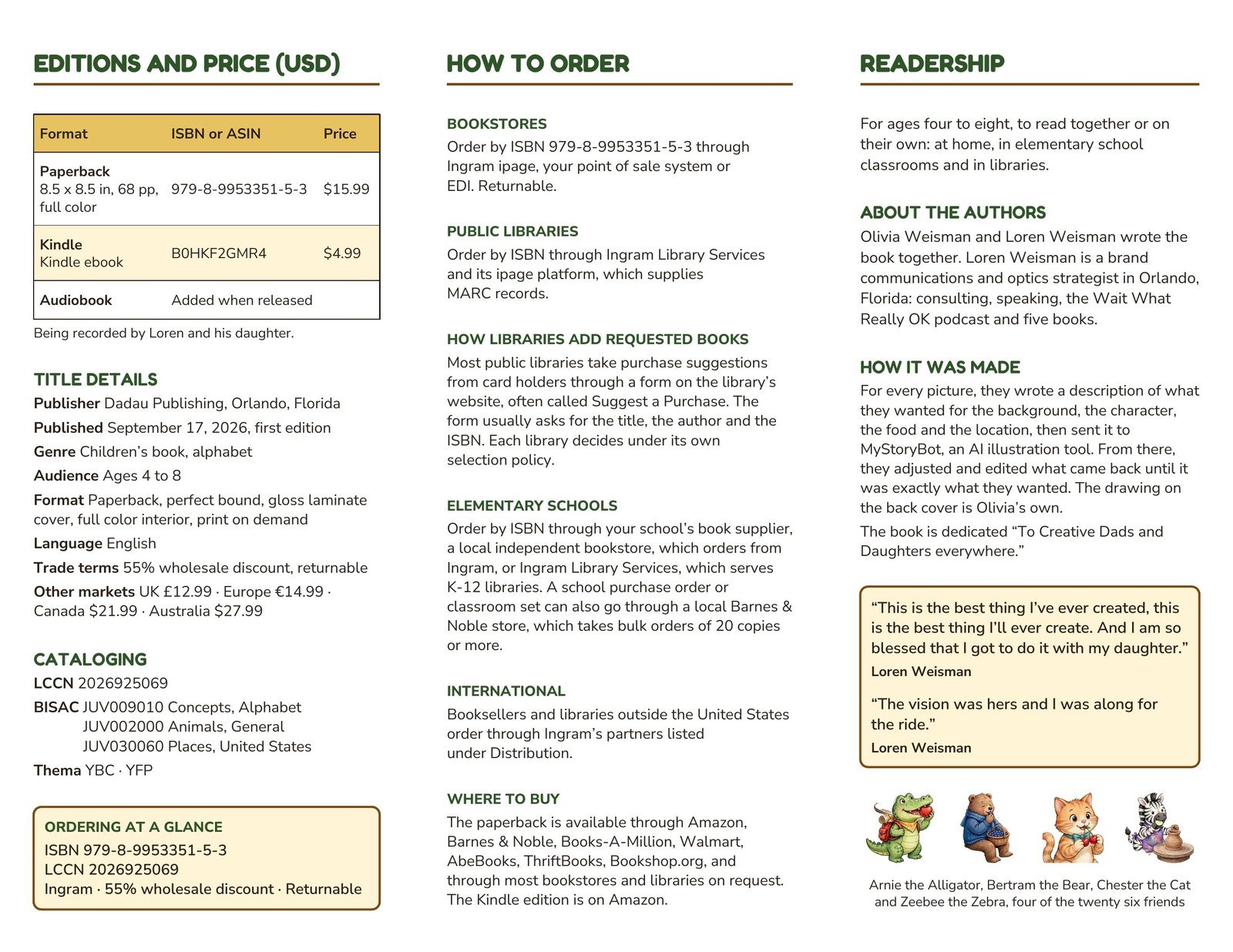
An 11 x 8.5 inch trifold for booksellers, librarians and schools, in color and in black and white: distribution, editions and price, cataloging, how to order, and ordering at a glance.
Stickers and social sizes
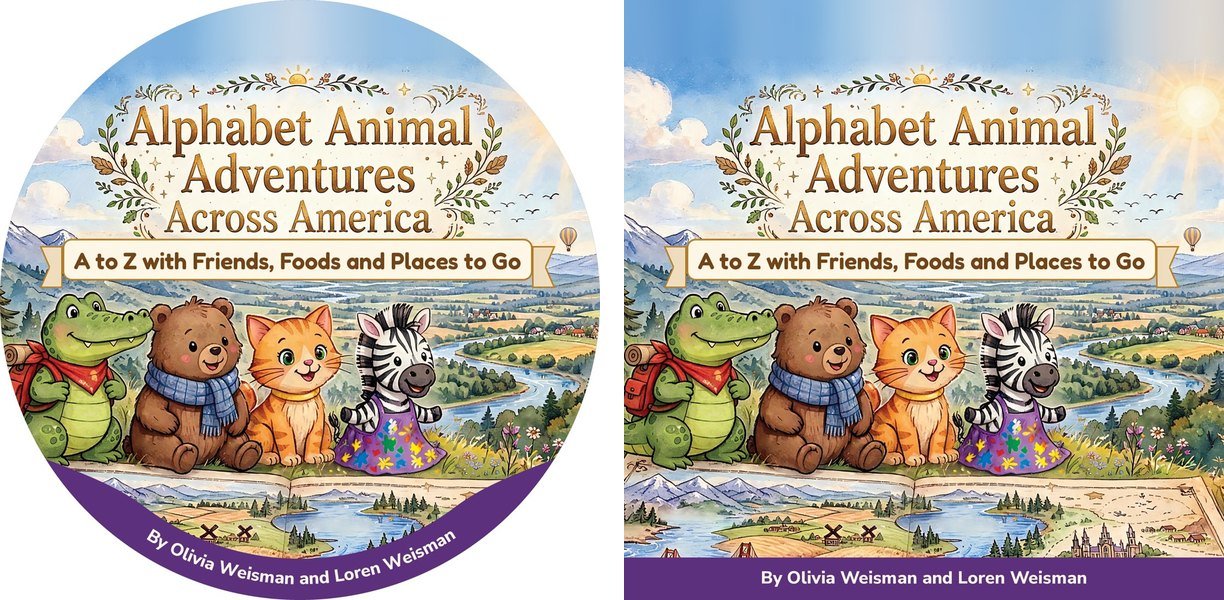
Circle and square stickers in 3, 4, 5 and 6 inch sizes, a sticker sheet for printing at Staples, and the cover and the character sheet in every common social size (square, Instagram feed and story, Pinterest, Facebook link, X and YouTube), with no art cut.
Libraries and schools
- Public libraries: a title suggestion through each library’s own form, starting with the Orange County Library System.
- WorldCat: an author cannot add a book to WorldCat, so the book went to member libraries: the UCF Libraries recommendation form, and five Florida college libraries that teach elementary education, each offered a free paperback for review.
- Schools: the media specialist at Olivia’s school, and the elementary school on the site of the one Loren went to in Amherst, Massachusetts.
- Ordering: libraries and schools order by ISBN through Ingram or Ingram Library Services.
Book signings
- Ask the store. Barnes & Noble: “If you would like to be considered for an author event, call your publisher or contact the store manager at any local Barnes & Noble store.” Its stores “host thousands of local authors annually” (Barnes & Noble, How to Be Considered for an Author Event).
- Libraries and schools: through each library’s own event process, and the school media specialist.
- Promote it yourself: Barnes & Noble names “social media, email promotion and networking with local news media and organizations.”
What we bring
| Piece | What it does |
|---|---|
| The paperback | $15.99; a store orders it through Ingram at 55%, returnable |
| The postcard | Goes home with people: where to buy, and a code for the book page |
| The trade and library guide | For the store, a librarian or a teacher |
| The stickers | For the kids |
| The seek and find page | Kids look for the hidden letters at the table |
| The app | Free, for kids at the table |
| The stories | What to say, from the stories to pull |
The press
A press release can help: one story, sent to the media at once, and it can go out through a press release distribution service such as Send2Press Newswire (send2press.com). The Press Kit holds the fact sheet, the story angles, the questions to ask and the two author media sheets; the press release and the letters to organizations such as All Pro Dad are written and held for their date.
6. What We Did, Step by Step
It started on May 29, 2023, and the book was published on September 17, 2026. The words and ideas are Olivia’s and Loren’s; the pictures were made with MyStoryBot from their descriptions. Claude, an AI assistant from Anthropic, was used on the production side: building and checking the print and ebook files, the records, the web pages, the app and this plan.
| When | What we did | Tools |
|---|---|---|
| May 29, 2023 | The first sheet: a row for every letter | A spreadsheet |
| Before publication | Checked every word and place; wrote the manuscript in Word; read every page out loud | Word; a dictionary; the places’ own websites |
| Before publication | Described every character and background, first for an illustrator | Word |
| Before publication | The pictures drawn from our descriptions and corrected; the extra pages; the cover | MyStoryBot |
| Before publication | The imprint and ISBNs; the Library of Congress number | myidentifiers.com; PrePub Book Link |
| September 17, 2026 | Published | |
| Around publication | Copyright filed before the book went on sale; Amazon KDP; IngramSpark, with the proof checked page by page | eCO; KDP; IngramSpark |
| After publication | One description of record; A+ Content; the covers in nine languages | KDP; lorenweisman.com |
| After publication | ISNIs and the records for the book online; libraries and schools | Bowker; Goodreads; LibraryThing; Open Library; Wikidata |
| After publication | The postcard, the trade and library guide, the stickers; the app | Canva; PWA Builder; Microsoft Partner Center |
| After publication | The audiobook script and cover | ACX help pages |
| October 8 to 12, 2026 | Kindle free days, with Father-Daughter Day on October 11 | KDP |
| October 2026 | Recording the audiobook, read by Olivia and Loren | ACX |
What carries a fee
- Fees: ISBNs from Bowker; the copyright registration; an ISNI through Bowker; postage and paperbacks for the Library of Congress; the illustration tool; printing; stickers.
- No fee: publishing on Amazon KDP and IngramSpark; the Library of Congress number; Goodreads, LibraryThing, Open Library, Wikidata, StoryGraph, BookBub and AllAuthor; the web app in the Microsoft Store; reading the audiobook ourselves.
This is our experience, not legal or financial advice.
7. A Simplified Version
1. Sit down together and plan the whole book in a spreadsheet, one row for every page.
2. Check every word against the dictionary and every place against its own website.
3. Write every word yourselves, together, and read every page out loud until it sounds right.
4. Describe every character and every background in detail, as you would for an illustrator.
5. Settle on one art style and use it on every page.
6. Make the pictures from your descriptions (your child’s own art, an illustrator, or an AI tool), then check every picture against its description and fix anything missing or wrong.
7. Add pages that give young readers something to do: a letter hidden in every picture, a seek and find page, a map.
8. Make the front and back covers together, with your child’s own drawing on the back.
9. Set up your own imprint and buy your own ISBNs, one for each format.
10. Before publication, request a Preassigned Control Number through the Library of Congress PrePub Book Link, so the Library of Congress Control Number (LCCN) is printed on the copyright page.
11. Register the copyright with the U.S. Copyright Office, making sure to claim what is yours and to exclude what is not, such as AI-generated pictures.
12. Build the print files and check every page of the proof.
13. Publish on Amazon KDP and IngramSpark, with the same description and keywords used in a uniform way on both.
14. Consider recording the audiobook together.
15. Set up the records that libraries, stores and readers look up (an ISNI for each author, Goodreads, Open Library and Wikidata), with your child listed as the first author.
16. Set up a website for the book, or give it a few pages on a site you already have.
17. Suggest the book to libraries and schools.
18. Consider creating postcards and stickers, and a trade and library guide as a page on your site and as a printed pamphlet.
19. Consider asking local bookstores and libraries about hosting a book signing or reading.
20. Consider telling the same story, in the same way, wherever you can.
8. How This Plan Follows the Talk
The talk, A Family Co-Authoring Blueprint to Consider: Creating and Publishing a Book With Your Daughter or Son, walks through the same five parts as this plan. Every touch point on the talk sheet, word for word, and where it is in this plan. The talk and its talk sheet are at lorenweisman.com/family-co-authoring-blueprint/; bookings, speaking@lorenweisman.com, +1-850-391-8053.
| Touch point, from the talk sheet | In this plan |
|---|---|
| Creating it together | |
| Deciding the roles a parent and child can each take, and keeping both voices in the book. | How we started; The manuscript in Word |
| Building the concept before the pages are written, and what to settle first. | The first sheet; The rules every page follows |
| Planning the pages, from the story to the extras, and the options along the way. | The first sheet; The additional pages |
| Choosing how the pictures are made, from the child’s own art to an illustrator or applications of AI, and being transparent about which one was used. | The descriptions; What AI did, and what it did not |
| Adding hidden elements and interactive pages for young readers. | The additional pages |
| Print and format considerations | |
| Considering trim size options, and what each one means for the layout, the cover and the cost. | The print files and the proof |
| Understanding bleed, margins and layout for a children’s book versus a longer book. | The print files and the proof |
| Weighing page count, paper and color, and how they affect the spine and the print price. | The print files and the proof |
| Preparing print files and ebook files, and the pieces to consider in each. | The print files and the proof |
| Recognizing the cover file differences between printers, including the barcode. | The print files and the proof |
| Knowing what to look for when checking and approving a proof. | The print files and the proof |
| Protecting it | |
| Approaching copyright registration, and the parts of the application to consider, including what to claim and what to exclude. | Copyright |
| Understanding how the mandatory deposit with the Library of Congress works, and when it is due. | The Library of Congress and an ISNI for each author |
| Setting up the Preassigned Library of Congress Control Number before publication, and what you will eventually send in for it. | The Library of Congress and an ISNI for each author |
| Applying best practices in setting up ISBNs and ASINs, one for each format, and properly filling out the details. | Our own imprint and ISBNs; Amazon KDP |
| Setting up a professional and proper imprint. | Our own imprint and ISBNs |
| Explaining what an ISNI number is, why a child can have one too, and how to set it up. | The Library of Congress and an ISNI for each author |
| Publishing and distribution | |
| Explaining self publishing, hybrid and traditional routes, and what each one means for rights, cost and control. | Publishing and Distribution (the route we took: our own imprint) |
| Using Amazon KDP and IngramSpark together or separately, and what each one reaches. | Amazon KDP; IngramSpark; Where it sells |
| Considering ways to price, and the benefits of wholesale discounts and returns for stores, libraries and schools. | IngramSpark |
| Comparing the use or non-use of exclusivity programs, and what they allow and rule out. | Amazon KDP (KDP Select) |
| Looking at a couple of ways to publish affordably, and where the money is worth spending. | What carries a fee |
| Post promotion steps | |
| Knowing what to look for and what to add to a website, from the book page to a trade and library guide. | The book’s home on lorenweisman.com; The printed pieces |
| Finding where to go for the records of the book that build authority, and which ones to set up first. | Records for the book online |
| Suggesting a book to libraries and sharing it with schools. | Libraries and schools |
| Considering a child’s privacy at every step, from the name on the cover to social media. | The app; Records for the book online |
Questions
How do you write and publish a children’s book with your child?
Olivia Weisman and her dad, Loren Weisman, did it in five parts: creating it together, print and format, protecting it, publishing and distribution, and the steps after release. The short version is the 20 steps in A Simplified Version, starting with planning the whole book in a spreadsheet, one row for every page.
How long does it take to write and publish a children’s book with your child?
For us, three and a half years from Olivia’s first idea to publication. The first sheet was made on May 29, 2023, and Alphabet Animal Adventures Across America was published on September 17, 2026.
Can a child be listed as an author of a published book?
Yes. Olivia Weisman is the primary author on KDP and is named first on the cover and on the book’s records online: the ISBN record, Amazon, Goodreads, Open Library and Wikidata. She also has her own ISNI, 0000 0005 3169 5949.
Who wrote the words and came up with the pictures?
Olivia and Loren wrote every word and described every character and background. MyStoryBot, an AI illustration tool, drew from their descriptions, and they fixed what came back. Olivia’s own drawing is on the back cover.
Can you register the copyright on a children’s book with AI-generated pictures?
We filed the Standard Application with the U.S. Copyright Office, with both of us as authors and claimants. We claimed all the text and Olivia’s drawing, and excluded the AI-generated illustrations. That is our experience, not legal advice.
Should you buy your own ISBN for a children’s book?
We bought our own from Bowker, one for each format, under our own imprint, Dadau Publishing. With a free KDP ISBN the imprint shows as “Independently published”, and with your own ISBN KDP checks the imprint against Bowker.
Should you publish with Amazon KDP or IngramSpark?
We used both. Amazon KDP prints and sells the paperback on Amazon and sells the Kindle edition, with Expanded Distribution off. IngramSpark carries the paperback to other stores, libraries and schools, at a 55% wholesale discount, returnable. Both are free to publish on.
What is a Library of Congress Preassigned Control Number?
A Library of Congress Control Number assigned before publication through PrePub Book Link, so it can be printed on the copyright page. Ours is LCCN 2026925069. After publication, one paperback goes to the Preassigned Control Number program.
What is an ISNI, and can a child have one?
An ISNI (International Standard Name Identifier) is an ISO standard number that identifies people in creative work, used by libraries, publishers and databases around the world. Yes, a child can have one: Olivia’s is 0000 0005 3169 5949, through Bowker, for a fee. It keeps a child’s work attached to her name for everything she makes later.
What size and page count did you choose for the children’s book?
8.5 x 8.5 inches, 68 pages, full color, perfect bound with a gloss cover. The pictures run to the edge, so the interior file is 8.625 x 8.75 inches with bleed.
What carries a fee when you publish a children’s book this way?
Fees: ISBNs from Bowker, the copyright registration, an ISNI through Bowker, postage and paperbacks for the Library of Congress, the illustration tool, printing and stickers. No fee: publishing on Amazon KDP and IngramSpark, and the Library of Congress number.
How do you get a children’s book into libraries and schools?
Libraries and schools order by ISBN through Ingram or Ingram Library Services. We suggested the book through each library’s own form, starting with the Orange County Library System, and went to the media specialist at Olivia’s school.
Can I download the blueprint?
Yes. The full blueprint is one PDF of 87 pages, and the Character Descriptions and the Background and Page Descriptions are also each their own PDF.
Is this legal or financial advice?
No. It is our experience and our approach: one set of ideas, options and strategies worth considering, not the only way.
Is there a talk on this?
Yes. Loren gives a talk, A Family Co-Authoring Blueprint to Consider: Creating and Publishing a Book With Your Daughter or Son.
The Book
Alphabet Animal Adventures Across America: A to Z with Friends, Foods and Places to Go, by Olivia Weisman and Loren Weisman, Dadau Publishing, September 17, 2026. Paperback ISBN 979-8-9953351-5-3, Kindle ASIN B0HKF2GMR4. Booksellers and libraries: the Trade and Library Guide. Press: the press kit.