Category: Brand Communications Podcast Transcriptions

Brand Communications Podcast Transcriptions Category for Brand Communications and Optics Strategist Loren Weisman Website.

Brand Communications Podcast Transcriptions
Explore full-text transcriptions of the Brand Communications and Optics podcast episodes from strategist Loren Weisman, designed for accessibility, skimmability, and search discoverability. Each post pairs the complete transcript with links, chapters, and context so readers can reference quotes, cite ideas, and integrate insights into brand, messaging, and ethics workflows.

These transcripts expand the site’s topical coverage with detailed, keyword-dense content that improves indexing and helps audiences discover episodes by themes like authenticity, messaging strategy, compliance, AI ethics, and professional positioning. This approach aligns with podcast SEO best practices that recommend publishing episode transcriptions to increase relevance, topical authority, and user experience.

What you’ll find
– Full transcripts with time-stamped chaptering for episodes on brand communications, optics, and messaging frameworks.
– Deep dives into ethical AI use, authorship integrity, transparency, and the business implications of misleading claims in content and publishing.
– Cross-linked posts, tags, and categories that cluster related entities (e.g., Brand Communications Podcast, Podcast Transcription) to enhance navigation and topic clustering.

Who this serves
– Founders, authors, and marketers building compliant, authentic communications systems.
– Content teams seeking referenceable, citable source text for research, briefs, and repurposing.
– Accessibility-first audiences who prefer or require readable, searchable text versions of audio.

Key takeaway
Publishing transcripts improves accessibility and widens discovery while strengthening topical authority around brand communications, messaging strategy, and ethical AI—making each episode more useful to readers, researchers, and search engines.

  • Fake Authors Using AI. Podcast Links and Transcription

    Fake Authors Using AI. Podcast Links and Transcription

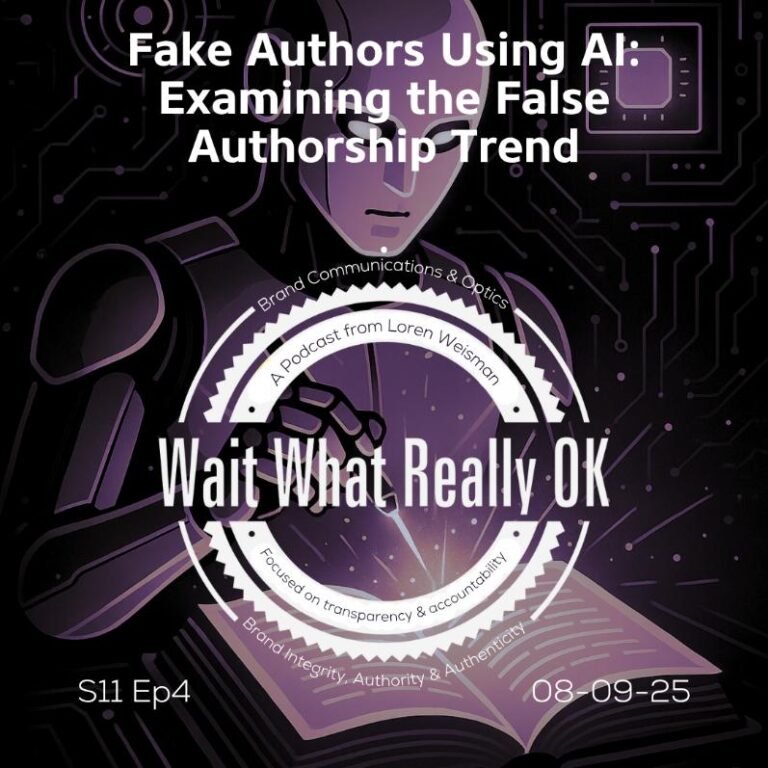
    Fake Authors Using AI. Podcast Links and Transcription for Wait What Really OK Podcast Titled “Fake Authors Using AI: Examining the false authorship trend.” Fake Authors Using AI, Examining the False Authorship Trend, podcast transcription, wait what really ok

    Fake Authors Using AI. Podcast Links and Transcription

    Fake Authors Using AI, Examining the False Authorship Trend copy
    Fake Authors Using AI, Examining the False Authorship Trend.

    Released on August, 9th, 2025

    🎙️ Tune In: Listen to this Wait What Really Ok Podcast Episode Fake Authors Using AI: Examining the false authorship trend on Apple Podcasts Spotify iHeart Radio Pandora Amazon Music Spreaker YouTube and other platforms.


    Fake Authors Using AI Chapters


    *** Fake Authors Using Ai Chapters: 00:00 – Introduction & Theme Song 00:20 – Host Introduction: Loren Weisman 00:28 – Dishonesty in Modern Publishing 01:11 – AI Book Writing: Real Authorship or Not? 01:26 – Fake Authors Using AI: Speedy AI Prompts & Ethics 01:41 – The Integrity Crisis in Self-Publishing 02:04 – Transparency in Writing & Book Creation 02:34 – The True Author’s Journey: Time & Effort 03:12 – Using AI Ethically for Editing and Proofreading 03:39 – Algorithmic Writing vs. Real Human Craft 04:10 – Copyright and Ownership in AI-Generated Books 04:34 – Fake Courses: AI Content and Deception 05:15 – Businesses Seeking Dishonest Creators 05:44 – Transparency in Marketing & Education Products 06:27 – The Authority Problem: Real vs. Fake Experts 07:05 – Human Input, Editors, & Authentic Voices 08:13 – How the Term “Author” Is Losing Validity 08:35 – Prompters vs. Genuine Writers 09:29 – Public Normalization of AI Cheating 09:56 – Be True to Yourself: Preserving Authority 10:37 – Identifying Fake Experts & Coaches 11:44 – Anthology & Mass Authorship Scams 12:21 – Questionable Motives in Content Creation 13:10 – Why Prompts Don’t Equal Authorship 13:31 – Ethical AI Use: Sharing Your Process 13:59 – Creating Genuine, Original Content 14:49 – The Ethics of AI in Content Creation 15:59 – Spotting Fake Experts Through Social Media Surges 18:02 – Evaluating Whether an Author Is Real or AI 19:40 – AI Detection Advancements & Accountability 21:18 – Transparency & Integrity as Competitive Advantages 23:59 – Real Authorship: Blood, Sweat, and Tears 25:49 – Final Advice on Honor, Truth, and Professionalism *** Fake authors using ai transcription


    Fake Authors Using AI Transcription


    Song: Wait What Really OK, OK. With your host, Loren Weisman. This is a fully licensed theme song for the show about stuff that makes you say, Wait What Really OK, OK.

    Loren: The state of publishing, writing, and putting out a book to me has become terrifyingly dishonest. And right now, in this time of dishonesty, there are more and more companies using AI models that allow for these books to be written, as they even profess, in minutes. One of the strangest issues that I notice with it and that I have with it is how incredibly popular these ads are on sites like Instagram, where it’s not just the ad.

    And, yeah, okay, there’s a whole bunch of fake people saying, oh, wow, this is really neat. This is really neat. But people saying, real people with real profiles saying they’re genuinely excited about this. The fake authors using ai problem shining bright.

    They’ve always wanted to do something like this. They’ve always wanted to write a book. But you’re not writing a book. You’re adding in a prompt. Some of them claim that you can set up a prompt in two minutes and then have a complete book. Some of these ads, they’re stating, oh, just go in here, add this prompt. You’ll have this. You’ll be able to upload it. You’ll be able to go out with your friends and have lunch. And now you’re an author.

    I find that pathetic. I find it to be dishonest.

    And as someone that I would consider myself a real author, it makes me not want to tell anyone I’m an author anymore. For all these people that are out there saying, oh, you’ll be able to tell people you’re an author, would you.

    Would you be that honest with it? Would you share with someone exactly how you wrote your book? Would you put on the front and the back a little note stating below by your name that I did a prompt, I filled out a couple questions, I added this part, and then AI wrote it for me, that you are one of those fake authors using ai.

    Most people, probably not, and yet so many are out there doing it. I’ve authored three books of my own. I’ve helped from a messaging standpoint on a series of other books. It’s a long process, and people saying, it doesn’t have to be that long. It can be done in minutes.

    I was proud of my third book, which I knocked out in just a little shy of four months, that also included, on average, four to five hours of writing on a given day, five days a week, as well as going back and forth with the editor and the proofreader and legal and all that stuff and not saying that Other people shouldn’t be involved in a book.

    Fake Authors Using AI, Examining the False Authorship Trend, whos writing nowFake Authors Using AI Transcription Continued:

    You should. And it’s not saying that AI can’t be involved in a book. It can be. You could give certain stuff to A.I. for a developmental edit. If you’re being honorable, that is, you could give stuff to A.I. for the grammatical. You could use some of these A.I. systems for proofreading.

    You could use some of these AI systems for legal aspects of compliance. You could use AI in a series of ways. That doesn’t take away from the validity if you actually wrote the book. And yet this is being bypassed now inside of algorithmic learning, it’s not necessarily artificial intelligence, but algorithmic learning. For you to put in such a simplified pattern or answer just a couple simple questions, and then all of a sudden you have a book. How does the copyright work on that for the fake authors using ai?

    You know, are you sharing? Are you honestly sharing a copyright? Would you to state, okay, well, you know, I wrote this with this given site or this given model. I mean, the same thing could be said for these courses, too, these fake courses where it’s fill in, oh, this stuff is easy. It’s 10 minutes of filling these things in, and a course will be created for you. What a deceiving ripoff. If you can fill out something for five to 10 minutes and that in turn gives you a course that makes you look like an expert that you’re selling. I question your honor, I question your morals, I question your professionalism, and I question you as an individual.

    And it’s so sad that there are so many companies that are looking for people, questionable people that will simply use their little model, flip this thing through. And in a sense, they’re looking for liars. They’re looking for people that are happy to deceive. They’re looking for people that will use their information. Oh, they’ll scrape pieces from here and from there and maybe even from a couple of these courses. Maybe you do learn a thing or two.

    But would you share that with your students? So for your little. My $99.00 course, my $499.00 course, my. My, that course. Oh, and all the marketing with it, would you put right on that front page in that scroll down section and your special. And your discount, would you list. These were the questions I was asked, this is what was prompt, and then it was returned to me, and I packaged it, marketed it, and I’m selling it to you now. For those that, that have no problem with that, who am I to judge?

    I have my feelings, I have my opinions on it. But to those out there looking for genuine authority, for those out there that are looking for genuine education, for those out there that are looking for real intelligence, it’s time to dig a little bit deeper and watch out from what you’re being presented and from what’s being presented to you and even those that have authority. There was one particular lawyer that had a. He had a book and a course. And this guy, I believe in some of what I heard from him, he definitely knew his stuff inside of family law.

    But what he didn’t realize, or it seems he didn’t realize, was that he used one of these little course creators and it took away his authority and it turned it into fluff. And because it was probably a five minute prompt, it put a whole bunch of stuff in there that did not show the efforts to write a book means or used to mean you wrote it.

    Yes, you would have editors. Yes, you would have, you know, people to proofread. You’d have technical editors, you’d even have developmental editors. My second book, there was an entire team at that publishing house to help make that book what it was. But the voice, the narrative, the message, the experience, the authenticity, the wisdom, the intelligence that came from me. And it was heartbreaking to write that book. It took a very long time. It was better part of. I say it was a better part of 12 and a half months of writing.

    music business memes, artists guide, success in music, loren weisman, tag2nd
    One of my books

    Fake Authors Using AI Transcription Continued:

    And then we went into the editing phases. Things had to get moved around. It was. There was a lot there. I wrote 1200 pages that got, you know, shrunken down into 478. And I needed help with that. And I had. There was an amazing, amazing guy. I still just, I. He took the time to read every single one of those pages. And it wasn’t the cheapest. It wasn’t the cheapest situation, because that’s time. It wasn’t just AI, but these days, like, you know, so there’s certain people saying, why don’t you share? Why don’t you lead a little bit more that you’re the author of these books?

    Because the term author to me has lost so much of its validity and authority. It’s been dropped back. Because these people are calling themselves authors that are actually liars. They are prompters. They’ve prompted the idea of a book.

    They’ve used an AI system that can then from that prompt generate stuff. And from that prompt you can state, who are you aiming for? And now it’s generating content that does not come from this individual. Oh, great. Maybe you even say, okay, well, I want your prompt and pull from a Whole bunch of my blogs on my website and blogs that you wrote. So it’s pulling certain information, but it’s still this, this initial process, the, the majority of the process is a lie.

    Fake Authors Using AI, Examining the False Authorship Trend, loren weisman, brand communications
    Loren Weisman Cartoon

    And that to me is so unfortunate. I don’t understand and I mean, I guess I don’t understand with a lot of the AI and I don’t understand how not only cheating, which at one point it was, let’s do it really quietly, has now turned into a thing where people are advertising how you can cheat. They’re advertising here, here’s the ways that you can do it. All you have to, all you have to do is this. You will appear as an authority.

    And I kind of like that whole appear as an authority because in a way there’s a little honesty in the middle of this because you’re not an authority, you’re not an author if this is the system you’re using. And I think that if you’re using these kind of systems, it reduces your authority. Be true to you and look a little bit deeper. Look, you know, when you, when you see a book, if you’re not 100% sure about it, is all of a sudden this person, they were just doing this and doing that or they were this kind of.

    Because I know this is very popular with that life coaching and the business consultants, oh, they’ve regurgitated so much crowd and there are many that have written books and they regurgitated it too. But search some of these chapter names, search the title, search the opening, the closing, see if that tone, see if it’s showing up anywhere else. Look at, I mean, you know, some of these people now and they’re stating, oh, you could put out a book a week.

    Nobody writes a book a week. And even some of these larger scale authors, even some of the, you know, the romance authors of the, you know, when it was that supermarket buy the book, some of these people had their ghost writers, had their writing team. It was almost like the early stages of AI but it was with real people where it’s okay, you’re going to scope out the concept, you’re going to hand it to some other people, let them develop it, let them add to it.

    It wasn’t really a developmental edit, it was really having a series of co writers and then bringing it back to the author. And the author had paid these other people and they zapped their name on it. The other one I can’t stand it doesn’t seem to be quite as popular these days. And I think the lack of the popularity Is because now you have the ability to make it all your own.Fake Authors Using AI, Examining the False Authorship Trend, fake books rising


    How My Daughter Changed My Approach Podcast Transcription


    Fake Authors Using AI Transcription Continued:

    Is that book of 20 different authors on something which is somebody who’s trying to make a buck and say, oh, I’m going to promote you. It’s going to give you a great promotion. Write this little section here. I had people coming to me with some business books where they’re like, write this section. Here’s what you pay me, and I’ll put this in the book.

    And it’s going to do great for your business. And I would say, I don’t want to be associated with some of these people you’re talking to. Oh, no, these are big names. I’m like, yeah, they’re frauds. Some of them are frauds. Some of them are hype machines. Some of them don’t know what they’re talking about. And yet you’re claiming it’s this authorship of all these people together.

    No, it’s a product. Is it a product that you want to create to try to hype yourself? And if so, if a book is not in, you don’t write a book. If a course is not in, you don’t create a course. I don’t care. If you need money and you can’t organize your content, your expertise to be amplified in the best way possible for you, that you need to lie, cheat and steal, then it’s time to get another job. Or I guess with some of these people, it’s fine. Just do what you’ll do.

    Think with a foundational transparency realize. And even with these AI things that they’re telling kids to use in college, use this. It’ll hide the AI writing we’ve come into this time on these sites like Instagram and these product models and these business models of here’s how you cheat. Here’s how you don’t get caught. Here’s how you create something amazing. Here’s how you become an author.


    Discerning and defining a project manager role. (Podcast Transcription)


    Fake Authors Using AI Transcription Continued:

    The last time I checked, becoming an author does not consist of creating a prompt and trying to sell people BS. And again, the option is there yet. Just because something is available doesn’t mean you should do it. Just because a whole bunch of other people you know that are doing it doesn’t mean you should do it. And maybe you can take some pride and maybe you can take just some, some foundational, ethical, moral, just honesty and be able to fire back and say, here’s how I used AI.

    I used it for this part of the editing. Here’s how long it took me to write it. Here’s how much I wrote here’s where I got my help. I create. The bulk of my stuff that I’m putting out these days is more so videos and podcasts. I create a couple one minutes, three days a week. The other two days a week, I create the fuller length, but they usually stand at between 3, 4, 5 minutes max. I create those ideas. I’m not going to use some kind of trending software.

    I’m not using a script thing from AI. These are my thoughts from my experiences. Now, once that video is done, I bring it into sites like Submagic and it automatically, with AI, creates the video, the captions. I also am a fan, a partial fan of Vidiq. Not for it to sit here and tell me this is what I have to film and this is what I should film. And here’s the latest trend. So just hop on this train. No, I like that. I can upload to.


    Branding an authentic book from the start to maintain messaging endurance.


    I can upload to Vidiq a video I can upload. I can also add in and say, okay, here’s. Here’s the captions, here’s the script, here’s the point of what I’m going for. What would be some good keywords to add to that and add to the description? It’s the same thing with descriptions. I create my videos. I will say, okay, I have just created a video. This is what the video is. This is the title of the video.

    Here is, Here is the. The transcription from the video. I’m looking for a couple keyword phrases that would be strong from what’s been created to amplify the marketing. And that feels completely moral and ethical and transparent to me.

    I’m happy to share that with the world. While it’s strange that some people from the faceless YouTube channels to others that will go, okay, what’s trending? What’s hot? What do I need? Oh, gosh, I gotta write a script. Not anymore. You can click on it and Vidiq will do it, and some of these other ones will do it for you.

    That’s not honest. Using AI as an editing tool, using AI to bring, to enhance or assist on authority, I find to be a moral, ethical thing. And it’s something that I have no problem sharing how I use it. To these people that choose to hide that, to these people that choose to deceive, to these people that use it so that it completely creates their content, all their authority, all their knowledge, because it’s built from somewhere else.

    That to me, is dangerous. And that to me, it makes me wonder, you know, for the people that are looking into it. What is it? Not only are they scamming, but they’re. They’re holding themselves with no liability to anybody, no accountability. So if you start seeing somebody that just pops up out of nowhere, watch for some of the signs.


    Brand Messaging Mission Statement and Brand Communications Methodology


    Fake Authors Using AI Transcription Continued:

    Do you notice that for all of a sudden they didn’t seem to have much going on? They had a couple blogs here, they had a couple posts here with social media, and then all of a sudden they’re drenched in social media. They have all these blogs coming out day after day after day after day. And many posts in a given day that might be AI, it might not be them.

    Do they all of a sudden have they gone from never writing a book to all of a sudden they have five books in a series of months to all of a sudden having these courses that just seem to have come out of nowhere? Might be. Again, might be AI? Yes. There are people that are working and they’re putting together and they’re prepping certain stuff for a given launch, and that’s one thing.

    But when all of a sudden the content, the courses, a series of books, a whole bunch of stuff seems to all of a sudden come into play, that fake authors using ai red flag can go up, that might have been the time when they signed up for their little subscription, they paid their little fees, and they’re in full exploiting mode of you don’t get caught in trying to buy into the hype.

    That is not true. And even inside of some of this, you may notice, see if you can get something where you can test out and read through it. Does it look like it’s just a call to action?

    There’s one individual I worked on with a book and I stepped away from working with him because at first it was truly a stewarding, gifting, intelligent book from an amazing individual that had great knowledge and great experience.

    But then he turned it into a call to action. Everything was a call to action about that book. And it’s not saying that a book can’t promote your authority, but I don’t believe a book should create your authority. And I don’t believe that a book needs to be a call to action. From that book, if someone gets a good enough sense, wow, well, this is who he is.

    This is how he does it. These are his experiences. This is a sense of him.

    Fake Authors Using AI, Examining the False Authorship TrendFake Authors Using AI Transcription Continued:

    Okay, great. But if in a chapter three different times to learn more. Oh, to learn this. Oh, to get this, you just got to work with me. Oh, you just sign up here. Oh, just, oh, pay me this then. It’s not a book, it’s an ad pamphlet in My opinion and for you, for the individuals that see these things, yes, I get it. It can be enticing.

    It’s kind of like, you know, sugar candy of like, I’ve always wanted to have a book. This scam site says I can have a book. I think deep down most people know that, wait, I’m going to be an author in two minutes.

    Fake Authors Using AI Transcription Continued:

    They know that there’s something wrong with that. The fake authors using ai, slowly being exposed… Go with your gut, think about it, pray on it. Stand on a foundation of truth and transparency. Because as you build, as AI gets smarter, AI is also beginning identify more and more the fakes. And for people saying, oh, well, we’re able to hide this AI.

    We’re able to hide the AI writing, more themes, more patterns are showing up, more is coming out. Are you prepared in your business, with your product, with your service, are you prepared to go truly transparent for who you are, for what you know, for where you learned it, for the knowledge, the wisdom, the discernment that you’ve grown?

    Does it prove out or did it magically appear overnight because of an AI system? Did you hire some kind of marketing AI thing to give off the appearance, or did you genuinely go and learn these things? It’s even awful. You know, some of these colleges, you don’t need to go this long. You don’t need this long to get this master’s. How do you know this individual might need that? It’s looking in and it’s vetting and it’s digging deeper and it’s choosing the path that you want to go. In the end, it is your choice.

    There are more options now than ever to lie, to deceive, to cheat, to steal, to rip off, to appear as something that you are absolutely not.

    But there’s also, in the middle of this honesty, there’s integrity. There’s the ability to stand out and shine like a bright, beautiful light of truth, of love and of transparency, of being able to share transparency. Hey, this. You know what? I did use AI, but I used it this way. Here’s what I did to create this.

    Here’s how long it took me to write the book. Here’s how I wrote it. Talk about those things. Showcase so that you can share. If you’re going the moral route, if you’re going the transparent route, so you can be seen differently in a sea of fakes, in how you stand and how you wrote, in where the book came from, in where the experiences happen, in how you put this together, having that little story that may end up being a series of videos, it may end up being a series of blogs, a post of pictures of the process, of the time, track it.

    When did you first sit down and start writing?

    When did you. When did you stop? 

    I’ve been writing something. It’s a. It looks like it may be another book for me. It started off not intentionally at first. It was. I’m just going to get this out to now becoming something that goes like, okay, this, this may be a book. This may be a book for a side of the story that I feel I want to have seen.

    And I’ve gotten to the point where it was started in June and the last I wrote the opener and the closer, I guess you could call it opening and closing thoughts for the whole thing this morning and in that may be my next book.

    I’m not sure yet, but I can state, here’s what I did, here’s how I worked on it, here’s how I created it, here’s how. Here’s the process, here’s the dates, here’s the timeline. I’m going that extra distance right now to showcase this came from me and did not come from a prompt or an AI system or some cheap software thing. That this is me. I am not one of those fake authors using ai.


    Music business ghost drumming. Being a ghost in the machine.


    Fake Authors Using AI Transcription Continued:

    And that’s where I want to leave you with this one. Be you if you’re going to be honorable, if you’re going to show that integrity to stand out against this sea of lies, of deception, thievery, false fronts and fake people and even those with some authority but trying to shortcut, share how you didn’t.

    A great deal of your marketing and your message and part of that narrative can be shown in how you did it to prove that you did it and in that how much better would it feel to be able to say no, you know, oh, this guy’s an author and this guy’s. Are they. I can’t say if they are. I can’t say if they’re not. But I can tell you this is the blood, sweat, tears and time that I put in. And with anything that’s worth anything, it is blood, sweat, tears and time.

    And while they claim and many of these fake false flag companies and scam artists, oh, you just do this in two minutes. Somewhere deep down, I believe everyone knows it’s fake, it’s wrong, it’s untrue, and it’s a way to make a quick buck. And I’d like to see, I’d like to see, you know, accountability on that. I like to see that if you had to use those things that you would not be allowed a copyright or it would have to be stated somewhere in the book what this was and how it was created.

    That’s not coming anytime soon.

    But at the same time, for you to counter and be able to tell the truth of your process, your system, how you came to get from point A to point B and the details in there, then in that transparency, you’re blowing the others out of the water and you’re showcasing the truth of you, the truth of a book, of where you stand, of what you have for experiences and, and what you are capable of over so many others that have so little capability to do anything that they’re looking for any way to appear as something they’re not. And they don’t care how it could come off. If they’re lying, if they’re deceiving, if they’re cheating, as long as they can make that quick buck and hold no accountability in the moment, they’re thrilled.

    Shame on them.

    And instead of being like them, consider standing in honor and transparency as you be true. Be true to you. Be true to the audience that you may want to build or that you’re trying to build. I believe it makes all the difference in the world and really highlights who you are as a person and who you would share that with.

    I mean, the last thing I’ll say, would you tell a daughter or a son, this is how you created a book. Would you tell a family member? Would you tell somebody that you look up to. This is what you did and this is the process that you did. And if you don’t feel comfortable or there’s something tugging or nagging, then why do that to the public at large?

    Fake Authors Using AI Transcription Continued:

    Honor yourself. Be true, be transparent, be professional. Even in a world where everyone is saying you don’t have to and you can go the other way, take that route that a little less people are going through, go through that gate that’s a little skinnier than the other one. It’s something that may allow you to be a little bit more proud of the achievement of what you create and how you created it. So that’s about it. That’s my rant on this one.

    Maybe a little more emotional than it needs to be, but that’s where I stand on this. This new practice of the. The two minute prompted book and the type of people and the choices that people are making right now to appear as so much more, while in a sense it only amplifies how much less they are as a person. Wait What Really OK, OK.

    Fake Authors Using AI, Examining the False Authorship Trend, ai book tsunami
    An ai book tsunami

    Fake Authors Using AI. Podcast Links and Transcription


    * Loren Weisman is a Brand Communications and Optics Strategist who specializes in illuminating authoritative intelligence and amplifying authentic experts. * Weisman is also the host of the Brand Communications and optics podcast; Wait What Really OK. * LW Website * © 2011 to 2026 Loren Weisman. All Rights Reserved ® ℗ * Fake Authors Using AI. Podcast Links and Transcription

    Related reading

  • Brand Strategy Blueprint for Your Book: Steps for Real Authority

    Brand Strategy Blueprint for Your Book: Steps for Real Authority

    Brand Strategy Blueprint for Your Book: Steps for Real Authority Podcast from Wait What Really OK and the transcription as well as links to the episode.  Planning a Brand Strategy Blueprint for Your Book, Steps for Real Authority

    Brand Strategy Blueprint for Your Book

    planning a brand strategy blueprint

    Released on June, 5th, 2025

    🎙️ Tune In: Listen to this Wait What Really Ok Podcast Episode Brand Strategy Blueprint for Your Book: Steps for Real Authority on Apple Podcasts Spotify iHeart Radio Pandora Amazon Music Spreaker YouTube IMDB and other platforms.


    Brand Strategy Blueprint Chapters


    Brand Strategy Blueprint Chapters: 00:00 – Introduction: Why Write a Book Today 00:24 – Authenticity vs. Authority in Book Writing 01:18 – The Problem with Quote-Filled Books 01:57 – Writing Workshops and Publishing Courses 02:37 – Self-Publishing Scams and Amazon Bestseller Myths 03:30 – The Truth Behind Amazon Best Seller Claims 04:22 – The Hype of Bestseller Status 04:51 – Building a Foundation for Your Book 05:32 – Self-Publishing, Hybrid, and Traditional Publishing Options 05:48 – Hybrid Publishing Explained 06:11 – Working with Major Publishers 07:11 – Book Revenue vs. Speaking and Services 08:08 – Children’s Books and Book Revenue Risks 08:40 – Multiple Book Formats: Paperback, Ebook, Audio 08:58 – Audio Chapters and Staggered Book Releases 09:30 – Flexible Book Formats and Reader Choice 09:45 – Staggered Audiobook Release Strategy 10:20 – Testing Book Chapters as Marketing 10:55 – Customer Journey: Audio to Ebook to Print 11:13 – Courses vs. Genuine Teaching 11:45 – Building a Book Foundation: Speaking and Consulting 12:21 – Protecting Intellectual Property and Book Integrity 13:03 – Outlining and Blueprinting Your Book 13:36 – Using Flashcards and Chapter Organization 14:06 – Structuring and Writing with Flexibility 14:42 – Overcoming Writing Challenges and Finding Inspiration 15:29 – Organizing Chapters and Sections 16:26 – Writing in Sections and Avoiding Burnout 17:01 – Creative Writing Process and Idea Capture 17:41 – Importance of Chapter Titles and Taglines 18:35 – Designing Engaging Chapter Titles 18:57 – Drawing Readers in with Chapter Openings and Closings 19:49 – Media Outreach with Chapter Snapshots 20:31 – Using Opening and Closing Thoughts for Promotion 21:06 – Leveraging Quotes for Book Marketing 21:52 – Making Your Book’s Quotes Stand Out 22:34 – Pre-Optimizing Quotes on External Platforms 23:37 – Blogging and Sharing Your Own Quotes 23:57 – Authority and Reputation Through Original Quotes 24:30 – Building Buzz Before Book Release 25:36 – Securing Domains and Social Media Handles 26:18 – Book Proposals and SEO-Driven Titles 26:56 – Pre-Release Marketing and Promotion 27:34 – Early Visual Branding and Social Media Assets 28:10 – Simultaneous Content Creation and Book Writing 28:38 – Outlining and Blueprinting for Security and Exposure 30:07 – Staggered Audio Chapters and Brand Analytics 31:00 – Investment Opportunities for Books 32:11 – Reading Contracts and Avoiding Pitfalls 33:04 – Learning from Publishing Mistakes 34:01 – Building a Brand Strategy Foundation 35:45 – Closing Remarks and Final Thoughts

    Brand Strategy Blueprint for your book Transcription Text


    Brand Strategy Blueprint for Your Book


    Transcription:

    Loren: This is Loren Weisman in this episode of Wait. What really, okay. Is focusing on those that have decided to write a book while it’s turned into a time where anybody can write a book, it seems. And many of these books that are coming out are AI generated and AI prompted.

    And there’s a lot of, there’s a lot of reasons for a lot of people not to write a book. If you’re really looking to the point of, oh, I’m trying to appear as an authority, so I’ll write a book, or I’ll use AI or I’ll use these Chat GPT prompt lessons and how to write a book in 20 minutes, you know, not really a great idea, and I’m not trying to get off that path.

    But if you genuinely have an authentic, authoritative, true story and there’s something that you want to get out, and regardless of whether it’s to sell some books to open up speaking opportunities, to move toward, you know, move something to clients that genuinely has a foundation that is true and that is you, then hopefully this podcast will be helpful.

    However, it’s really a stop point and turn it off. If you’re just doing the book thing because they say everybody has a book in them. I don’t, I don’t believe that.

    I don’t think everybody has a book in them.

    And I think it’s shown more and more in these last number of years with so many people trying to push out these double spaced, large font, all these images, images of other people’s quotes, other people’s stuff, that model of chapter openers where it’s some famous Zig Ziglar or Dale Carnegie quote. Where is the authority in that? It’s sort of like those videos that you see on YouTube or Instagram or anywhere else where it’s. Somebody else is commenting on an actual authority, but they’re not really bringing anything to the table.

    So I guess that would be kind of the preface of this. Let’s say that you are not one of those people and you have a genuine story and it’s a story that you want to get out there. While many say, okay, well, you’ve just got to write and you got to join these writing workshops and you’ve got. And here’s how you write a book, and here’s how you do this, and here’s how you do that, that does work for some, but not necessarily for all.

    And many of these people that are pushing the here’s how to publish a book, many of them have, you know, not really all that successful books for themselves and they’ve put together some kind of course or some kind of model to try to get other people to do it so that they can cash in. I would be very wary of these courses. And also when you’re looking up about publishing, there are a number of self publishing scams out there. And the thing is, anybody, oh, we’ll hook you up with editors, we’ll hook you up with this, we’ll hook you up with distribution, we’ll get this thing to be an Amazon bestseller.Brand Strategy Blueprint for Your Book, artists guide in new orleans

    Brand Strategy Blueprint for Your Book Transcription Continued:

    I’m going to touch on that before we dig into the book an Amazon bestseller and look at the expert. You can become many. There are genuine self publishers out there, but a lot of these are scams where they’re looking for money to basically build a book that has no solid foundation, no security and no real stability, especially in today’s market with AI, with plagiarism.

    And as all these things have just increased and gotten worse. And then that last touch on the whole Amazon bestseller, I don’t know what the price is, I’m sure it’s gone down now, but these people claiming to have Amazon bestsellers, isn’t it amazing?

    Take two seconds to think about it. Isn’t it amazing how many people have claimed to be best sellers that you’ve never heard of? Amazon has thousands of categories. And just to touch on this and then move on, what some of these book consultants will tell you to do is to pick a category that’s very, very low and then you attack in there and then…

    You can buy this little program where it’s going to get a whole bunch of robots to download your book at the same time and it’s going to bump you up to number one in a given category and you’ll be there for a minute or five minutes or ten minutes, who knows? And then they’re going to grab a screenshot when that happens, they’ll send it to you and all of a sudden you’re an Amazon bestseller.

    That’s a lie, that’s deceptive. You are a best bought download for a momentary time for seconds, minutes, maybe a few hours, and then it went away because you didn’t see a single sale from that. You ended up spending money for this hype position. And more people are getting onto that. Again, if that’s something that you want to do and you want to claim on the Amazon best seller thing, this podcast might not be for you.

    I’m not trying to turn people off in a way, but if you genuinely want to put out a book Consider doing it in the right way, in a foundational way, in a secure way, and moving away the assumptions and the connotations of an industry that has become more and more flawed.  I’ve published three books. One was completely self published.

    It was, it was self published through an agent and it was a self publishing house of sorts. So a lot of it was paid for. I was guided through, I was guided through their process. I had paid out of pocket for that. And then there was baseline distribution.

    The second book was a hybrid publish and these are publishing options that you can have. The second book was a hybrid publisher. It was a great publisher that took some of the cost, I took some of the cost. It’s a very fair percentage that comes back. You’re going to get paid a little bit more when you have some skin in the game.

    And it worked out decently well. The third book was a major publisher and I ended up brokering a deal with that major publisher, knowing where the state of the book industry was, where I really wrote on the front side and gave royalties and extended elements on the backside back to the publisher.

    And in that it was an advantage for many years for me because the level of promotion went up, up that much more because I wasn’t necessarily getting the royalties. Now some jumped on me for that saying, okay, that’s foolish. But even with certain major publishers and with hybrid, you are paying or money is being spent that you have to pay back, that comes to the warehousing, comes to the transportation, parts of printing, all of these different costs that come into line.

    And what I felt was I’m going to get on the front side before the bulk of these costs come in, handle some of these costs, take the advance, take these payments and I’ll be good to go. And in that book that still is marketed and out there today, it helps to promote me.

    Is Honesty Still Valued in Reviews Today, brand strategy blueprint
    Is Honesty Still Valued in Reviews Today Video

    Brand Strategy Blueprint for Your Book Transcription Continued:

    And I guess as we jump now into the actual foundation, are you looking for a book where you’re trying to make X a quarter and most of the books, major publishing, they pay quarterly or are you looking at other elements? Because if you’re looking solely to have a living as an author, that’s a very challenging world to be in and more than likely it really is impossible these days.

    I would advise that if you have a story, if you’re tying that to genuine speaking, if you’re tying that to services that you provide, if you’re tying that to other elements, it’s going to put you in a greater position than trying to put out this book.

    Now the Same thing goes. It even goes a little bit worse for children’s books. Children’s books pay even less in some. In some cases. Is it something you want to do genuinely from the heart and tie it to a company that you’re with, a nonprofit speaking clients product, anything like that, that can be a great connection, that can be a great bridge. But sitting there solely operating purely on just book revenue is a dangerous way to go.

    Now adding the numerous elements can be a good idea and that can up the. Up the revenue too. And this is kind of on the front side. Thinking about not just the paperback, but are you going to do a hardcover, are you going to do an ebook? Are you going to also do an audio? I really recommend all of those. Now, my second book, it was a music business book.

    One of the things I did with the audio and I highly recommend it for people that are putting out something that might be a little bit more. If you’re a strategist, a consultant, coach, you have a series of different topics run through different chapters and you’re able to have a book that can be read from any space. And I prided myself on my second book that you could read.

    brand strategy blueprint, joke graphic to my daughter,You could read The Artist’s Guide to Success in the Music Business. If you just wanted to read chapter nine, you could read chapter nine. If you wanted to read 10 and go, then go to two, you could do that. You could read it front to back. It had a format to it, but it also was a choose your own adventure. And in that when I released the book with the hybrid publisher, I went to them and said, as opposed to okay, we’re putting out the paperback, the hard copy, the ebook and the audio all at once. I opted to go a different route. I said, let’s get the ebook out first, get it warmed up, get some press releases going, then put out the paperback and the hard copy.

    Then from there, a month later, we staggered for 12 months an audiobook coming out once a month. And in that audiobook was just a single chapter. So chapter one came out a month later, chapter two, and inside of the promotion that was online and also in press releases and in major media. It wasn’t the same concept of buy my book, buy my book, buy my book, you got to buy my book, review my book. There was an element of this is available right now, the audiobook for chat, you know, the audio chapter for this book is available now. And it ended up being a cool and almost. It was humble in not saying, okay, buy the book, but run me for a test drive.

    Try this 99 cent chapter. I think some sites might have charged a buck 99, some were up to two 99. But try this chapter, see what you think of it. Maybe you’ll want to wait till next month and get another chapter. Maybe from there you’ll want to get the ebook, or maybe from there you’re going to want to get the paper back. And I found in looking at sales over time that many people went to a couple audio chapters and then they buy the ebook. And then even some of them, when I was out speaking, they said, well, I bought these four chapters, then I bought the ebook, then I bought the paperback. I wanted to have the physical copy as well. So that one customer ended up being an array of purchases which then help with the profit as a whole.

    Brand Strategy Blueprint for Your Book Transcription Continued:

    The other points inside a profit are not necessarily courses. And I know that people say, oh, you need to have a course, you need to have a course. I don’t believe it. If you’re not a genuine teacher, if you don’t genuinely have a course in you, don’t use one of these AI things to fake it, because people are going to know. And right now, more and more these courses are getting slammed and attacked for people that maybe they did have a book in them and maybe they can serve well as a coach or a consultant or a strategist, but then inside of a course, it just looks like crap.

    So if you don’t have a genuine course in you, try to move away from products like that, please. Getting back to the foundation, though, we’ve talked quickly about the different models of what you can put out. You talk about the speaking element, the consulting element. These all become part of the foundation even before you write the book. And as you go to write the book, thinking about ways to protect the property, the intellectual property, the integrity, and at the same time to look good for.

    If you want to go to a major publisher, if you want to go to a literary agent, what are ways that you can do that can stand out in a world where everybody supposedly can be an author, but really are they selecting you or are they going to look at you? Or do you become worth the investment? Does your story stand with authority? And in that, as you begin to outline it and you begin to almost blueprint it, this may open many more doors, opportunities, and even advances to do the book in the way that you’d hope to and in a way that can really protect you.

    brand strategy blueprint for your book, loren weisman, drums

    What I mean by that is outlining a blueprint of understanding the shape of the book. What are you Know, as opposed to the. I’m going to sit down and write the Great American Book, and I’m going to start writing from the opening point to the closing point. Consider laying it out, maybe even using flashcards. I used flashcards for my third book, and I moved them around. I wrote down. I’m like, okay, is this a chapter? Is this a section? Is this, you know, a subheader? I would call them. I did one of the For Dummies books. So Is this an H1, a header 1, a header 2, or a header 3? And in slowly moving the pieces around and getting this sound foundation of what this looked like of what was going to be written, it became much more comfortable.

    I wrote my third book in just under four months, and I did that after I put together the blueprint and this baseline foundation. And in the book I was talking about, it was another book on music, but I was talking about different things. And some of the same things from the second book, but in a different format. And I really wanted to collect my thoughts in a way to make it easier to write. I’m not an author. I dropped out of college to become a drummer. I was in music and television for many years.

    I’m not an author. I was not a writer. There was a bartender in Seattle, Washington, gosh, what was his name? John Moroney, said, you need to write a book. And I laughed at him. And my first response was, as he was serving alcohol, so you must be drinking. And he kind of ripped me for a while and just kept going, you should write a book. You should write a book. And the more I thought about it, I said, okay, I’ll try. And with that first book in kind of looking at, okay, I’m not going to write something front to back.

    Brand Strategy Blueprint for Your Book Transcription Continued:

    How am I going to remember all these things? Let me break it out. I began to design chapter ideas. They weren’t the chapter titles, and we’ll get to that in a bit. And then I began to say, okay, what sections will go where? And then I began to see a form and inside of this format. The idea was not to write it front to back or write complete chapters. It was to write from the standpoint of not being a writer. I had sections and eventually I made on my computer files for each chapter. I made file sections of, okay, so this chapter is here, that chapter is here, okay? And I had a little, you know, notepad, word docs that had notes in them of this will go into this chapter.

    Let’s cover some stuff on this. Let’s cover some stuff on that. And I was able to, in a much more comfortable way, write the first book by writing what I felt in any given day. At that time, I was producing full time. I wasn’t really on the road. I was speaking a little bit. And I would get up in the morning, I’d usually go for a swim, the, you know, have a little bit of breakfast, and then I just try to write for, you know, an hour or two.

    But in that, it wasn’t just writing fluff or writing, who knows where this is going to go. I would think about where I was, where the inspiration was, and I would see, what chapter is that going into? And then inside of that file for that chapter was, okay, here’s some loose ideas, but this is what it’s going to go, and I know it’s going to go in this chapter. And then eventually inside of those chapters became sections. Then I could hop around this model, which made it a lot easier than people if they were back in the days of typewriting or writing by hand. I could jump from place to place.

    And I never got burnt out in writing because I never felt the restriction or the constriction of being stuck or like, okay, I’ve got to fill this in. I could be sitting here working on this section, you know, some subsection in chapter three, and all of a sudden I’d have an idea. And I’d either pop that idea into a notepad to address it later, I pop that idea on a page in another chapter file, or I take a break and then just go into that other file and write from there. In this, it brings almost a greater creativity, or it did for me, and a greater relief to jump around, to have the freedom and at the same time to get all the thoughts out.

    And then this master notepad that I had that was right on the. Right on the front of the laptop. I don’t know where this is going, but here’s a note. And oftentimes when I was checking emails in the morning, I would look at those notes. Where does this belong? And I moved that around myself. And then the foundation grew into large chapters. And then there was a format, and that’s when the editor came in, and so on and so forth. The other element in this initial phase can be titling and seeing almost the chapter titles as something more important at first than the title of the book itself.

    When we sit here, I need to have the great name. I need to have a great name. I need to have a great name. Maybe consider that having a great chapter title name something that can stand on its own. So if you do an audio chapter that can stand out, something where there’s a tagline, not just a tagline for the book, but a tagline for the chapter. I believe in more of the educational books, and even some of the ones that aren’t as educational, a little bit more story. Having that chapter title, designing that tagline for the chapter, and having an opening thought and a closing thought to that chapter can be a great tool to get people to read, and especially get people to read that might not necessarily want to read.

    So the concept here, and some of this can also be, if you choose a different writing mode of saying, okay, I’m going to work on chapter titles, taglines, opening and closing thoughts, and then I’ll fill in and write the chapters in from there. Or you might end up writing inside and going backwards. But either way or either direction that you choose, please consider having the importance of that chapter title. Almost like a headline, probably under 70 characters, a tagline to it, it brings an extra piece to that and an opening and closing thought. Here’s one of the leads for the idea of the book as a whole.

    brand strategy blueprint for your book, Publishing a book does not make you an authority or an expert, loren weisman
    Publishing a book does not make you an authority or an expert.

    Brand Strategy Blueprint for Your Book Transcription Continued:

    Could somebody go into each chapter, read just the opening and closing thoughts, and get the gist, or from there be drawn in that much more to want to read the rest of the chapters? I believe this to be a great way to draw people in and at the same time to draw media in. There are many people inside of media where they’re handed a number of books on a daily basis. What’s going to draw them to review? What if you sent out with a review packet saying, okay, here’s the book.

    By the way, there’s opening and closing thoughts for each chapter. So if you just want to skim, you can get a much better idea. One of my promotion points and promotion docs that I sent out when I was doing pre reviews and pre release of the second book was a PDF document that was just the opening and closing thoughts of each chapter, as well as the opening, the opening of the book and the conclusion of the book. I got a lot more interest and a lot more return on the investment of the time that I put in of people asking for the entire book, of people wanting more, of people wanting to dig in.

    So consider that opening thought and that closing thought, and even inside of some of those opening thoughts and closing thoughts, when you get them honed in and you’ve now designed a chapter, even before that chapter is completely done, some of those opening and closing thoughts can Be used in advance of the book being put out through social media, by audios, by videos, and especially quotes. And getting to the quote part, jumping over to quotes, please consider inside of your book. If it’s, let it be your book. Be the author of your book. Don’t put other people’s quotes all over your book. Don’t let these opening thoughts, like so many choose to do, have somebody else’s authority, somebody else’s expertise, make it yours.

    If there’s a certain quote that you are tying in some kind of knowledge or some part of the story to, by all means, but don’t have these segments and these books with these people where it’s just quote unquote, on quote unquote of other people’s authority. Let it be yours. And as you find a quote that might be important, that might be something going, okay, this is definitely in the book, this is definitely here. You can make it as you can have it be something that’s pulled out as a pull quote in certain images as opposed to just having a chapter and a whole bunch of pages. You could have something enlarged, something italicized, something bolded, something to stand out, something to break it out for the eye for someone to read.

    And if you know, okay, this quote is going in, this quote is going in here. It’s going in the middle of chapter two. It’s on this subject. I really like it. I know it’s going to be there. Boom. That is in chapter two. Feel free and please consider doing this to add that quote to Goodreads and you can add a quote to Goodreads before your book is published, to sites like quotes.net to quote fancy and to many of these other places where you can begin to pre optimize the IP of your work so that as the book comes out, when people look up some of these quotes, they find them located in all these other places. Every so often it can be good to put out that blog of your quotes and add it on a website inside of an article.

    brand strategy blueprint for your bookBrand Strategy Blueprint for Your Book Transcription Continued:

    Quotes that you can be quoted on inside of interviews. Would you quote me on this? That’s great. Let’s say it’s one of the Kirkus reviews and it goes through a major publisher. That’s a quote that’s going to have some high authority and point back to you. Recently, right now, in just protecting some of my older quotes, I ended up doing a, you know, I ended, I titled it Top 100 Loren Wiseman Quotes. Now, this isn’t a look at me. These are quotes that I hope people are happy with.

    But the main point was to reestablish quotes that were from my book, from my three books, quotes that I’ve had on my website, quotes I shared in interviews, quotes about how I operate, how I like to work with people, what I advise people to do. And again, it’s a re energizing of these are mine. And so at the same time, you can do that in advance, these are yours. Creating elements in advance can also help whether you’re going to a literary agent, whether you’re going to a hybrid, whether you’re going to a major publisher for them to see the strength of what’s being created, to begin to see the buzz of what’s happening, whether you end up with a working title, whether it ends up having the title ends up having to change somewhat, that can happen too.

    But coming back to the blueprint, in really designing chapter titles, in designing a title for the book, in looking, in doing a brand discovery, and that’s something you can do with someone like me, that’s something you can do with other brand strategists that understand this methodology and this model to work in, to understand what is the chapter title, what is the title of the book going to be when that’s searched on. Are you buying some of the domain names already? Are you securing a social media Are you securing a social media set? Do you have this stuff taken?

    Maybe you don’t know what the cover of the book is necessarily going to be and you have just a holder image, but this is where your ex is going to be or formerly Twitter. This is the Facebook, this is the Instagram, this is where you’ll have your YouTube having these things set up. Not only does it set up a primary level of security for you, for your IP and for the book, but it can be a great preliminary marketing element to go to, to go to a publisher and state, this is what I’m doing. When I had put out a book proposal, put out a book proposal on a Friday and it came back on a Monday afternoon saying we want this. And what I sent in the proposal, it was one chapter done, it was 11 chapters stated.

    brand strategy blueprint, artists guide to success, loren weismanBrand Strategy Blueprint for Your Book Transcription Continued:

    These are the names, this is what I want to call them. I understand certain things are going to change, but from an SEO standpoint, from a competitive standpoint, from a comparative standpoint, from a connotative standpoint, these may be the strongest. Here’s the opening and closing thoughts as they are at the moment for the rest of the chapters. And by the way, here are the domains I purchased. Here’s the social media sites that are all up, there’s nothing on them. And here’s the outline in the direction of where I’m taking it. I became less of a risk and a safer investment to be viewed for what I was doing and what I was doing in advance while the book was still being written.

    And in that it brought a level of promotion and it also helped once the book cover came back, I believe that was. Oh, book came. It came back in. I think it was like December. I don’t even remember the year now. But then I could use the image of the book. And the book was still five months out from being released. And I was able to get the images of the book, the fonts, all the typeset, all the look up onto all these social media headers. I was able to get the front in the backs for the YouTube videos. I was able to get a lot of just the watermarking done. And then I was even starting to put out from there the videos about going a little further into this is what I talk about in this chapter.

    These are some of the ideas. Here are some of the quotes. I was putting the quotes up through Goodreads, through Quotes.net, OwnQuotes.com and through these other places I was building simultaneously while writing the book. And then yeah, it went to editing and went to, you know, tech editing and proofreading and the whole nine yards and a lot of that stuff. Yeah, that’s down the line. And again, the writing process, it might be a little bit longer for you. Not saying you have to write it in four months, you might write it in two years. But still in the first phase in this security, stability, foundational phase, consider the outline, consider the blueprint.


    Brand messaging blueprint strategies for creative careers.


    Brand Strategy Blueprint for Your Book Transcription Continued:

    Consider putting this together for yourself, working with someone like me, or working with me on one of these so that you have all the formats in place, so that whether you’re pre pitched to a hybrid, a major, a literary agent, whether you’re doing this yourself and you just want to protect the story as it goes out, whether you want to build up the advanced traction before the book comes out, you’re setting a precedent with a better foundation that’s that much more stable to build and get the exposure you’re looking for.

    Consider taking your concept, and this is part of where you protect it as well, into a level where it’s showing up in. It’s almost like blockchain book writing, for lack of a better word, that it’s not just I’m working on a book and it’s coming or something that you pop out on your personal, your business, social media, but that the domain is taken, the social media handles are taken, the outline of what you’re creating is out there. That this begins to showcase a strong, viable product that has the legs to it to run for a long distance.

    Brand Strategy Blueprint for Your Book Transcription Continued:

    That idea of stating if you can, multiple audio chapters released over an extended amount amount of time discussing in options if there are other books inside of you or other books that tie to this, that here’s the book that I’m doing, here’s the outline of it, here’s the opening thoughts, closing thoughts, taglines of chapters, tagline of the book as a whole. And from here I would go to here figuring out some of the market and some of the analytics and the brand of where this may impact the best. Not, excuse me, not shortcutting. If this is to be something a little bit bigger than that local little, you know, mom and pop self publishing publishing house that can pop you up on Amazon and print you 500 copies is not going to be the answer. There’s also in between the self, the hybrid.

    There’s also investment opportunities, there are ways to go for investment for your books. And once you showcase what’s going on, you may be able to draw out investment. So the main point being and kind of summing things up and then a last thought, prep the best foundation that you can for the authenticity and the authority of your story so that even while you’re in the midst of writing it, you’re promoting it, while you’re building the message across it, you’re marketing it and that you’re already bringing in all the authentic structures prior to the editor, the proofreader, the tech reader. You’re authoring out and advertising what this thing is going to be to the public, to media, to literary agents in advance.

    And in the last part of this, and this impacted me with a particular book in the last part, read carefully the contracts and the deals that you get into. Look for the warning signs, look for situations that don’t maybe appear at first. This goes with anything I would say. And I used to say I don’t say it anymore. And I really corrected myself shortly after one of the books came out that I felt a little bit screwed over by a situation that occurred. And in the end it was my fault. It wasn’t.

    These people chose to do something that was not very moral, not very ethical and absolutely questionable. And it cost a lot of. But I didn’t take the time to read a section of a contract that I thought I just buzzed across it. It seemed fine to me, but it wasn’t fine. And it cost me a lot in the long run. And while I’m still proud of the work and the work still is out there promoting, there was also a piece of that that it was very harmful, but it was harm that I caused because of my lack of due diligence, my lack of vetting, and my lack of double checking.

    If you get right as you’re getting to that point of whether it’s signing or distributing or whatever deal that you might end up cutting, look very carefully. And if you’re not 100% sure and really in all to get a lawyer to review a contract or if you’re really clear on parts of it, to say, okay, I’d like to book this consultant, because there’s this one page or this paragraph or this that I’m a little unclear with. Having that legal person review that with you, it can make all the difference. So in close, consider the brand strategy of your book, the optics of your book, the foundation, even before you’ve written the whole thing.

    Brand Strategy Blueprint for Your Book Transcription Continued:

    Consider moving away from the idea of I need to write a book and complete this thing. Before I think about any of that, I say do the very beginning steps simultaneously to create the greatest foundation so that the IP stays yours, so that people know. Begin to learn your quotes, begin to learn parts about your story, things that you can feed into podcasts, into videos, into short videos, into the quotes that go out, into articles, even into parts of it, of a little bit of the story of where you’re at with how you’re writing it and bringing this whole product that goes beyond just the book itself to a finish line that is a starting point for the book, for the subsidiary elements of the book, the ebook, the audiobook, whatever else, the speaking, if there are seminars, whatever else is involved, or if it’s cross promotion of products or your services, whatnot.

    But when you add that different view and when you power up a little bit more with this blueprint and this foundation and you have that genuine story, I believe you can have and create a greater impact in media, in the publishing world, and then in the launch, sales and recognition, as well as genuine reviews, and be able to get that just that much further out to the world, that’s all I got. My name is Loren Weisman. Have a good one.


    How My Daughter Changed My Approach Podcast


    Brand Strategy Blueprint for Your Book


    * Loren Weisman is a Brand Communications and Optics Strategist who specializes in illuminating authoritative intelligence and amplifying authentic experts. * Weisman is also the host of the Brand Communications and optics podcast; Wait What Really OK. * LW Website * © 2011 to 2026 Loren Weisman. All Rights Reserved ® ℗ * Brand Strategy Blueprint for Your Book: Steps for Real Authority

    Related reading

  • Honest AI Podcast Transcription

    Honest AI Podcast Transcription

    Honest AI Podcast Transcription Honest AI Will Not Replace Humans. A hope for the future of ethical AIHonest AI Will Not Replace Humans

    Honest AI Podcast Transcription

    Honest AI will not replace humans
    Honest AI will not replace humans

    Released on May, 20th, 2025

    🎙️ Tune In: Listen to this Wait What Really Ok Podcast Episode Honest AI Will Not Replace Humans. A hope for the future of ethical AI on Apple Podcasts Spotify iHeart Radio Pandora Amazon Music Spreaker YouTube and other platforms.


    Honest AI Podcast Transcription Chapters


    ***** Honest AI Podcast Transcription Chapters: 00:00 – Honest AI Will Not Replace Humans: Opening and Podcast Introduction 01:40 – The Hype vs. Reality of AI in Business 03:23 – Taking a Middle Ground: Not Anti-AI, Not Pro-Hype 04:26 – The Wild West of AI: Lack of Standards and Regulation 05:11 – Learning from the Music Industry 07:46 – The Consequences of No Accountability in Tech 11:49 – Five Key Points for the Future of AI 12:22 – Advanced Multimodal AI Systems 13:51 – Agentic AI and Autonomous Agents 15:04 – Quantum AI for Specialized Applications 16:41 – Industry Specific AI Applications and Fraud Detection 18:17 – Why Human Expertise Still Matters in AI-Driven Work 20:18 – Building Teams: The Value of Diverse Human Skills 21:20 – The Danger of Shortcuts and Over-Reliance on AI 22:31 – Transparency in AI Use: Authors, Experts, and Authenticity 24:54 – The Importance of Expert Oversight in AI Integration 26:27 – Accountability, Policing, and the Need for AI Standards 29:23 – Blockchain AI: Protecting Truth and Validating Claims 32:03 – Combating Fraud and Hype with Clear Documentation 34:41 – International Standards and the Future of AI Regulation 37:07 – Building Ethical AI Businesses 41:18 – Transparency Statements 42:35 – A Path Forward for Honest AI and Human Collaboration 44:17 – Closing: The Call for Ethical Action in the Age of AI

    Honest AI Podcast Transcription Text


    Honest AI Podcast Transcription


    Song: Wait What Really OK. With your host, Loren Weisman. This is a fully licensed theme song for the show about stuff that makes you say Wait What Really OK. This is Loren Weisman.

    Loren: This is Wait What Really OK, The Brand Communication and Optics podcast and today’s title is loosely or its working title is Honest AI will not Replace Human Beings over the last and you may be hearing a little bit of wind or a lot of bit of wind, but it’s a beautiful day, it’s windy, it’s a little bit overcast where I am, and it’s just this comfortable sort of summer wind in May. And it’s nice to be outside and with some things that are happening that have kept me in bed and kept me inside. I just want to be outside and I want to share this thing outside.

    So the brushes of wind in the background, they may get louder, they may get softer. I spoke to Doug Fish of Fish Stewarding Group about a week ago and he had said at one point, he said, I really think that you should do a video talking about some of the future of AI and some of the thoughts that we’ve discussed together and the trends that I’ve seen and some elements about the motion of it and the right way to use it and the wrong ways to use it. And I at first was thinking just absolutely not.

    My views on the way that AI is being shared right now was so much hype and so many people stating it or claiming to state what the future is going to be, or for that matter, using AI to ask what the future is going to be, and oftentimes in a very selfish sounding way, presenting it as what they want it to be in their intention or inside of their business or inside of their needs, as opposed to the motion of where it potentially can go, where it won’t, where it can’t go, and so on.

    Then just yesterday I was having a great conversation with Mark Simpkins and he’s the CEO at AWS, and we went into a little bit more about AI and he said along the lines about structuring and some of the same exact things. A conversation went on for a very long time and the structure and the ideas and thoughts that I’ve had on AI for the better part of 10 years.
    And as much as people say, oh, AI is new, AI is new. AI has been around for a very, very long time. Even in some of the modules and aspects, they weren’t as strong, but they were being used. And for many years, as in many decades, it’s now a lot more known it’s now a lot more accessible, it’s now being used that much more by the public, and in some ways it’s being exploited that much more. So the goal inside of this episode, I’m not going into an anti AI rant. At the same time, I’m not going into necessarily a pro rant about it either.

    I’m coming from a middle standpoint, from viewing the authenticity and the options of AI, as well as how I believe authentic, authoritative businesses can apply AI and use standards that are strong, that are true to heart, true to morals, true to professionalism and true to transparency. Now, this is not so common with how the abuses of AI are taking hold and growing and growing and growing at the same time. I’m going to throw out one of my forecasts of what I see and a couple different options on that forecast because it really, right now there is no clear path on AI. It could go a number of ways.

    Honest AI Podcast Transcription, foundation of your messaging quote from loren weismanHonest AI Podcast Transcription Continued:

    Right now it’s continuing to move forward and yes, it’s being abused already, but because of the lack of regulation, because of the lack of understanding, because of the lack of compliance, this is the wild west that’s out there right now regarding AI as is. Jump back. Let’s jump back 20, 22 years to 2003 and the wild west of what was happening around the time of digital music. I put out in a press release, when I was part of the music industry, I put out in a press release and I got pretty heavily attacked for it at the time.

    My thoughts on what I saw happening with the downloads, what I saw happening when you with Napster, what I saw with the early forms of itunes, and there are many people that put many predictions. I think that if you’re going to put out a prediction, if you’re in the business world, if you believe and you can justify what you’re saying and you stand by it, put it out in a press release.

    Put it in a genuine press release, not something you call a press release and put for immediate release now and some kind of crap on Twitter or X, but more so through a series of different channels so that people can find this stuff. A year, two years, five years, maybe even 10 years down the line of what you said. It’s almost this blockchain and I will reference AI and blockchain in this concept a little down the line, but it’s almost like a blockchain approach of proving and bringing the validity of what you stated and showcasing.

    You genuinely stated it as opposed to being in a group of people 20 years later. Saying no, I said this was to happen. I said, oh, when and how can you prove it? Did you write it in your book? Did you put it here? Did you put it there? Can you back that up? What I said a number of years back and I said it when I was tied to a digital download company, one of ethics and one of independent considerations for artists.

    I remember that release went out on. It was March 3rd of 2003, and there were a couple releases that went out just short of the release of this company and its product. And then a couple weeks afterwards, I don’t remember, I think it was the one before stating, the music industry is about to go undergo a massive change and here’s how it can potentially harm the artists. I wasn’t worried as much about Napster

    .honest ai podcast transcription, loren weisman book

    Honest AI Podcast Transcription Continued:

    My viewpoints on Napster and the way that was being done was, hey, we’ve had plenty of chances to set the regulation and the compliance when it comes to copyrights, when it comes to publishing, when it comes to licensing, there were for many years things were being brought up going all the way back to Motown. And even before this goes all the way back to when opera was being pressed on vinyl and people were taking over. I mean, even mobsters taking over and forming some of the initial distribution companies and making money with no consideration to authorship or who had the rights to a given piece to when something became open use, so on and so forth.

    Go even back to the time when some of you may not be as old, but you go into the Chili’s or you go into the Fridays or you go into the Applebee’s. And for many, many years they had to sing their variation of Happy Birthday because they didn’t have the rights to sing Happy Birthday in their given restaurant. But this is not to get off track. But this still does kind of relate.

    I said the music industry was going to have a massive nosedive when it came to profits, the understanding of profits and the distribution of profits. I estimated that in a number of years, probably about a decade, that artists would after that start selling off their entire catalogs to get whatever value that they felt. Because the royalty systems with digital downloads, with different forms of digital distribution and the issues arising with physical distribution would make it no longer worth collecting that royalty check, but more so just selling out the rights entirely. And as we’ve seen, major artists across the board have sold off their catalogs.

    Money has dropped out of the bottom. People that say, oh, I get this for streaming, I get that. Some, yes, they’re making it, others, they aren’t the music industry had an opportunity. And I get that AI goes beyond music, but the music industry from a national standpoint, from an international standpoint, there was the opportunity to meet, to discuss, to plan, to organize. Even before all the digital stuff, as the digital stuff happened, as it went even.

    But the lack of accountability, the lack of organization and the excess of people bitching and moaning and complaining about what was wrong as opposed to coming together to figure out how do we make it right was not being put together. We were not, you know, we as an industry, I’m not part of it anymore. We’re sitting here saying we’ve got all these great ideas how to make artists money and yet no one was coming into stating where do we set the commissions, where do we set something where we could start it on a county level, bring it to the state, bring it nationally, bring it internationally,

    How do we set these standards? How do we set these standards with distributors? How do we police this, how do we discipline this?

    Small little elements were set up. But still to this day, the music industry has become even a bigger crapshoot. If I was starting, I mean, I started in the music industry in 92, if I had to start in the music industry today, I wouldn’t have gone into it. I went into the music industry in 1992 as a drummer, seeing the opportunity, seeing in some ways a lack of opportunity and knowing that as being a drummer there was work. I don’t think I would have gone in as a guitar player. I saw the business side as much as I saw the creative side.

    Honest AI Podcast Transcription Continued:


    Fake Authors Using AI. Podcast Links and Transcription


    Now tie this all back to AI.

    We are in a similar wild west situation. This has been growing, it’s been building, it’s been building up. There’s been some jumps in the last five years, even in the last 10 years, we begin to see these companies saying they’re AI, you know, they’re creating AI modules, they’re creating AI businesses, AI consulting firms, AI this, AI that’s. And yet is it being done in a manner that truly brings a level of authentic, organic, authoritative expertise. AI has all the potential in the world to be something so incredibly strong.

    At the same time, it has all the ability and has become in many circumstances something that’s absolutely evil, deceptive, plagiarizing and creating these false prophet type self proclaimed experts that claim to know everything because of a ChatGPT prompt where they’re going in and learning little ways to trick, fool and deceive audiences into paying them. That part I can’t stand.

    I want to jump to the five key points I see of the future of AI, the stuff that I see happening by 2030. But at the same time a lot of questions of what’s going to happen in the next two years, in the next three and four years. I think the advanced multimodal AI systems, those are going to continue to grow now. Those are that kind of, you know, they deliver the hyper personalized experience.

    This can be again a great thing subjectively. At the same time it can be incredibly dangerous. Okay, you want to for parody, you want to for leisure, you want to for fun create some picture where you’re sitting there holding hands with Taylor Swift or you’re presenting yourself, you know, or you’re presenting yourself on a, as an animation or you’re doing something of just fun, something you might send around to a couple different friends, something that you might post out there and say isn’t this funny? Something that you would put out there but you wouldn’t lie about. That’s some of that multimodal AI.

    honest AI podcast transcription, loren weisman, bull by the hornsHonest AI Podcast Transcription Continued:

    It’s these hyper personalized experiences from the audio, from the visual, even a touch of it going into broader experiences in the text, elements of what can be put together. Now the bad side of that and the bad side of some of these other ones.

    Now somebody puts an image of them up on stage speaking to an audience that’s not there, claiming to be an in demand keynote speaker when the only thing that they’ve done is speak to their camera or you know, or gone to one of those local little, you know, meetup talk things where everybody gets seven minutes to speak. I have a problem with that. I have a problem with some of these AI photo generators where it’s make your headshot that much better.

    Okay, so some nuancing in editing a photo, colors, lights, this and that. But when you’re really starting to overly enhance and then presenting a professional version stating this is me. Where is the line in the sand where this is deception to this is true. There’s also the… Agentic AI and the Autonomous agents.

    Those are where you’re starting to see and it’s been especially stronger in the last couple years of the personal assistants being able to come out, the therapists. What I found too, and it’s been a little bit of an issue for my field and some of the people I work with, the strategic advisors that now you can format this thing and say what would be this person?

    Or give me the answers of this person, this person and this person, what they would say regarding this business. Like okay, these again are giving you Ideas. But are they giving you the right ideas? I’m going to jump back to that in a bit.

    The parts of AI that I find the most exhilarating, the most innovative and the most helpful are the last three, the Quantum AI for the specialized applications. This is that complex problem solving, the stuff that can help a cryptography, material science, drug discovery. The way that you can use quantum, you know, this quantum computing in a much faster method where you’re using a series of absolute, objective, substantiated numbers, facts and information and you’re compiling that data and making it that much easier to read, to review, to organize.


    How My Daughter Changed My Approach Podcast Transcription


    Honest AI Podcast Transcription Continued:

    This is the place where it saves hundreds of hours and many, many different researchers. You’re still going to need those researchers. And I’ll touch on that in a bit. But such a way to scan and learn in this quantum scale is absolutely amazing. And it goes into the reasoning and the frontier models where again, mathematical elements, these further out scientific elements, law.

    I mean really to have all that information, all, you know, pretty much every true law case, every updated law case, everything in the books there to be able to cross reference in that way, it brings it to a new level. And lastly, the industry, specialized AI applications. And this is where I think that it needs to go with AI businesses specialized into specific areas.

    One of the first ones I like the idea of, and that is growing is fraud protection, I’m sorry, fraud detection.

    And that fraud detection I think should be, as this part and module grows, that it’s building as much for AI to be able to identify some of the AI characteristics.

    Was this, was this just a simple prompt? Is this person stealing from here? How is this being done?

    But also when you go into medical, when you go into finance, when you have these abilities where you could run somebody’s information, you know, their entire medical history and again, as long as they were telling the truth, being able to have all of that together and then not make a decision based on that, but then have the right doctors who receive this data, using that to come to a preliminary conclusion, preliminary assumptions, you know, this, these preliminary thoughts.

    And maybe together then from that data, bringing it back into the AI module to say, okay, from what was asked, from what was gathered, from what is in the discovery, now this information has been returned with this information. These experts, these doctors, these scientists have viewed it as this, are asking about this, are concerned about this, see this as this, what are your thoughts on that? So it becomes this series, this give and take. And that to me brings authenticity and authority through the roof.

    Honest AI Podcast Transcription, library of congres, lorenweisman Honest AI Podcast Transcription Continued:

    Now take a Step back into what I was saying before about the researchers or the strategists.

    Yes, There are a whole bunch of people out there that are stating they’re business experts because they can run a check or they can run a prompt, or they can run some kind of advanced prompt, or they took one of these thousands of AI courses. And the awful thing is there’s so many people out there creating AI courses for pennies on the dollar to try to make whatever they can make, and yet they have no idea what they’re doing. And then they’re getting conclusions off of algorithmic learning.

    They’re getting summaries, they’re getting answers that can be an answer from what data was captured, but they may not be asking all the right questions for the particular situation that they’re in. And their lack of expertise in analyzing that data, in knowing what questions to ask, in knowing what red flags to raise, that’s where the problem runs in.

    That’s why I think that honest AI will not replace humans. I see it with a formidable, foundational, authoritative business, or even AI business, from anything from strategy to doctors to finance to fraud detection. It still includes having a core group of experts, people that have the experience, people that have the experience in the given field, that understand communication, that understand compliance, that understand the law.

    Then you have the outer team, which would be the individualized group. Okay, say you were, you know, you were working, or let’s say, for that matter, I was consulting with a team on a business located in, I don’t know, we’ll say, Las Vegas, Nevada.

    honest ai podcast transcription, hilton hotels, loren weismanHonest AI Podcast Transcription Continued:

    I’m going to step in as the communication and optics guy, the person looking at the messaging. I’m going to look at some of the comparative, the competitive, the intention of the perception, the psychology, the experiences that I’ve had in music, in tv, in many businesses around the world. I’m also going to look to people that understand business on a different, on a different note, people that understand building, people that understand exit strategies. For this particular thing, I’m going to want to bring in team people that are right inside of Las Vegas.

    Are they looking investors? I’m going to want the right people to review investments. Now in that from a discovery, getting as much information together, and that’s something I’ve been doing for more than 10 years, is the initial. It’s the initial brand messaging and communication discovery.

    It’s a lot of information in the beginning. And in that, from that data, we’re able to compile and come up with a plan of action or an investment plan. Or a business plan or standard operating procedures.

    Now, in the same way, when it comes to AI, if you are not creating that initial discovery first before entering everything in there, you’re cutting corners and you’re getting answers that may not apply to your type of business, where your business is located, and many of the parameters of how much money do you have, how much money do you have access to, what aspect of reputation, what comes to land, what ties to real estate, what ties to so many other variables that are oftentimes not thought of.

    And then you have that single little AI self proclaimed expert. He doesn’t worry about any of that. He’s just popping in. I want to build in Vegas. I want to do this, I want to do that. I need this much. Tell me how to do it. Give me a business plan. People are writing business, but people are writing books. I think that part is absolutely pathetic.

    If you can’t inside of this, if you can’t state how much AI you use inside of writing a book, I think there’s a problem there. It’s fine to state, you know, maybe you put on the back. I used AI to help me proofread. I used AI as a technical editor. I used AI to do this. These are the kind of things, and I believe authentic, true authors putting that out there can help stand out, whether they’re choosing to go to a major publisher, a hybrid, or even self publish against some of these awful. And I can’t believe that they’re allowed to continue to advertise online.

    Fake Authors Using AI, Examining the False Authorship TrendHonest AI Podcast Transcription Continued:

    But that’s the state where we are, that’s the state that we’re in. All you have to do is come up with these 15 prompts and AI will write a book for you. And then you can say you have a book and you’ll look like an expert, you’ll look like a plagiarist.

    And yet that stuff is out there, advertised. Have you noticed so many of the ads out there or appear as an expert even in some ways, some of these AI fraud companies and realize they can’t make you an expert, but they can make you appear as one. I believe we have to admit we have to be transparent in what we use AI for, in how we use it, and in that transparency, in that authenticity we can draw. It’s not going to be everyone because there are a lot of people that want a shortcut.

    There’s a lot of people that don’t care. They want to do whatever they’re going to do to make their money to grab that client and have no concern whatsoever they’re putting into the little legal elements. How do I create this contract so that if it all falls apart, they can’t come back and sue me? As opposed to, why don’t you work on your expertise so that you’re not going to screw them?

    I mean, of course you want an aspect of not being held liable for what a client may have done, but it goes too far now. I mean, my thought about where this can go when you have an AI organization or organization that uses AI in this authentic way is that it’s going to be amplified and furthered with true human expertise. You know, you look at some of these organizations and like this is a top notch organization. There was a given, a higher level consulting firm that has been, has been saying, you know, we use AI and they’ve stepped away from sharing though the expertise, which I don’t understand.

    They step away from sharing the expertise of these individuals, the experts that are around them. It’s not just using AI. The cornerstone of all of this, the foundation of all of this to me is the expertise using AI. Because as AI grows from an authentic, from a transparent, from an authoritative standpoint to truly steward, to truly grow in some of these areas that are not as clearly objective, where it’s, you know, too many different parameters, you’re going to need the experts that are going to have to know how to ask, how to look.

    Some of these law firms right now that are getting sued because some of the paralegals are cutting quarters, not researching, not looking through, they’re asking the wrong questions into AI prompts, getting back simplified answers, giving that to the partners or the attorneys. And unfortunately then the attorneys are using that saying, okay, well they did the work, they found it, they’re quoting where this is, okay, great, let’s go. And they’re getting in trouble, they’re even getting fined.

    I believe this is a good thing.


    Twelve One Minute Messages from Loren Weisman and FSG


    Honest AI Podcast Transcription Continued:

    And it’s one of the steps I’d like to see with AI. I’d like to see an accountability, I like to see an element of discipline, of fines and for lack of a better word, policing. Because if that’s not in place, then the crazy side of AI just gets crazier. I know that there’s no way presently, and even if some of this stuff comes into play, that you’re ever going to be able to stop the fraud.

    The frauds have been there forever and they’re going to pull their games and they’re going to create things and they’re going to screw people over. That’s going to continue. But we can set a standard for those that are prepared to look a little bit deeper, for those that care about their businesses, for those that care about their information to set in place.

    Say, Here’s how we operate. Here’s how we operate with AI. Here’s our AI Statement of use. This stuff can go up on websites. This stuff can go to companies.

    This could be an internal thing stating back to, you know, stating back to that paralegal that, you know, they come in, or even. Or even a lawyer if you use this stuff and you have not checked those links. And it’s. It’s funny because sometimes AI will send you back links, you know, in a given prompt, and it’s dead. It’s not true. And it’s not that AI is trying to fool you, but are you asking the right questions? Are you vetting the materials that you’re coming back to see if that’s information that can be compiled correctly, or are you just taking it at face value because it’s AI? I’ve done some, you know, some people say, google yourself, you know, AI yourself, ask some really broad questions.

    According to AI, I’ve done a lot more albums than I actually did, and it’s absolutely not true. I know how many albums I did. Now, there are articles out there from magazines, from stuff of when I was in music that have stated higher numbers that were not true. They weren’t shared by me, but they were put out there. And yet that was where some of the scrape came from. Now, one of these articles, as it came through, boom, it goes up. It’s viewed as this. It’s compiled here. Now it states X. But it’s not true. AI doesn’t know that.

    When we compile information, if we’re not vetting it, we’re not honoring the opportunities of how great this research can be.

    We’ve got to test this. I mean, even. Even having peer reviews inside of AI, I don’t think is a bad thing. So in that, I mean, in that clarity, that to me, is stronger. Now, coming back to what was said before, I don’t know what can be done about the lying elements. It is frightening. The videos that can be made, the images that can be made, the things that can be said. And in that, it’s got to be. It’s got to be something where your defense is not coming off defensive.

    There’s a letter, a letter I’m putting out. It’s on a private matter. And I’ve thought about it going like, wow, how could that get twisted? How could that get blown around? How could that get messed up? So the letter is going out as. It’s an audio letter.

    honest ai podcast transcription, st louis hiltonHonest AI Podcast Transcription Continued:

    It started as an audio and the audio is being placed in one area and in a file. It’s also transcribed on a back page of my website. That is not optimized. It’s a, it’s accessible. Not, not like, not, not like password secured, but you’ve got to have the right link to find it. And it’s also printed out having certain elements like this to potentially prove that if someone was to take something proprietary of yours and slightly adjust it and then claim that that might be a step that we may need to take.

    That might be a step in secure documentation and proof down the line at the same time with major things that you’re putting out there. Maybe it’s making sure you’re putting it out there in major places. Returning to that point, this point being blockchain. I am a big fan of the blockchain.

    Not, not the cryptocurrency aspect. It’s much more so the blockchain.

    I believe that with, with information that is not just on one given server right over here, but it’s found and dated and clarified that it shows up on all these servers and all these different places. And then at the same time with the blockchain security, some is, some have advanced to this, some it’s still waiting to where somebody makes a change and then something is pinged going, no, that’s not right.

    Because here’s 30,000 other servers, computers, whatnot, stating X.

    And it was dated to, you know, June 2, 2023. And all of a sudden something’s been put out and it’s that exact document. But now it’s had some massive changes and these are wrong changes that, hey, this came a year later and this has been edited, this has been adjusted, this is off, here’s the original. I think that that’s a great level of protection. We’re looking at some of these places that are dealing in real estate holdings overseas in certain not as strong countries where people have contracts for land, for homes, for businesses. And you have people that go in and say, okay, we’re going to take these things over. We’re going to burn down a bank, we’re going to burn down a building. We’re going to make sure to shred these given contracts because there aren’t really copies of them. On the smallest level internationally, that could be of assistance of going, okay, this goes away.

    At least it’s located elsewhere.

    But on the largest level it’s not just elsewhere, it’s so many different places. How can we begin to use aspects of AI and amplify the authenticity and the authority of an individual? What they wrote, what they found, when they found it, and that being backed up enough so that it’s in tens of thousands of places and then add on to that the security parameters that when somebody puts that up.

    Here’s your plagiarism detector or here’s your alteration detector.

    This study was putting out, I mean these third party studies and like you know, a couple years ago I was speaking at the Miami, it was a Miami Cannabis Expo, it was for CBD. And I stood up in front of a crowd and I said, you know the number one problem with this industry right now, it’s not the people, it’s not, it’s not the distributors, it’s not the sales system, it’s not the government. I said it’s you. It’s you people that are trying to falsify, trying to hype and trying to shortcut these people saying oh we have this great third party tester and that third party tester ends up being a lab that they own that they’ve just structured under a different business. But accidentally it ties back to their business.

    These elements where people just shortcut for hype. It doesn’t help them. But when we come to this clarity, we come to this vetting. I’d love to see inside of whether it’s the quantum modules or, or you know, getting, getting back to the advanced multimodal and, and these elements of fraud detection where things that are coming up where it’s the, you know, not, not just the response of the community notes of well this is this. And somebody found one other thing to object it and then all of a sudden they’re changing it.

    I don’t want you to find one other thing to object it.

    It could be subjective. I want you to find 30,000.

    more players transcription, wait what really ok, loren weismanYou find a document that says X, you find a picture that has been altered, that then all of a sudden this picture on the blockchain on a number of, you know, a number of different websites too that we have scans going across social media scans going across different. Our existing search engines, new search engines, showcasing.

    Click down here to see the backed up documentation of what is there now. Of course things can change. Study, you know, new things can be learned. But who’s making those changes? That’s one thing. And that can be an edit on the other side of it.

    Honest AI Podcast Transcription Continued:

    Is someone trying to abuse this, okay, the pill that’s Hard for some people to swallow. And kind of coming around the last couple laps here is the policing. I’ve talked to a lot of people inside of AI or that are interested in AI and they’re like, I don’t want the policing, I don’t want the government policing. I don’t want people, you know, saying this. I don’t think somebody should be fined.

    I think you’re wrong. And here’s why I think you’re wrong. I think that without that policing, without that accountability, without the liability, without the discipline, it leaves us to be the wild west, just like it was in music, but on a much bigger scale and affecting many, many more people.

    I’d like to see on, you know, on a state, on a state level, on a national level, and even on an international level, whether it be some kind of board, commissions, councils, getting something set up in stating, here are the parameters that we’re going to look toward and not something that’s going to take, you know, five years to build something of. Okay, here is our initial committee, Here is what we’re going to grow it into. Here is where we’re going to vote into these elements.

    Here’s what we’re going to come to agree on when it comes to AI and then setting this, is setting certain standards on an international level. And that if there’s certain countries that don’t necessarily comply with that, that, okay, you’re using this module, you’re using this, you don’t know that this is absolutely safe. It’s come to a time that if we’re not taking that step to have some kind of discipline, to have some kind of, for that matter, punishment for doing wrong, then they’re just going to keep taking advantage.

    And the people that are doing right, I believe, should be rewarded. Here’s a, you know, here’s this, here’s their AI statement of use. Here’s how they’re doing that, here’s how they’re backing up, here’s how they’re walking through what they build, how they build it, how they prompt the experts that look at this, here’s our process, here are the experts that look at the data with expert eyes and have the expertise to go back and revamp the prompt or use that information in the best way for whatever given industry, that to me, becomes so much stronger. That’s your AI. To me, that’s your AI ethical business.

    It’s building businesses with the right people and the right teams for the best data. And the only way that you’re going to get the A optimal effect of AI as it continues to grow into these new modules, into this expanded element are going to be by having those people that know how to ask the right questions and not just taking these AI things of, you know, take my 90 day AI course, you’re going to learn all these different prompts and all these words to use and all these things not to, and here’s how you apply it. And then you can launch your business in 90 days and you’re up and running.

    No, the differentiator there inside of whatever the market is, whatever the trade is, that you have the right people doing the discovery first, that it’s AI based research that still can also be mixed and vetted with actual research too that sets for a discovery that gets the baseline information about a new thing, re establishing an old one, whatever from all that data.

    Then to be able to say, okay, What are you trying to do? What are you trying to accomplish? Where do you take this from?

    You know, to this next step. And from the data that comes back going to the expert or I’m sorry, the experts again that run through that data, that strategically look at that, these supposed strategic consultants, they’re popularized answers that don’t always relate.

    And it’s something that I’ve even seen, you know, a tick down in people going, oh no, I don’t need your help. I’m, you know, I’m using AI and of the people that have gone that route, I’ve watched a lot of mistakes being made that’s in the, you know, the, the agentic AI, the, the autonomous agents. Oh, if you just ask the right questions and here, and here’s a whole bunch of questions you can ask.


    Messaging and Optics Podcast Wait What Really OK


    Honest AI Podcast Transcription Continued:

    Yes, but you don’t know or have the experience that I have to ask the questions to ask a wide array of here. Oh, and you can even ask in there. You can ask for someone like me, someone like another expert that you like, some larger scale name. But what do you find? Are you only getting some major popular answer that doesn’t relate to you? Okay, it’s a high level answer. It’s been found in a couple different places under a couple different examples. But still it’s popularity response over authority response. It’s an impersonalized response. So I know I’ve kind of gone a little bit, a little bit all around the map here when it comes to AI.

    To summarize it up a little bit as best I can.

    To me, the most effective business model and some of the most effective businesses for AI are still going to at the root of them have to have experts. And for these people that are doing their little 90 day AI courses and prompting off of what they think and not having the humility or the understanding that they may not be getting the type of data that they, they might get the base data and they might get popular data, but it might not be personalized or applicable or really, for that matter, professional data that applies to whoever they got to hire them.

    That if you’re going to start some kind of AI business like this, and even if you want to start one of these, that you’re bringing in the experts to review this, that you’re looking at the questions, that you’re taking every experience inside of AI and not trying to put it into a template, simplified system. The exciting part about AI to me is that it will continue to grow to collect data and information.

    How that data is collected and that information is formatted is crucial.

    And the laws and the regulations that step in, that’s even more crucial to ensure that something is designated as, okay, this is an opinion, this is a fact. Here’s where it’s backed up here, here’s where it’s backed up there. The elements of getting into the fraud detection, the elements of these blockchain like elements of stating, this is found in this many places. This was adjusted, this was adapted for someone to put out certain stuff that it has to tie back to them. And then lastly to the individual’s responsibility or the company’s responsibility to state, this is how I use AI and this is how I don’t use AI.

    This is where I apply things, this is where I don’t apply things, this is where I set the standard, I believe that that should be laid out. So even regardless if you’re parody, if you’re just doing it for fun, that it’s clearly stating there. And some of these AI, you know, the graphic things, these modules, where it’s clearly stating, okay, you threw a couple words, you know the music ones. You threw a couple words in and you create.

    And a song was created off of a couple words and a couple chords. Are you really going around saying, I wrote this for you, or can you be a little bit more honest and say, I used this thing and it helped me create this for you together. In our honesty, in our authority, in our integrity, in our transparency, AI has an opportunity to be something so amazing, just as it has the opportunity to be something so incredibly dangerous.

    And while AI to a certain extent, and these personal assistants and strategists and whatnot, these fake things that are just compiling off of different information can be dangerous. I still believe the honest use of AI will not replace the human beings and that we may end up seeing in these next couple years. In this surge right now of people claiming to know things they don’t know is businesses that end up falling apart because of bad decisions made based on bad information or partial information or incomplete information or information that was not vetted and checked by experts.

    If we take AI to these next levels with ethics, with transparency, with regulation and policing, I believe we can get amazing things from it. Amazing new businesses, things that can be formed faster, quicker, more affordably and also correctly.

    But in that it might not be as. I mean, and in the affordability, it might not be as cheap because it might still take more than one guy, you know, plugging away prompts at his computer. I know this is a little bit of a ramble and a rant, but I think this is an important thing. I think this is going to be a topic that is going to be on minds for the next number of years to come.

    I think that it’s important that we begin to take these steps to get these committees into play to figure out, you know, who’s going to set the regulations, that it’s not another situation where just let whatever’s going to happen happen, because it’s already dangerous, it’s already impacting people. We can do better as this new and better technology continues to grow.

    And if we do better, if we do honorably, and if we treat this in love, in honesty and transparency, I believe AI can be something so much greater, so much bigger, but still stand in a foundation of truth and authority.

    This is Loren Weisman. This was a long one, a bit of a rant. That’s all I got.


    Honest AI Podcast Transcription

    wait what really ok

    * Loren Weisman is a Brand Communications and Optics Strategist who specializes in illuminating authoritative intelligence and amplifying authentic experts. * Weisman is also the host of the Brand Communications and optics podcast; Wait What Really OK. * LW Website * © 2011 to 2026 Loren Weisman. All Rights Reserved ® ℗ * Honest AI Podcast Transcription

    Related reading

  • How My Daughter Changed My Approach Podcast Transcription

    How My Daughter Changed My Approach Podcast Transcription

    How My Daughter Changed My Approach Podcast Transcription from How My Daughter Changed My Approach to Business Integrity Podcast.How My Daughter Changed My Approach Podcast Transcription

    How My Daughter Changed My Approach

    How My Daughter Changed My Approach to Business Integrity
    How My Daughter Changed My Approach Podcast

    Released on May, 13th, 2025

    🎙️ Tune In: Listen to this Wait What Really Ok Podcast Episode How My Daughter Changed My Approach to Business Integrity on Spotify Apple Podcasts iHeart Radio Pandora Amazon Music YouTube and other platforms.


    How My Daughter Changed My Approach Podcast Chapters


    How My Daughter Changed My Approach Chapters: 00:00 – Introduction to how my daughter changed my approach 00:25 – My Reflection? My daughter changed my approach 01:09 – Working as a Ghost Drummer 02:24 – Music Industry Deceptions 04:02 – Shifting to TV Production 05:15 – So easily accepted by the public 06:50 – The Artists Guide to Success in the Music Business 08:37 – Transitioning to New Opportunities 09:28 – Couldn’t do the same thing 10:45 – The Revelations in Discoveries 11:50 – The Impact of Fatherhood 12:59 – Pride in my daughter and her awareness 14:46 – Disturbing and dishonest business coaches 15:20 – Not my place to judge but I won’t support that approach 16:03 – Navigating Ethical Dilemmas 16:59 – Selling out the soul 18:14 – The Separation from my ex 19:08 – Moving away from guarantees 21:09 – The Abuse of AI 22:12 – The Role of AI in Business 24:20 – Embracing Transparency and Honesty 25:30 – How My Daughter Changed My Approach Because of my daughter 26:32 – Having to hold things back from her 27:29 – A Message for My Daughter 28:45 – A Message for the Future 29:30 – Final Thought and Conclusion

    How My Daughter Changed My Approach Podcast Text Transcription


    How My Daughter Changed My Approach to Business Integrity Podcast Transcription


    No one, nothing has ever had the impact on me as much as my daughter, and not just as being a father, but what she did to me and how she’s affected me with my work, with my life, with my faith. I point so much of it back to her. So, how my daughter changed my approach… let me count the ways.
    My name is Loren Weisman. This is Wait What Really Ok and this episode is titled “How my daughter changed my approach to business integrity”. A podcast that has not been updated all that much. But I’m to trying, trying to get better at that.

    And this episode is based around my daughter and how my daughter changed my approach to much of my life. And this may be a little bit more of interest to those that may be working with me or may want to work with me to understand where I come from and where my foundation stands.

    And a lot of my foundation and my present foundation has been secured and stabilized and reinforced because of my daughter. I was not an immoral person. I did things that I am not proud of. When I was in the music industry, I did certain albums that I automatically knew were going to go nowhere. I worked as a ghost drummer and as a session drummer. And I remember when the boy band phase was happening.

    how my daughter changed my approach, Loren Weisman How my daughter changed my approach continued:

    Many of the sort of organizational or investment groups, when it came to that, it wasn’t pick up this one band and develop them. That wasn’t very often the model. It was pick up five to 10 bands. And oftentimes a lot of the session players, they would work with all of them. And the plan really was to get out 1 max 2 and use the others as a write off. So there were times going into the studio and seeing the excitement of some guys thinking, you know, this is it, we’re putting it together, knowing that from a meeting that I had been privy to, that these guys were basically a write off.

    And from elements of using songs that were written from them or rearrangements or reproductions, these guys were soon to be dropped and to never be heard of again. And there was a thing that stinks. It stung a little bit. It didn’t bother me as much as I think it would now, but I let it go. And then as I moved into music production, I found myself wanting to work with more authentic artists.

    I was hungry to work with artists that could genuinely play. I think that there was a. There was a lift in that. It was, I want this to be better.

    But then there was a time in that when it was, okay, you know, we’ll get him, as long as we get him in this range. We’ve got the auto tune. We don’t, you know, it wasn’t. It wasn’t striving to get them to hit the note. It was striving to get them close enough to the note so that autotune could be applied at that time and it wouldn’t be noticeable. It was an aspect of deception. It was the aspect of deception of what a lot of my early career was.


    Library of Congress Visit. The psychology and perceptions of a brand misread


    How My Daughter Changed My Approach continued:

    Where if somebody was too drunk, they didn’t show up, they couldn’t play the part that I would cover it and they would get credit for it and I didn’t complain. And on those sessions I ended up getting more to shut my mouth.

    But it was also a deception of what the music industry was. And that was a deception well before I started it. It goes back to the days of Ringo. Wasn’t always Ringo on the drums. Wasn’t always, you know, the Wilson Brothers or Dennis on for The Beach Boys.

    There was a lot that came out and it’s less of a thing now. I spoke to somebody a few weeks ago and they were saying, how do you become a ghost drummer? I really think that’s pretty much expired. Many of these bands are coming out flat out stating, oh, we had this session drummer come in and he played the part.

    More people are coming out right now explaining and even telling stories of this guy came in. That guy came in to help me out. This guy came in to, you know, fix this. So that’s not really there anymore. There was a part of deception there. And then going into.

    As I shifted over into television, it jumped up a bit. There was an infomercial that I worked on and it was fun to do, but it made me physically sick at times in what was being done and what was being made up. And things that were lied to. Briefcases of money being handed to doctors to just sign off to sedate. Oh, yeah, no, this is actually healthy. I endorse this.

    how my daughter changed my approach, Daddy Daughter Stretching


    Library of Congress Visit. The psychology and perceptions of a brand misread


    How My Daughter Changed My Approach Continued

    They endorse it because they get a check and there used to be a list through a production company that would state, these are the doctors you go to that will happily endorse whatever you have and say, this is the thing to do and this is the right thing and this is good for your health. Just make sure it’s not even. Make sure the check clears.

    Make sure the briefcase of cash gets in their hand. And there was something a little bit off at that time. And it also tied in a little bit to some of the work with the reality shows. And it was just putting out these things where it was a game and it was so well behind the scenes.

    And it was amazing how the deception just. It was so easily accepted by the public. We could sit here in a room and come up with this idea. And I remember one particular show and one particular idea. I’m not going to dig into it, I’m not going to name names, but it was this thought of, the public will never go for this. They’ll never buy this.

    And then I was on a flight from Los Angeles to Seattle and somebody had handed back a USA Today. And this idea that a couple of us had come up with a presentation of, hey, wouldn’t this be cool if we push this out this way? If we pushed it through these channels, made it seem like it was coming more so from the public, but was really contrived and built by us for promotion. And boom, there it goes. And all of a sudden it’s on the COVID of USA Today. And there was this element of going, wow, that’s really cool. And there was an element of, wow, that really isn’t cool.

    How My Daughter Changed My Approach continued:

    How My Daughter Changed My Approach , Expect more than just the studies have shown marketing claims

    How My Daughter Changed My Approach Podcast Transcription Continued…

    This continued on for some time and I got myself. I knew I had to get out of Los Angeles. And I know that there are. I’m not saying all la, and I know that there are some moral and ethical and faithful people that still work there, but the energy of it and the vibe of it, it just wasn’t there. And getting out of there, it was. I mean, it was good for me. It was good for me. I’d gone onto a book tour for the summer and it was this idea of not going back.

    It’s, you know, the end result was to go somewhere else and not to return there and only to go back to LA for a specific date, if need be, for a specific job, if need be, and not anymore. And as I shifted the, the, the second book that I wrote, I had formatted because I was starting to touch base with other businesses.

    And it was as I was going into the messaging and the branding and the optics, communications. And the second book opened up many more doors outside of music. The Artist’s guide to success in the music business was for musicians.

    Yet a lot of the people and the buyers were parents of musicians, friends of musicians, spouses of musicians. And it was. It served well. It was. It was what I wanted it to be. It was sharing that this is a viewpoint from all my experiences, from all my albums, not some here’s the trick or here’s the template, because there isn’t one. And here, you know, in some of these books that were put out in the music industry, it was somebody that had one linear line of success.

    And so then they tried to attribute that as the answer of all success, which is just not true. And so I Was proud of how that put out. That was put out. And it became exciting to me to experience people that were outside of music starting to reach out. It was confusing at first, but I started working with real estate companies, small businesses. I worked with a law firm, I worked with a hospital. I worked with a group of some, you know, individuals. I worked with some media professionals.

    How My Daughter Changed My Approach, hollywood, loren weisman

    How my daughter changed my approach continued:

    I even helped some other consultants and coaches. I was still doing stuff with record labels, I was still doing stuff with independent artists, a couple larger scale artists. But it was this great shift at the time into working with other businesses. And as I found myself enjoying that and moving away from music and moving away from entertainment.

    And I loved what music was and I loved what entertainment was. And I was asked the other day, like, but do you miss it? Do you miss drumming? Do you miss the studio? No, I don’t.

    I loved it for what it was, but when I was a drummer, I practiced many, many hours a day. And I love the practice. And then I go right to playing. And I love playing and I love the audiences and I loved the studio. I love the one off experiences of it was you go in and you’re only with a band for a night and learning the charts or writing, even sometimes writing the charts on the plane on the way there and then returning and never hearing from them again.

    To me, that was more satisfying than looking at some of these bands that have just been together forever playing the same songs. You know, they put out the new material, but they play the same songs every night. And then they go out on that next tour and maybe they’ll pop out a new album.

    But it’s the old songs that people want. That to me would have been torture. And so at that time when I was a musician, to be able to jump around to just hit from, it’s gonna be a jazz thing this night. It’s gonna be pop here, it’s gonna be rock, it’s gonna be metal, it’s gonna be reggae.

    How my daughter changed my approach, loren weisman, wait what really okHow my daughter changed my approach continued:

    That was fun and it was beautiful and it was exciting because I didn’t know what it would bring, I didn’t know how it would go. I didn’t know the people that I was necessarily working with. So it was just brand new experiences over and over and over again. And for that I loved it. And so when I got out of that and I started shifting to more of the communication, more of the optics, more of the strategies with, you know, elements that were outside of music and entertainment.

    It was sometimes bringing an entertainment eye to something that was outside of entertainment, but staying out of entertainment, staying outside of music. And as people started to call and I got involved, I was involved at the time with, you know, there were some shady businesses, there were some shady individuals.

    And in that, you know, I’d start. I’d start a project. And then as I dug in, when I do my discoveries, it reveals a lot. And with some of these people, it was, well, this is great money.

    I’m just going to let this go.


    [embedyt] https://www.youtube.com/watch?v=uuTDgH-9A7E[/embedyt]


    How My Daughter Changed My Approach continued:

    There was one particular couple, it was. It came. It came away very soon that not only was their business shady, but that they were even harming other people. And what I was doing inside of the communication and the optics was presenting the image that they wanted to have come across, the optic that they wanted to have come across as strong as possible, which is something I love to do.

    The problem with it was it was to hide what they were really doing. And it was around this time that my daughter was born. And it had a massive impact on me. It felt bad for that. But then it was really this experience of holding my daughter the first time I had a sense of how she was impacting me and how my daughter changed my approach from the minute she was born.

    And I was moving away from some of the more immoral practices in business, in music and entertainment, outside of it. But it was this feeling of, how am I going to be the best father? Who am I going to be to you? What can I share with you as you grow, and how can I share it? And what would I need to hide from you? And that had the biggest impact on me. And it started me changing in what and who I was working with. It was an element of, I can’t just do this to do this to make money. I can’t just do this to survive, to support, to profit. This realization in it self was a big part of how my daughter changed my approach.

    It has to be on a completely different level. It has to be something where with transparency in the stuff that I discuss inside of communication, that transparency had to be there for my daughter with me. And in that, it shifted me. And yes, it cost me some money.

    It was making a little bit less, it was being more picky. There were times when I was going, well, you know what? Be easier, be less time, be more fun to just pop this this way. But I couldn’t do that anymore. And I was proud of that shift. I was proud of through my daughter in her early years that she could come into my office, in the house, and she could sit and draw. There was nothing that she had to be kept from. That was a big part of the transparency in How My Daughter Changed My Approach.How My Daughter Changed My Approach, differentiate your opinions from facts, loren weisman, quote

    How My Daughter Changed My Approach Podcast Transcription Continued…

    The conversations I had were not, okay, you can’t overhear this. And she was great. She was quiet. She knew when I was on the phone. She knew through Covid, when I was on Zoom, she would, you know, excuse me. I mean, it was her. The way, even if she needed to interrupt, it was perfect. She really was just so aware of the surroundings and when I was working and what she could do. And, I mean, she knew if I was on a phone call, she could come in and even sit on my lap and just hug and hold me and be quiet while I was on the phone.

    And she also knew if I was on Zoom that she couldn’t necessarily do that. I mean, she’s just. She’s. She’s amazing. But as. As she grew and as she grew on me, I thought about the elements of what I want to be able to present to her and not say, okay, yes, okay, I’d love to be, you know, uber wealthy and be able to provide every absolute thing that you could ever need, and that would be great.

    But however, inside of that wealth, what is that at the expense of? And that’s something that affects me to who I work with and who I will work with. I will not profit at the expense of anyone. I’m not going to just throw something out there. And it’s become a scary time that people are trained to do this.

    How My Daughter Changed My Approach, loren weisman, megacon How My Daughter Changed My Approach Continued:

    This is how you sell. This is how you 10x. I mean, these 10xers, this 10x thing. I think Grant Cardone is mentally disturbed. I do not like the man. I respect he’s got his business, I respect, he’s got his success, but where he’s chosen to go with his morals, fine, that’s on him.

    But the presentation and the presence of what he shares, and, I mean, it goes the same for the cats like Gary Vee and Tony Robbins, and I think that they must have fantastic, amazing, outstanding lawyers that protect them, that set up settlements, because some of the things that they’ve shared and some of the things that they’ve done and some of the things that they’ve kept hidden, it feels very off to me.

    To each their own. I’m no judge, I’m no jury. I just know I can’t operate that way.

    And it’s scary to me when these businesses that just say, okay, I’ve got to raise my prices, and this whole, you need to raise your price to this. Do you. Are you doing that because the value of your service or your product is worth it? Or are you just buying into this because you’re trying to make more money for you?

    We’ve come into a I’ll screw anyone over culture and not care, but at the same time present this. Oh, I’m just Loving. Oh, I just want to see everyone succeed. Oh, I’m so. I feel so humbled that I made this money on breaking the backs and hurting who these cats like, the dude that they’ve, you know, put up on a pedestal. The.

    Was it Jordan Belfort? The dude they did the thing, the movie Wolf of Wall Street. This is a celebrated criminal that hurt people. And now some of his new optic and his message. Oh, it was all, you know, it was all wealthy people, and they could handle the loss.

    So you’re admitting it’s fine that you took a whole bunch of money from wealthy people, but you’re also not talking about how you screwed over small people, how you harm people, how people, I mean, that were that negatively impacted, and yet it’s shoved to the side. And you see the optic and the constant trend that keeps coming up about sell me a pen.

    How My Daughter Changed My Approach, my daughters impact, loren weisman
    How My Daughter Changed My Approach. My daughters impact on me.

    How I work now and working with me


    How My Daughter Changed My Approach Continued: 

    No, to me it sounds like sell me your soul. You sold out, in my opinion, a total sellout. And claiming, no, he’s in this better place and he’s learned all this? I don’t think so. And I think that that’s scary. And even right now, there’s been some things that have happened to me in the last couple years that have been just absolutely devastating that I’m still fighting through right now.

    And I’m able to operate. I’m able to work with people. I haven’t been able to get out and speak. I’m in a. I guess you could say health crisis and dealing with a series of surgeries that have to take place and dealing with a whole bunch of issues that I never. I never imagined and never fathomed, I have never been in as much pain physically and. And even on some levels, emotionally as I have in these last two years.

    Yet in the middle of everything that’s happening, and even in the middle of a time where I’ve been away from my daughter due to an incredibly unfortunate, you know, period, this finalization of a, you know, to. To state it, lightly contentious divorce.

    And it’s not something new. I. I was not with my. My ex. We were. We were apart. Apart seven years ago. But it felt the. The. The intensity of certain things that happened in the past couple years, and then the finalization of it. It. It. It’s been. It’s been something. But even in the middle of all of that, I will not work with someone that is trying to get.

    Get somewhere or get something over someone else. I will not work with a fraud. I will not work with anyone that I can’t immediately get on the phone or Facetime with my daughter and tell, this is who I’m working with, this is their product, this is their service. Because she’s interested and she wants to know, I will not hide that thing and I’m not going to shortcut, I’m not going to harm someone. I mean, it’s. What is it that Hippocratic oath that doctors take. Be nice if we saw more people inside of business development, inside of strategy, inside of communications taking the same thing. Harm no one, only do good.

    It would be interesting to see someone sign, or a series of people sign that as a document guaranteeing the guarantees and not making the promises where they shouldn’t make the promises, because too many do make promises.

    I guarantee your business, I guarantee your product, I guarantee your online presence, your YouTube views, your monetization, your sales. Sales, your distribution. And you turn around and you go to some of these people and something I’ve shared with my clients said, you know what, all this guarantee stuff they have online, make sure that when you do something with them that they have that guarantee written down. Not the one not on social media, on a contract with you, that if that stuff does not come through and present that you’re.

    How My Daughter Changed My Approach, music business for dummies, loren weisman How my daughter changed my approach continued:

    You’ve got your guarantee and you’ve got your money back or you’ve got whatever. And it’s funny to hear them on, almost not funny to see, oh, well, we can’t exactly do this. And there’s certain things here, you know, you look at the small print still, it’s a lie. I ask people, just as I do, to step away from the claims. I ask people, just as I do that I hold clients accountable.

    I can work with you with your communications, your optics, your messaging. I can help you through a series of different areas, an array of options. However, if you’re not going to do the work, the continuity of it, if you’re not going to put to the solid foundation of it, it’s not going to work in the long run to switch out from something and say, okay, I’m going to build and develop this to.

    I’m just going to cross over to AI and do three simple prompts. And that’s what I’m going to use. It will fail because it’s not artificial intelligence. It’s almost this algorithmic popularity. And AI is for another day. And there are people, oh, you know, I can, I can just get your information, I can just get what you do on AI if you can, good for you.

    I’ve not really found that with a lot of people and they say, oh, it’s just fixing your prompt and doing this. It’s a little bit more than that. And there are a lot of people that choose to use AI and they use it. I mean, it’s in such immoral and awful ways, and yet it’s so heavily promoted.


    Musical Influences that impacted me


    How my daughter changed my approach continued:

    I mean, there are guys that are bragging on there saying, gosh, you look like your stuff looks like it’s from a major brand, looks like it’s from your major competitor. I mean, are you stealing their stuff? Is that illegal? No, it’s not illegal. I can go in and I can. I can copy all this stuff through this AI prompt. I can figure this out, copy it, and then shift it just enough to make it mine. It comes. It comes in just crossing too many lines for me. And I. And I’m not knocking AI.

    There are things inside of AI. There are things inside of prompts, inside of organizing that can be incredibly helpful, but at the same time to sit there and steal and come up with things that aren’t yours. These people that come up with AI books, they pop in, you know, what should be my chapters? Okay, what should be in here?

    They’re filling this in, and then they’re bragging and claiming they’re an author. I don’t even call myself an author anymore. I have three books, and I’ve worked with a number of authors on a number of other books in formatting them. I don’t take any credit to that, because right now, to be an author, it seems to be a simple task and a simple prompt that you pop into AI.

    How My Daughter Changed My Approach, I read it in a book quoteHow My Daughter Changed My Approach Podcast Transcription Continued…

    And that, to me, is a problem. Staying in this idea of where it changed me, how my daughter changed my approach, and where my daughter changed me, all of this grew and continued to get stronger. And even in these times with this stuff that I’m dealing with, with my health, when I’m on the phone or FaceTime or seeing my daughter, I’m prepared to tell her what I’m doing, how I’m doing it, and why I’m doing it.

    And in that is honesty, and in that is love. And if I can’t do that directly with her, then what I’m doing is wrong. And I don’t want to be wrong. I enjoy working with those that maybe they were in the same position, maybe they were doing. Maybe there’s been a calling on them, whether it’s a child or something else that’s brought them to a place of going. I can’t work the way I used to work.

    Maybe it’s something inside of them saying, I’ve got To I gotta flip the switch. I’ve got to adjust, to do right, I’ve got to do it the right way or I’m having a hard time standing out where all these people are shortcutting, where they’re popping up claims, where they’re making hype, where they’re stealing, where they’re lying, where they’re cheating.

    And those people that don’t want to join that crowd but want to stand firm on stability, with security, with love, with faith, those are the people I want to connect with because those are the people I feel happy to share with my daughter and say, this is what I’m doing, this is what I’m building, this is what I’m working on with this person.

    My sort of vetting stance for a client. If I get in into a discovery, if I get into development, if I get into even strategic sessions. And I am not 100% sure that I can share what I’m not giving my daughter all the every single detail, but that I can’t share the basics of what is happening, that I’m working with someone I shouldn’t be working with.

    And yes, it was that way for a long time. And I did a lot of things I’m not proud of in the music days, in the television days. But the impact that my daughter had, that I will not settle, that I will not lower a standard, that my standards have been raised up by her, is everything to me. My daughter is my inspiration to do the work that I do.


    My daughter is the inspiration to get healthy again from the things that have happened. Just one of the ways in how my daughter changed my approach to so many different parts of my life.


    How my daughter changed my approach continued:

    My daughter is the inspiration for how I’ve found new elements in communication and new ways of understanding how to communicate. That is a key element in how my daughter changed my approach.Because of her. She is at the root of my business. She is at the root of my heart and at my soul. And it’s because of her that I’ll only work with those that I know are true to heart, true to form, true to honor, because I have to be that for my daughter.

    I can’t hide and say, okay, I’m just going to be so honest with you and I’m going to share all these things, but I’m going to hide this over here. It’s hard to hold things back. It’s hard. And it’s not about bad mouthing an ex, but kind of sucks when there’s, you know, things in those divorce decrees and whatnot.

    You can’t discuss this and you can’t share this and you can’t state this and it’s not bashing the ex, but it’s unfortunate that there are times that legally I can’t discuss that. And it’s not in like, okay, I need to get that out and I need you to know. But to hold anything back from her harms me. It hurts me, and I don’t want to.

    Now, legally, there I have to. And even with some of the confidentiality agreements from the past that are, you know, were signed for a very long period of time, there’s certain stuff that has to be held off.

    But I’d rather with everything that I can share with everyone that I’m around, that I can openly share it with my daughter. And I close with this thought and maybe this is a little bit of a ramble and not something that many people will listen to, but maybe it just feels good to say, maybe it’s something that my daughter will come upon someday and listen to this podcast and hear it and know.

    I know that she knows where I stand.

    But maybe this will, in the end be a reminder for one and a reminder for her and exactly how my daughter changed my approach.

    And if you’re listening at some point in the future,


    I love you, Olivia. You are my everything. You have changed my mind. You have amplified my faith. You have made me a better man. You’ve made me a better strategist, a better communicator. You’ve made me better for what I do and how I do it and picking carefully who I do it with. And I owe so much of that to you. And I love you very, very much.


    How my daughter changed my approach to business integrity continued:If youre saying the same thing as everyone else then why, loren weisman quoteHow my daughter changed my approach continued:

    And to anybody else, I hope, I pray that when you choose to switch paths, maybe from doing something a little iffy to standing on a better ground, that you build up to that point that you could communicate with your family, with your loved ones, with total transparency, with total love, the ability to profit and expand and extend, but not at the expense of hurting anyone else.

    And in that many of us doing it together, what kind of impact and how great would that be for young entrepreneurs, for older entrepreneurs, for businesses to, in the time and age where accountability is shoved to the side, if the volume on accountability could be turned up, if expectations could be raised, if morals, honor, all of that could just be turned up and amplified that much more. What an impact that could make for business. In how my daughter changed my approach, it was the biggest impact to me.


    Fake Authors Using AI. Podcast Links and Transcription


    How My Daughter Changed My Approach Podcast Transcription Continued…

    And at the same time, how much could that protect businesses, consumers and others that go out there to expect just a little bit more, a little bit more, and look in just a little bit deeper, to make sure that the people that they’re involved with, that they’re working with, that they’re buying from, that they’re selling to stand just a little bit stronger.

    I think that would be amazing. I think that would be everything. And while I can’t change the world, I’ve made that change for me and for my daughter, Olivia. And in that, and even in the times and the health and all that, I can still stand strong. I can still be proud of what I’m doing, how I’m handling what’s in front of me and how I work with people and who I work with.

    So probably because it’s more of who knows how many years down the line for Olivia. I love you. For others, stand your ground or find your ground off of what you know. Because when you can be that open and that honest, it may just open up that many more doors and the right doors for what could be something that you could never imagine and be so much greater and so much more profitable in your heart, in your mind, and in your soul.

    I’m Loren Weisman. This was a podcast about how my daughter changed my approach and what I would call a different and interesting episode of Wait What Really Ok. And I’ll call it there.


    How My Daughter Changed My Approach to Business Integrity Podcast Transcription Back ground for website


    * Loren Weisman is a Brand Communications and Optics Strategist who specializes in illuminating authoritative intelligence and amplifying authentic experts. * Weisman is also the host of the Brand Communications and optics podcast; Wait What Really OK. * LW Website * © 2011 to 2026 Loren Weisman. All Rights Reserved ® ℗ * How My Daughter Changed My Approach Podcast Transcription from How My Daughter Changed My Approach to Business Integrity Podcast.

    Related reading

  • Messaging Before Marketing Transcription

    Messaging Before Marketing Transcription

    Messaging Before Marketing Transcription for the Messaging before marketing to create a sound foundation Podcast from Wait What Really OK. Messaging Before Marketing Podcast Transcription

    Messaging before marketing transcription


    messaging before marketing to create a solid foundationRelease date – September 10, 2020 (United States)

    🎙️ Tune In: Listen to this Wait What Really Ok Podcast Episode Messaging before marketing to create a sound foundation on Spotify Apple Podcasts Pandora Amazon Music Youtube and other platforms.

    IMDB Page for Episode


    Messaging Before Marketing Transcription Chapters


    Messaging Before Marketing Transcription Chapters: 00:00 – Introduction to Messaging Before Marketing 01:07 – Common Marketing Problems & Pitfalls 02:41 – Why Marketing Hurts Brands Without Messaging 04:19 – Building a Strong Messaging Foundation 06:48 – Authenticity in Brand Messaging Strategy 08:30 – Maintaining Messaging Integrity Across Platforms 10:03 – Steps to Create Effective Messaging Plans 12:55 – Avoiding Marketing Hype & Assumptions 15:14 – Aligning Messaging with Business Goals 17:28 – Compliance & Security in Brand Messaging 19:10 – Engaging Audiences with Authentic Content 21:30 – Messaging as a Strategic Branding Tool 24:36 – Final Thoughts on Messaging before marketing

    Messaging before marketing transcription text


    Messaging Before Marketing Transcription


    Song: Wait What Really Really Ok with your host, Loren Weisman. This is a fully licensed theme song for the show about stuff that makes you say Wait What Really Really Ok.

    Loren: Hi, this is Loren Weisman. This is the Wait What Really Really Ok. Podcast, a brand messaging podcast. And today I’m talking about the concept of messaging before marketing.

    Messaging before marketing, to create a sound foundation before you go to advertising, before you go to PR and before you go to marketing. I’m going to identify, and it’s not every single marketing agency, but I’m going to identify a very common, very high percentage of marketers that showcase a problem that end up hurting and harming many businesses, entrepreneurs, products, startups and even establishing establish businesses.
    And then I’m going to go into a concept and an idea to consider when it comes to your messaging, that it might even be time right now, if you can, to put the brakes on a marketing campaign, to put the brakes on marketing as a whole and make sure that your messaging and the messaging palette for your business, your brand, your product, your service is there, it’s sound, it’s laid out and then the restart, the reset, re-ignition of marketing to work with maybe who you were working with already or finding the people that can market and stay on point, resonating, stay with the foundation of what you’ve created.

    So in breaking this down in a couple parts, the first part is the problem. I’m going to run through some things that you might be experiencing or maybe you’ve even been questioning. There are a lot of businesses that find themselves deep into a marketing deal, deep in with a pr, a publicist, an advertising plan, and it just doesn’t feel right to them. And then they continue to move on with it because they get a lot of hearsay and they get a lot of information about, oh, we just need to do this. Oh, it takes time.

    Yes, marketing does take time, but is it taking too much time? And is this marketing company person, whoever, making it almost like it’s going to take that much longer, that it’s going to be that much more challenging or at the same time harming your brand, your messaging or what you’ve created in the first place?


    Authentic messaging strategies for transitioning businesses


    Messaging Before Marketing Transcription Continued:

    Then I’m going to go into a couple different ideas to keep in mind to put in check, to say, do I have these things in place? And maybe they might be there on the tip of your tongue. Maybe it’s not an entire, you know, revamp.

    In some cases it can be, but maybe it’s not an entire revamp. And some of the things that are just so obvious to you, adding that to your messaging, getting away from the assumptions, getting away from the issues of what you think you’re supposed to be doing, according to a lot of these hype, popular professionals that don’t necessarily know what they’re talking about has pushed your authenticity and your authority to the side.

    I believe, I hope that in some of these words that they reignite words in your mind that maybe you just put to the side saying, well, I don’t need this. Maybe you do and maybe it’s right there. And then lastly, the sort of checklist, if you will, of some things to hit before you go to marketing.

    And then when you go to marketing or you go to a marketing person, whether it’s online, whether it’s physical, a mix of both a publicist that you are in tune and resonating with them and understand what they’re doing with you, not necessarily what they’re doing for you. Because sometimes when you’re unaware, your reputation online can be harmed by the static template, overly hyped, spamming marketers that are doing you more harm than good. So first, let’s identify.

    I call them the four A’s.

    I’m not big into the whole acronyms and this and that, but here are the four A’s. Are you marketing or is somebody marketing you in authenticity and authority? Or are they marketing in the other two A’s? Assumptions and arrogance.

    And many companies, many brands, they’re pushing through to marketing companies in assumptions and in arrogance. And sometimes the intention isn’t even there. The individual is saying, well, this is what we have. This is the best thing in the world. Would you want to hear somebody else say that? Could you say this is the best in front of 10 high level, relatable, comparative, competitive businesses?

    It’s not losing your confidence, but it’s removing the arrogance and being as inviting and engaging to those that may be competing with you. Because there’s plenty of room in all these markets as those that you’re trying to capture. It’s hard to make mention of that right now when you’ve got so much negativity around different political campaigns where it’s, I don’t want you to vote for this person because they did this, or, you know, they’re naming out things and sometimes they’re legitimate.

    messaging before marketing, loren weisman, studioMessaging Before Marketing Transcription Continued:

    But it goes so incredibly negative. And even if you’re in politics, maybe it’s time to go more toward that authenticity and not come off with that arrogance still here. When you have the messaging and maybe even differentiating some marketing People say, oh, we do the messaging. What are they doing in the research of the messaging?

    That’s where the number one problem I find lays. They want to look for a bio, they want to look for a poster, they want to look for a template. They want to fit you into a box so they can get to the part where they’re pushing you out via online ads, via content, via areas where, in the end, for many of these people, this is where they’re making the bulk of their money.

    This creative standpoint for marketing agencies, it costs them too much. They don’t want to spend a lot of time there because they’re not making the revenues that they want. They can make a lot more money in automating a marketing campaign. And again, this is not everyone.

    There are some legitimate, authentic, you know, they have integrity, they have morals, but they’re also limited and they’re a rare find. You find a lot of people, you find a lot of organizations. They just want to push and they want to get to that point. So the messaging isn’t that important.

    And because it’s not that important, here’s the new tagline. What if that Tagline belongs to 20 other people? Here’s the new pitch that we’re going to do. Oh, we all loved it in this room. Okay. Everybody in the room love to pitch. How about, is that pitch similar to something else? Does it have negative connotations? Does it compare?

    Does it compete with another one? Is the timing of that pitch really. Is the wording in that going to resonate? Or is it hitting with something you really don’t want to touch on?

    These are some of the psychological, the strategic, and the fundamental foundational aspects that are oftentimes skipped in those marketers that claim, oh, we’ll knock out the bio. And yes, that bio can look good and it can be great and it can be in English and it might have better grammar than I write.

    Still, in writing that and keeping in this closed door of marketing, the intention that you have and then aligning the intentions with a marketing agency without looking at the perceptions and all the other elements inside of an audience that’s receiving spam and advertising and marketing every day on everything, without those considerations, in some ways, you’re flying a little blind. Now, here’s some elements, and jot these down.

    If, if it’s of any help. Are you identifying, auditing, and reviewing these three sections, these core discovery elements of your brand? And sometimes it may be time to get somebody else to look at. Maybe you’re too close, but you’re identifying the pros, the cons. Are you identifying the aspects and understanding the actions that have been taken to date and the mistakes that you’re not trying to shove under the rug, but recognize and see? What are we doing with these? How are we handling these?

    As challenging as it can be from businesses to relationships to anything else if we ground ourselves in the respect
    As challenging as it can be from businesses to relationships to anything else, if we ground ourselves in the respect…

    All of that comes in a great level of humility that gives information that can help, that can create the right message, that can create the right brand. And it’s not just reviewing for right now, next week, next month, it’s looking across and the next three, the core timeframes. Are you looking where you are in the present? Call it the utopian, the past, the traditional and the plan for the future. The existential.

    Is your messaging in what you’re putting out, the shockwave you send out in the moment. Is that being looked at from where you came from and where things are going next? When you’re looking at the trifecta of a timeline, that consideration can be so incredibly helpful to the uniformity of your messaging.

    And your messaging will change, it will shift, it will alter, things will move. But when the root and the foundation of the brand and the brand messaging and the core foundation is locked in place, then you move, you switch, you swivel, you change.

    Maybe the blueprints are slightly altered for this floor, but your foundation was laid with the consideration that things would change. So it doesn’t send the entire building crumbling down. Now, the operational touch points of your messaging and even this messaging. Remember, messaging is not just the words. It’s not the bio, it’s not the cell.

    It’s the messaging inside of the operational aspects of what you have, the protective, the secure aspects, the compliant aspects. Let’s look into the world of cbd. Look into the world of cannabis, thc.

    messaging before marketing transcription, wait what really ok, loren weismanMessaging Before Marketing Transcription Continued:

    Look into the world right now of vaccines, different health things, how you can make claims, how things can be mistaken, misunderstood and they can come back to visit you later to create more problems.

    One of the roots of foundational messaging in the compliance and the protection and the security is that element of the messaging. From the look to the feel to not only the words that are going out to the public, but the documentation from the non disclosure agreements, the confidentiality agreements.

    Your messaging is bigger than marketing and knowing how you’re protected in that protection too, in how you’re protected, it can allow an investor, a sponsor, a partner to feel that much more safe to get involved with you or to gift you something or donate or invest.

    That’s the messaging. That’s where it goes in to the security, it goes into the Compliance, it’s not just what you’re putting out there to the world, it’s what you have going on behind closed doors. Is your brand, your brand messaging.

    The messaging that you’re putting out, the messaging internally in the company, the, the privacy, the security, the compliance, is that all set in a solid foundation that can be trusted? If it’s not, it’s going to make it, it’s going to make problems for the, the marketing, messaging and everything else that you put out.

    People look, look at it from a campaign standpoint, come a circle back around to politics. How much is cleaned up in your foundation and what is prepared for if somebody is going to come at you. And there are many people that are specifically doing that. They’re attacking companies, they’re attacking products, they’re attacking brands.messaging before marketing transcription, loren weisman

    People say, I don’t need these documents. We’ll deal with that later. Different companies that are sending things themselves that don’t necessarily have the liability and the delivery and return coverage of Amazon, those are spotlighted by people. They want to get a bad package, they want to insert something into it, they want to set up for a lawsuit.

    You have people out there that are looking to destroy you. It’s not being overly negative, it’s not a conspiracy theory. There are specifically people out there that are thinking the best way to make money for them is to attack somebody else that can showcase a weakness. And when they identify that weakness, they’re coming after you.

    And it’s not saying that you have to be perfectly strong and your foundation has to be completely done. But having that blueprint, that messaging in place before you go to marketing can set you up to be that much more secure, that much more sound and that much more strong.

    Messaging Before Marketing Transcription Continued:

    Looking over the methodology, the morals, and not just here are our core values. I don’t care. And many people don’t care about your core values. And this is the difference between words and messaging. Is your messaging standing in authenticity, in integrity, in intelligence?

    And is that integrity, intelligence, performing across all your internal documents, your external documents, your marketing, your messaging, your advertising, your branding, when it is now you’re harmonizing in a way that’s going to be a lot more challenging to attack and at the same time, in a way that can build trust so much more organically and authentically than going to some spam campaign.

    Let’s say, well, we’re going to try this and then we’re going to do this massive ad campaign, we’re just going to push here. And then, well, nothing came from it. We’ll try this differently, I like to see. And this is a very specific example, but it’s amazing to me where people will push a massive online ad and they push it everywhere. They don’t test individual markets.

    Why not take that time to say, hey, I’m going to push something out in the Southwest, maybe San Diego, I’m going to do it for a week and then I’m going to try some other campaign and then I’ll do something up in Boston, the Northeast, maybe I’ll do something down in Orlando and then go up to Seattle. These small little tests. And this is a different element that comes with the metrics.

    And understand also, though, let’s hit with the metrics right now. Somebody explaining when it’s time to post. Wrong answer. So, yeah, when is the best time to post? There is no best time to post. There is no best ad. Yes, certain things begin to see conversion and results. But then there’s a series of metrics that may not relate to you whatsoever.

    For example, if you were to go to a local radio station, a small market, and they sit there and then their references say, well, Kia advertises with us, okay? And let’s say you’re, I don’t know, you make business cards locally. So you’re doing business cards and printing.

    And here’s Kia, you have a small mom and pop shop. They are an international brand. You have a very limited amount of marketing money to spend. They’re spending on local radio, national radio, satellite, they’re spending on tv, they’re spending on print. So when they come back and say, oh, they’re great, and we really love our, our engagement with this particular radio station, are you really getting the metrics to make the best decisions for yourself?

    And yes, there’ll be people that come back and state, oh, it’s amazing. And these people heard me on the radio. I would rather smaller businesses look to their comparative and their competitives and seeing where that marketing worked and where that messaging worked.

    Because oftentimes it’s a lot more about the authenticity and the authority over just slamming and spamming people. This again is why the messaging is so crucial and why inside of marketing campaigns that continue to fail and that continue to cost more, it’s because the messaging was not secure enough to begin to spend and it’s going to take time and it’s going to cost.

    Marketing ends up costing. But inside of planning that messaging and having that blueprint, it will cost less. It will take less. It’s still a long game. It’s not a race.

    Everyone says you know, it’s a marathon. But getting away from, I call them the myths of opportunity. People see this myth of I’m just going to advertise here, or this person’s going to say this or this one thing, or I’m just going to put all my eggs in one basket.

    Messaging Before Marketing Transcription Continued:

    That idea. But setting up that foundation basket of your messaging, figuring out from and circling back around the morals, not just the values that you have or stating the values that you have, but getting content out that supports it.

    So I don’t, like I said before, I don’t care about your core values. Tell me one of the reasons why you started this business, why you do what you do. And it shouldn’t be that it’s going to take me to get to a website and it’s going to take all this time to find that out or to actually sit down with you.

    What if it came to a point where I could find a video and it talks a little and it’s on YouTube and it’s been shared through social media?

    Maybe it doesn’t have all the views in the world, but the people that are getting to it and seeing it really get a sense of what your values are, what your morals are, what your approach is, what your methodology is.

    Many times in marketing, and it’s interesting to me and it’s, it’s scary at the same time, so many of these certified life coach programs, certified business expert programs, they’re spending 5% of their time on templates that they want you to learn.

    And they spend up to Some up to 95% of the time explaining how to market. And in that marketing, they’re sharing fear tactics, spam tactics, ways to dig in, psychological approaches.messaging before marketing transcription, loren weisman, music business for dummies

    Messaging Before Marketing Transcription Continued:

    It’s a common place. It’s 5% authority, 95% going after popularity. So in your authority, inside of your authenticity, bring in the messaging and the support systems and the arms and the branches of that messaging that will be so clear for everyone else. It’s not setting up the Facebook page or the Twitter page and say, come like me here.

    It’s inside of messaging. After you have the fundamentals, after you’ve covered and you’ve reviewed these elements, you’re looking at the past, the present, the future. You’re looking at the methodology, the morals, the materials, the metrics, what you’re doing, that there’s content to be found. Once someone sees an ad, the biggest execution problem that I see inside of marketing is that it is a singular linear. I’m going to have you see this ad, hear this ad See this image, see whatever, find this search and then it just leads them right to the cell.

    It disrespects the audience, it disrespects the engagement inside of your core messaging. And for even his established business to circle back around. Do you have some videos talking about your methodology, about your morals, about why you started this business?

    Oh, you know what? Oh, I hate when, and I get this a lot, I hate when people assume this about me or I assume this about my product. Completely understand that where online do you have anything that addresses those perceptions?

    Well, I don’t.

    I mean when I sit down or I talk to someone, YouTube is free. You see certain things come in, you understand, you address the perceptions. That’s positive, humble messaging that can go to the marketing so that when somebody, when you’re at that time and it’s an ad and it’s testing around with phrases and it’s moving things through different channels, that it’s not just leading someone right back to the cell, but it lets them make some choices.

    It’s not well produced videos, it’s not extended podcasts, it’s not long blogs, but beginning to set the foundational blueprint.


    How My Daughter Changed My Approach Podcast Transcription


    Messaging Before Marketing Transcription Continued:

    The footprint of your messaging online can then supplement the marketing that comes. So that if someone’s coming through, maybe they’re not ready to buy, maybe they don’t know yet, maybe you still sound like somebody else. But inside of the root of your messaging and the content that you distributed, they have an opportunity to find this out for themselves and find out you are different, you are what you say you are.

    And the best part of it inside of messaging, that the perceptions that they begin to have are matching the intentions that you want to put out. For you to go from just your core intention and not consider the perceptions, not consider the over saturation, not consider all of those other aspects and elements that are oftentimes skipped in those marketing stages.

    When you respect that audience, that audience will respect, engage and convert with you. And it’s not even necessarily trying to treat an audience inside of your messaging as come buy from me, come hire from me, come do this. But more so to engage in a time when everyone’s selling, to sit back, step back and give them reasons to engage, to learn about you not.

    And in the core of the messaging, not that overly dominant, like me, follow me, find me, you know, convert here, leave a review, push, push, push. But shifting the tone to here’s a video on why I started my business.

    Here’s something that I do, here’s something that I don’t do one thing I would love to see for more businesses. Here are the type of people I like to work with and here are the type of people I just wouldn’t fit well with. Instead of trying to come off like these, Sir Spamalot, grab everybody 10x your way to the top. Set your standards.

    You say you have the morals. Showcase them. You say you have the authenticity. Explain it. You say, oh, once you understand this, I just, I need you to understand me. Teach them, invite them, teach them, engage them authentically.

    Move them to be able to make a choice for themselves. If they want to move that much more toward you or learn more, then we go to marketing with that messaging in place. From the taglines to the bios to the understanding of the internal, the external, what you’ll do, what you won’t do. Seeing where some of these phrases have show competition, show too closely compared to something else are oversaturated.


    Fake Authors Using AI. Podcast Links and Transcription


    Messaging Before Marketing Transcription Continued:

    When you look at the temperature and the tone, the timing of a message, and yes, that part does shift at times. Then you create this palette of sorts. It becomes your messaging palette. It’s this personalized integrity intelligence performance guide. I’m going to say that one more time. A personalized integrity intelligence performance guide.

    From discovering the elements of your messaging, of your brand, of looking a little bit deeper than just your intention of looking across a series of different discovery elements, timeframes, operational touch points, how you’re leading with your message, where you might need to shift, where you might need to protect a little more, where you might not want to go, where you might want to go.

    Then in connecting with a marketing agency, you’re giving them fuel, a great amount of fuel. This means they can also go to the areas where they want to be the most, but they’ll have the best fuel, they’ll have the best ammunition.

    They’ll have the best firepower to move forward and not just throw things at a wall. And again, it’s not every marketing agency that’s doing it, but I stand firm in saying it’s the majority because marketing, to a certain extent, from my experiences, is one of the biggest scams out there as a whole. It’s people that specifically don’t necessarily need to say, okay, well, you’re messaging. We’ll just keep doing this.

    Oh, we’ll just keep. We have to keep switching this up. Oh, let’s try this, let’s try that, let’s try that. You’re still going to have to test, you’re still going to have to play. You’re still certain things are going to work great. Other things aren’t.

    But with that foundation, that palette, and that initial guide, so that all the changes, all the shifts, all the alterations, all the adjustments still stand on the foundation that is you, your brand, and your messaging, that will allow for marketing and the execution of marketing to work that much better for you. And that’s why I believe messaging comes before marketing.

    That’s why, through the Fish Stewarding Group, FSG Messaging and Optics, we believe messaging comes before marketing, because when the messaging is sound, then the marketing can resonate that much farther, that much further, and that much more effectively for you. Wait, What? Really? Okay.

    Messaging Before Marketing Transcription


    * Loren Weisman is a Brand Communications and Optics Strategist who specializes in illuminating authoritative intelligence and amplifying authentic experts. * Weisman is also the host of the Brand Communications and optics podcast; Wait What Really OK. * LW Website * © 2011 to 2026 Loren Weisman. All Rights Reserved ® ℗ * Messaging Before Marketing Transcription

    Related reading