
Tag: loren weisman

Loren Weisman Archives Tag for the Brand Communication and Optics Strategist Loren Weisman Website.

  • Authentic messaging introductions transcription

    Authentic messaging introductions transcription

    Authentic messaging introductions transcription from Authentic messaging introductions and impression perceptions PodcastAuthentic messaging introductions transcription, Authentic messaging introductions and impression perceptions, podcast, loren weisman

    Authentic messaging introductions transcription

    Authentic messaging introductions and impression perceptions
    Authentic messaging introductions and impression perceptions

    Released on October, 4th, 2020

    🎙️ Tune In: Listen to this Wait What Really Ok Podcast Episode Authentic messaging introductions and impression perceptions on Apple Podcasts Spotify iHeart Radio Pandora Amazon Music Spreaker YouTube and other platforms.


    Authentic Messaging Introductions Transcription Chapters


    Authentic Messaging Introductions Transcription Chapters 00:00 – Introduction to Authentic Messaging 01:02 – Networking Observations and Trends 02:15 – Post-Pandemic Networking Dynamics 03:10 – Authentic Introductions in Networking 03:58 – Examples of Effective Networking Engagement 05:00 – Avoiding Scripted Networking Pitfalls 05:55 – Communication Strategies for Genuine Connections 07:00 – Building Trust Through Honest Interactions 08:00 – First Impressions and Perception Challenges 09:32 – Managing Networking Interactions Effectively 10:30 – Vetting Connections for Authentic Referrals 11:45 – Time Management in Networking Meetings 13:00 – Online Presence and Quick Impression Tips 14:30 – Respecting Time in Professional Engagements 16:21 – Maximizing Impact with Authentic Authority 18:24 – Creating Positive Lasting Impressions 20:40 – Engaging with Authenticity Over Hype 23:15 – Strategic Networking Without Spam Tactics 26:26 – Final Thoughts on Genuine Connections Authentic Messaging Introductions Transcription Text


    Authentic Messaging Introductions


    Song: Wait What Really OK with your host, Loren Weisman. This is a fully licensed theme song for the show about stuff that makes you say Wait What Really OK.

    Loren: Hi, this is Loren Weisman and this is the brand Messaging podcast. Wait What Really OK. I try to deep dive into the ideas around messaging and how messaging matters, optics, authenticity and getting to your story.

    And not just a story. And this is from what you produce inside of videos, inside of audios, inside of articles, inside of interactions. It’s digging into the authenticity and talking about authority. Not the hype, not the false hustle and all of that, but the true grounded set in the solid soil, best foundation authenticity for you to grow.

    Now, on the topic of growing, today’s episode is titled Authentic Messaging Introductions and Impression Perceptions. This is when it comes to growing, when you’re meeting people and what I’ve been experiencing lately, I’ve gone into a series of networking groups. I’ve been going across a number of networking groups just trying to get a tone, a temperature, a feel of how people are reacting and interacting.

    I was part of one, I was part of one of these down in South Florida and I went there and would sit in the far back and I’d have my phone out and I enjoyed it. For research. It was listening and experiencing the way different people were presenting themselves, were selling themselves and were communicating.

    It wasn’t about finding any given clients, but really watching how people are trying to find clients and watching how people are taking different information that they’ve been handed a great deal of it, hearsay and hype and how they go about saying, okay, this is how I’m going to communicate. This is how I’m going to draw you in. And unfortunately, a lot of the times the information and the source they were looking for, that information from was only a source and not a resource because that style of communication was just so over the top.

    And now on what some people are saying, the backside or the downside of the pandemic, I’ve been seeing these networking groups are starting to come back up, both online and physically in person. So I decided over the past two weeks to do a test of sorts and to go into a whole bunch of these meetings and just experience what was going on, the interactions, reactions, how people were communicating, how people were listening, how people were engaging. We’ve come out of a time of fear and there is still aspects of fear right now. But I thought about looking at this earlier in the year, but as we hit this point of fear and we hit this point of toxicity,

    Authentic messaging introductions transcription continued:

    I just, I Stayed away from it early when everything shut down. But now, as the country is starting to reopen, I wanted to get a vibe to see, is this the same as it was? Is there something new? Is there a better engagement? Is there better connection? And really the answer that I’ve found to date is it really depends on the person and where they’re coming from authentically.

    Because the majority of these people, and I do feel safe in saying the majority, unfortunately, they are scripted, they are pushy, they are dominant, and oftentimes the ones that are saying they care the most and they want to refer your business, they are the selfish ones. Or at least from the perception, they are the selfish ones.

    Right now, looking to grab every card, every connection, every contact and every name inside of your potential database to see what can happen and be done for them. Now, in not going completely negative, there are some bright spots. I’ve been a part of a couple different meetings and I’ve watched some people just shine.

    They come from a place of love and not fear. Maybe they’re rebuilding their business. Maybe their business has been, you know, shut down or taken a hard hit. And watching them and watching them, whether it’s a two minute pitch or watching them in an open room where the conversation is open and it’s not all about sales. In the middle of seeing a lot of the not so good, I got to witness some amazing.

    Authentic messaging introductions transcription, email frequency quote from loren weismanAuthentic messaging introductions transcription continued:

    I watched one particular individual, I’m not going to name him or name his product, but you could tell this guy’s taken a good number of hits in the last number of months. And just his way of asking questions, the way that he engaged others, the way he kept it moving away from a sales topic to actual networking, communication and engagement, it was outstanding. He was sitting there and I can see he was sitting there.

    We were all on zoom and he was just, he was asking questions, not taking notes, not copying down something, not adding a profile, not spamming, not, not pushing. And in that, that particular individual, I remember him most in this particular room where everyone was taking a conversation, wherever it was going, it was lasso it in, pull it back, and let me tell you about my cell. I didn’t see a lot of the stewarding.

    There were certain individuals. There was another woman who, she was just outstanding. She was running a room in one of these, in one of these networking groups. She was keeping the time and her entire Persona, everything. She was resonating. Again, it was coming from love. She wanted to share about her business, but at the same time she was there prepared to hear about others and not just to see if she needed it or didn’t need it, but if this was the type of person that she could recommend.

    And I want to hit on that point first with the recommendations. Whether you’re meeting one on one, whether you’re meeting in one of these networking groups, this referral situation gets a little bit scary. One way to get through that, scary. One way to stay in honor, in integrity, wrap your reputation in anybody that you would refer.

    Too many, refer this guy, refer that guy. I got an email from a guy through LinkedIn. I’d love to have a one on one so I can know who I can refer you to. How do you even know me? This guy was in a room and he wasn’t even in the same room as me. He sends an email, he goes, I want to have a one on one schedule on my scheduler for 30 minutes. Let’s talk. I want to see how I can help you and your business. It really didn’t feel that authentic.

    It didn’t feel that organic. And the last thing it felt was anywhere coming from love. It felt like forced fear of let’s get this together, let’s see who you know so we can figure out how to help me. That’s how it came off. We come to this idea of the first impression and as the title of this episode is the impression perceptions, we’re so concerned and it might sound like a double negative or redundant, but it’s not impression perceptions, it’s creating that first impression, but understanding the perceptions of what people are seeing.

    So it’s getting away from the script, it’s getting away from that Tony Robbins, Gary Vee, Grant Cardone hype. There are pieces and I’m not naming the name of who says it exactly, but they’re putting out their inside of scripts going, this is how you email, state that you want to help this. Then that person is going to get back to you, it’s going to set up a meeting and you’ll find out what this person has for you. How selfish and arrogant is that? And where is that truly authentic networking?


    Top 100 Loren Weisman Quotes: Considerations for Branding, Communication and Marketing


    Authentic messaging introductions transcription continued:

    It’s attacking, it’s picking. There’s nothing positive or authentic that resonates in that. And at the same time, when somebody comes to me and it’s, well, let me see who I can refer you to. I know the foundation that I stand in, but at the same time, if there’s someone that’s saying, let me get on a one on one so I can know exactly who to refer you to, then I’m thinking that that individual, the perception that I have and the perception that many other people have of that.

    authentic messaging transcription, Integrity, loren weisman, wait what really okI’m trying to figure out who I can share you to, who you can share me to. And I say this to everybody. I don’t want to be shared by the referrers or the referral people that are just pushing out everything to bring business and not taking any responsibility or accountability for information or the people that they’re sharing. And when it comes back to bite them in the rear, say, well, I didn’t know. Oh, I didn’t expect. Oh though they looked really great. I’m sorry that happened to you.

    That doesn’t feel like an authentic sorry. No, you’re not. How can you do that? To be able to vet, to be able to have the time to be able to address someone, you see someone in a room, if you’re in one of these networking things or maybe you’re there in the room with them. Personally, what would draw you to a one on one? I completely disagree with the business coach model of get as many one on ones as possible, shake as many hands as possible, get as many business cards as possible, and then get back to every single one of them, add them all on your LinkedIn, follow them here, message them there, email them this way, add them to your list and funnel where is there any honor in that?

    Maybe it’s even going to that idea of taking just a fine seed. Let’s pick a fruit maybe. I’m originally from western Massachusetts. We used to see the apples, a lot of apple orchards. If you take a fine apple seed and you plant that in rich soil, hydrated soil, good soil, a good tree will grow from that and good apples will then come off of that tree. Now at the same time you take that seed and you plant it in toxic soil, something with poisons around it. Maybe there’s asphalt and whatnot coming too close.

    Maybe it’s not well hydrated and there’s something, whatever poison around it, the fruit that you get from that, it’s going to be bad. So in thinking that and keeping that in mind with the connections, yes, it is good to network, it is good to meet people, but it’s also good to take that extra time maybe as opposed to trying to set up every 15 and 30 minute meeting you possibly can. Maybe you take half of that time after you got that card to vet them. And yes, it’s a short vetting period. But what are they saying? What aren’t they saying? What are they tied to? Are they coming off the way that you would be happy to put your reputation behind to share with someone else?

    Or is it something that could endanger you, your reputation, your authority? Because that is happening. There’s certain referral people out there, I block them at this point. I want to refer this guy to you. I want to refer that guy to you. That’s great. Well, you’re going to refer to me, you know, email back. I say, I can’t. I haven’t seen anything on your websites or on your social media showing any kind of authority or any kind of proof of what you do.
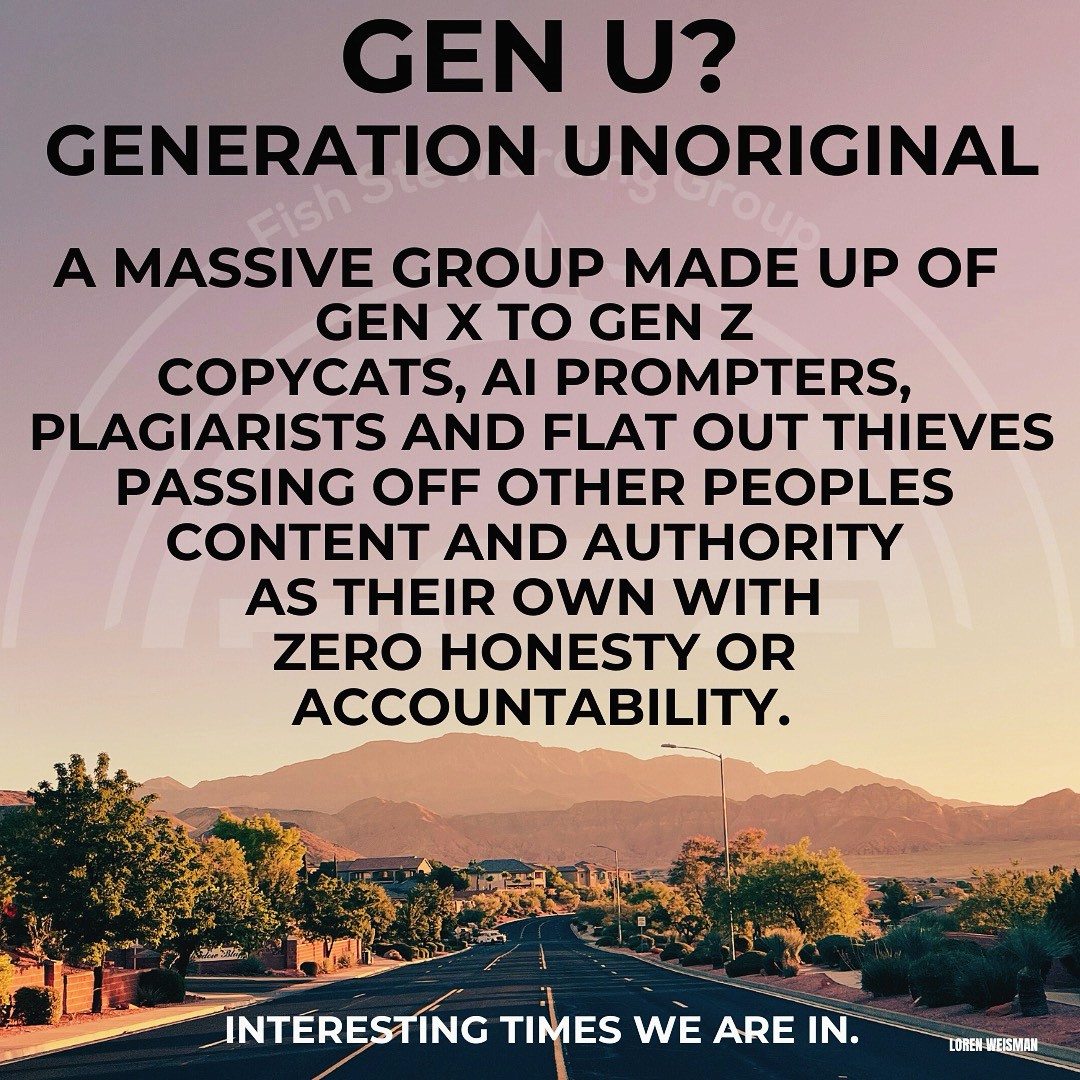
    Authentic messaging introductions transcription, generation U loren weisman quoteAuthentic messaging introductions transcription continued:

    Well, I do the best of this and I’m, I guarantee that where I don’t see the testimonials and the only testimonials that I do see come from other people that are in this business with you. So I protect my honor and I protect my reputation by taking the time to vet and I ask you to consider doing the same.

    And at the same time as you’re planning to reach out, let’s set up a one on one. I saw you in this room or I saw you in this meeting or I got your business card. Why do you want to set up a one on one? Even if it’s from a referral standpoint? Take a second to look into someone. I went into one very big one last week and it was a blast of emails afterwards of I want to set up a one on one.

    I want to set up a one on one. I responded to a few of them, I said, why? And the answers were borderline shocking. One guy in finance, it was just, well, and it was the same answer as other people. I want to see who I can refer you to in my network. All right, there was another guy, he was in insurance and it’s, we need to set up a one on one. And I said, okay, what would you like to discuss? I’d like to tell you right now, being very transparent and honest, I am fine with my insurance portfolio as is. I and my family are not going to be making any changes at this time. He responds, oh, that’s cool. L

    et’s just set up a one on one. What do you want to talk about? Do you want to talk about branding? Brand messaging? Do you want to talk about the fish stewarding group? I got nothing. So he got nothing back from me. I’m not going to waste my time and I’m not saying that this guy is a waste, but I have nothing to go off of and I am not prepared to put the time in to someone that is just spamming and sending these same type of emails to every single person. And I ask you to consider to do the same. Your time is valuable, your connections are valuable.

    And maybe as opposed to taking 20 meetings over the next week, if you take 10 or five, and you have a sense of what is being done and how you’re connecting and why you’re connecting, it starts off on a better path. Now starting there. What do you have when it comes to your business, your vision, your experience, your ability and your authority that invites someone that may want to take a fast peek, Not a deep dive, but a fast peek into you? Where can they go? One person that I asked that question to, I said, okay, maybe we should talk.Authentic messaging introductions transcription, Authentic messaging introductions and impression perceptions, podcast, loren weisman, woman and microphone

    How My Daughter Changed My Approach Podcast Transcription


    Authentic messaging introductions transcription continued:

    Do you have a page? Do you have somewhere where you can send me that has some short snippets or just examples of who you are beyond the sell? I don’t want to spend a lot of time. Where can you send me so I can get a brief overview of you? What was sent back to me, I don’t really have that stuff together. I’m kind of building it. Here’s a 30 minute interview and there was a part of me that was curious and in prepping for this podcast, I turned it on. I was out in less than three minutes. It was conversational, back and forth fodder.

    I didn’t get anything. What I ask you to consider here is having that page, whether it’s the front of your website, whether it’s somewhere that someone can go and we honor and we give the respect to someone that right now they’re being inundated by all these people saying, look at me, meet with me, talk with me, understand me, give them a taste test, give them a sample on the front of lorenweisman.com, my website. I offer that and I ask you to consider offering something like that, something similar or the same, or if it’s not even on the front of your website, that it’s a page.

    Is there a page that someone can go to and just get small pieces to get a sense about you that can entice them to learn and want to get bigger pieces and then from there to be in touch with you. Where should we. And where do we have the right as a whole to say, go look at all my stuff and my bio and this 30 minute video or this 30 minute podcast or this or that, or go search here or go check that out.


    Brand messaging blueprint strategies for creative careers.


    Authentic messaging introductions transcription continued:

    Where do we have the right when so many other people are asking for that right? If we can flip that intention, see the perception of what people are seeing and experiencing and invite them to a fast introduction. It may be that much more effective on my website when you come to lorenwiseman.com and it’s not the prettiest by far. It’s a blog site, but it’s a blog site set up very strategically for messaging. You come to the top. You know, I’m a brand messaging strategist.

    I’m with Fish Stewarding Group and FSG Messaging and Optics. You get a sense of my basic tagline, the short touch of my bio, that I have a podcast. And then if you look down the left side, there are a whole bunch of blogs that you can click through and they’re titled right there. So you can read an article if you want. And These average between 300 words to 500 or so. I’m not pushing people into articles.

    On the right side, you can see here’s a quote, and if you click through on that quote, it’ll send you to a whole bunch of other quotes. It also is a link to the podcast. That one’s a little bit longer, but it’s not saying, go listen to this. It’s saying, here’s my podcast. And you can find out more about the podcast I have. Or you can click to one of the videos in the video, the different video series.

    All of those are under three minutes. And then there it’s, here are a couple social media sites I’m on what my intention and what I’ve been able to shift to the perception for others is stating or hopefully is being received as I get.

    You’re busy. I get that a lot of people want you to check them out and run through and look at this and sign up. I’m not asking for the, like, the share, the comment, the subscription asking that if you’re interested in learning a little bit more, here’s a little bit.

    That’s the beauty of it. It’s a little bit. And they can find that quote and they can read that little bit of the bio and then click down and read the longer bit of a bio. They can see this short video and if that short video does something for them, they can look at a longer podcast. It’s sharing the authenticity over the cell.

    The above the fold is the information, it’s the integrity, it’s the authority that’s there, not the above the fold of do you need this? Or the next best thing or you’re missing out on that, or here’s everything you’re doing wrong. My intention is to showcase that I realize you’re dealing with a lot, and you’re being asked a lot. So I’m offering a little.

    And I ask you to consider maybe offering a little to the people that you want to reach out to, to be able to state, here’s some information about me here on this given page. There’s some short audio, short videos, some of my quotes. Here’s my short bio. This isn’t seven pages long.

    You invite them into getting a sense of you and from that standpoint, in that honor that allows that person to go, wow, I want to talk more. Because why should some of those simple points be the first part of a conversation? Why do we find so many people out there?

    Let’s say they waste so much time on these one on one calls, and then it’s, oh, I wish I could gotten to this point by this much earlier. Just all this time, I don’t understand the time I’m wasting. Here’s where it’s wasted. It’s wasted in that you’re trying to make this connection so fast, you’re not realizing if it’s a connection that should even be made in the first place.

    Now, it’s not saying you’re right, it’s not saying you’re wrong. But if somebody comes to my website and they disagree with the quote, or they think the video is silly or they think that a podcast is stupid, then I’m not the person for them. And I don’t need to defend that. I mean, if somebody want. If someone wants to debate it or they find that it’s interesting or.

    Okay, I don’t get where that guy’s coming from. I don’t understand this. I’d like to have a discussion. By all means, let’s have that discussion. But there are a lot of people out there where their subjective opinions have shifted to objective facts that are just opinions and really not true, not substantiated.

    Why waste the time? It’s not disrespecting. It’s not saying you’re better than anyone else, but it’s honoring you and it’s honoring them. Maybe there are certain people you shouldn’t get on the phone with and it will save you time and it will save you even stress. I talked to some of these other networkers out of the room.

    I get really stressed out on these calls, and at certain times I just want to hang up. Why don’t you. Why not interrupt and say, I’m not resonating. I’m not getting this. This just isn’t a good call, man. I felt like I was just. This guy was pulling teeth for 45 minutes.

    Authentic messaging introductions transcription, I read it in a book quoteAuthentic messaging introductions transcription continued:

    You let him pull teeth for 45 minutes. You allowed the call to go on. It’s not about being discourteous, it’s not about that. It’s being able to say, excuse me. And again, it can be done in a nice way. I’m not hearing or I’m not connecting or I’m not resonating with what you’re saying. I don’t believe this is a good connection. I don’t really see how I can refer you.

    It’s not saying your service is bad, but through the people that I know, through the way I communicate, through what I share and through my reputation, I just can’t do this. Have a great day. You can separate. You can not be a referral and still be nice. So let’s move on to the last section. Whether you’re in person, whether you’re in one of those meetings, whether you’re on a zoom call, a lot of them have that two minute window.

    And in those two minutes think. And even if it’s a, even if it’s not a spoken out rule, two minute window where you’re meeting someone or you’re meeting someone somewhere, allow it to be relaxed, to be authentic. Don’t script it, but perhaps practice it.

    Maybe practice in the mirror, practice in a video. Watch yourself back. And when I say practice, take a video of yourself in these two minute things. Please don’t show me a video. Where are you? And here’s another thing. From the impression and the perceptions, I’m going to show you this quick video. I can fit this in. It’s a minute 15. I have two minutes.

    So I’ll even have a little time left over. Here we go. Now the screen is a video. If you’re getting on there to share your authenticity, your authority. If you’re up there networking and you’re just using either a video that you made or a video from some company that they’re saying, get this out to absolutely everyone, then where are you? The person that can amplify and communicate if it takes a video and inside of two minutes, you’re unable to get your point across, you’re not ready to be networking that point.

    Allow those two minutes to not feel rushed. You’re not going to get to say everything that you want to. And for some of these meetings where these people have meeting after meeting and they’re weekly, then perhaps it’s bringing up different points, perhaps it’s giving people a sense of how they can directly and indirectly vicariously relate to you inside of so many of the insurance salesmen and women financial advisors, what is a tip?

    What is something that can be stewarded, that can be shared, that say, I never contacted you, but by going into that room, I learned something about you. You. When I went in and when they moved around and made me my. Gave me my two minutes in a couple of the ones that we did last week, it was, here’s this. And I look at authority to authenticity, subjective to objective, intention to perception. I talked a little bit about what I did, but then I spent the bulk of the time saying, think about this.


    Consulting Referral Agreement for Brand Communications Strategist


    Authentic messaging introductions transcription continued:

    When it comes to an email, when you’re doing this with a video, consider this, okay, here’s some volatile things going on when it comes to security and the security of your message and your brand. It was gifting and giving and stewarding people information. And then in that they remember that information and then maybe they remember me. And there’s a better chance that they’re going to remember someone that is out there gifting, giving, stewarding than someone that is rushing as much material into two minutes.

    That’s only directing to them and it goes nowhere. That was one of the things I noticed when I was part of some of the those South Florida networking groups. The same people would go every single week or every single month on some of these other ones. And there was one particular one in Palm Beach Gardens.

    No, it wasn’t Palm Beach Gardens, it was Port St. Lucie. And they had this amazing breakfast. So not only was it great to learn and watch people with their messaging, but it was really good food, too. But I’m sorry, jumping off course here. Some of the same people would get up and they’d say the exact same thing at every single meeting.

    Nothing had changed. It was only the cell. So it was a story. It wasn’t their story. I like to watch. I usually got up and I bring different tips. I bring different pieces, I bring different flavors. It was, think about that. What about that? Change up this. Consider that I’d have fun with it. And I watch people and networking can be fun.

    You can have fun. You can engage with people. You can bring your story in. Think of it like that supermarket angle. Maybe you’re not going to sell someone immediately, but can you invite them to want to come look into you? And from there consider. Consider looking at the front of my web page, my website.

    Authentic messaging introductions transcription continued:

    Can you do something like that on the front of your website or on a page alone where it invites people to this sampling menu of you that they can get through very quickly and from there make a decision as you’re inviting someone to a one on one share with them. Be that different person. I love to want I saw you here, I’d love to have a one on one with you. Here’s my scheduler.

    How about I saw you here, I heard you say X, Y and Z. Or I went to this page and I loved what your comment was on this or I loved your content on that or I agree with you here or I disagree.

    Would you like to continue the conversation in a one on one? Now you’re inviting, now you’re engaging, now you’re not playing the games of these business gurus that are pushing for every single person to be talked to for you to figure out what they’re worth or what they’re not worth. And that can make people feel worthless and that can make people not feel good. When I was in the music industry, I used to go to this really big event out in Anaheim, California and we used to do the pocket thing.

    The people that were engaging and then they hand the cards at the end, you put them in the right pocket, those are the ones you were going to keep, the ones in the back left pocket, those were going to hit the trash.

    And most of the time, even if it wasn’t a company or a situation I was involved in or needed to be involved in, the people that engaged, that were honorable, that were considerate, that had fun, I wanted to be in contact with them, I wanted to know them, I wanted to have a drink with them. And then maybe down the line I wanted to see how I could authentically and honorably helped them. And it wasn’t because of what they were selling or how they sold it.

    It was how they authentically engaged their messaging introduction. The way that it was a draw and an invitation to have a conversation and not something forced, that felt, you know, scripted, saturated, spammed. That’s the beauty in it. And that’s the beauty in a true authentic introduction and a connection.

    Consider stepping back of this program mindset of say, this, email this, follow this, add this person to your email list, do this, add them on LinkedIn and simplify it, moralize it, bring it to a place of honor, of attraction, of finding out, should we be in touch? Should we have the conversation? Should we not? What can I learn a little bit about you in advance so I can make that conversation as effective as possible?

    What can you add inside of that two minute pitch or your original pitch that brings a piece of you into the picture and not just the big picture sell that you’re trying to create in that authenticity, in that patience, in that honor and in that integrity of you showcasing you. You’re going to attract that many more people.

    And it won’t feel like it’s scripted because it’s not. And it won’t feel like spam, because it’s not. And it won’t feel fake because it’s not. What it will be is an honorable conversation, authentic networking and allowing a message to be heard just as you hear the other person’s message to decide if that conversation should continue. And from there, to see where that conversation can lead. My name is Loren Weisman.

    This was. Wait What Really Ok. 123 Season 7 Episode 10 I hope you enjoyed some of these thoughts. I hope there’s some stuff in here that you might want to consider and add to your networking, your introductions, your messaging, when you’re communicating with new contacts and if you. And again, if you’d like to see an example of what I do with that simple. Learn a little bit about me quickly. It’s right there in the front on lorenwiseman.com and if you’d like to have a conversation.

    If you’d like to have a discussion, not even necessarily, okay, you want to hire me or hire FSG, send me that email. Not just asking for a one on one. Tell me why you want to have a conversation.

    Tell me what you’re about. Tell me where I can find out a little bit more about you. Maybe together with these emails that go out in loud spam blasts can shift to an inviting tone, an inviting volume, and an inviting element of authenticity that maybe will draw people in and make them want to connect with you that much more.
    Authentic messaging introductions transcriptionAuthentic messaging introductions transcription


    * Loren Weisman is a Brand Communications and Optics Strategist who specializes in illuminating authoritative intelligence and amplifying authentic experts. * Weisman is also the host of the Brand Communications and optics podcast; Wait What Really OK. * LW Website * © 2011 to 2026 Loren Weisman. All Rights Reserved ® ℗ * Authentic messaging introductions transcription from Authentic messaging introductions and impression perceptions Podcast.

    Related reading

  • Mary Poppins Messaging Transcription

    Mary Poppins Messaging Transcription

    Mary Poppins Messaging Transcription from Mary Poppins Messaging and Practically Perfect Perceptions Podcast Mary Poppins Messaging Transcription

    Mary Poppins Messaging Transcription

    mary poppins messaging transcriptionRelease Date: October 11th, 2020


    🎙️ Tune In: Listen to this Wait What Really Ok Podcast Episode Mary Poppins Messaging and Practically Perfect Perceptions at these links: Spotify Apple Podcasts Pandora Amazon Music  Spreaker YouTube and other platforms


    Mary Poppins Messaging Transcription Chapters


    Mary Poppins Messaging Transcription Chapters: 00:00 – Introduction to Mary Poppins Messaging and Brand Communication 00:45 – Childhood Memories and Rediscovering the Film 02:15 – The Concept of “Practically Perfect” Messaging 04:05 – The Impossibility of Perfect Messaging 06:10 – Authenticity Over Perfection in Brand Messaging 08:00 – Navigating Perception Gaps Between Intention and Reception 10:20 – Avoiding Toxic and Over-Polished Messaging 12:05 – Understanding Market Competition and Messaging Ethics 14:00 – Tailoring Messaging for Different Business Sizes 15:30 – Finding Your Unique Brand Voice and Tone 17:15 – The Danger of Copying Competitors’ Messaging 19:00 – Balancing Authenticity with Audience Perception 20:45 – The Role of Marketing as Authentic Communication 22:30 – Avoiding Sales Tactics That Undermine Authority 23:01 – Final Thoughts and Conclusions

    Mary Poppins Messaging Transcription Text


    Mary Poppins Messaging Transcription


    Song: Wait What Really Really OK with your host, Loren Weisman. This is a fully licensed theme song for the show about stuff that makes you say, Wait What Really Really OK,

    Loren: This is Loren Weisman. This is the brand messaging podcast. Wait, What? Really? Okay. And how about this for a. Wait. Weird title.

    Mary Poppins Messaging and Practically perfect perceptions. What I’m going into here and I, I first want to back up for some of the people that may not have seen the movie. I grew up on this. I remember watching it on VHS when I was a little kid. And a few weeks ago I was able to get it and have my daughter, who’s just turned five, see it and watch it with her. And there was something just this, this reconnection to it.

    I loved watching her react and I love the reactions that I remember now being, you know, 46, but feeling like I did when I was 6 years old. Now, in this story, for those that might not have seen it, it’s this magical nanny that comes down to take care of these kids. It’s based off of this series from. I believe it’s P.L. Traver. I’m going to double check that. And in that and I remember this from IMDb the summary.

    The magical nanny employs music and adventure to help two neglected children become closer to their father. In seeing that again, it reminds me of the perception and it reminds me of the elements of the neglect that goes into our messaging and how there are other people that can’t quite see it or can’t quite see us. Now she is referred to by these penguins by this chimney sweep and others. Practically perfect in every way. Now, in that we’re never going to achieve perfect messaging.


    Fake Authors Using AI. Podcast Links and Transcription


    Mary Poppins Messaging Transcription Continued:

    It is impossible. This is an objective truth, not a subjective opinion. It is impossible to clarify your messaging for everyone. And it’s one of the things that kind of gets me and it bothers me when people state, no, no, no, everybody gets this. Everybody gets this. I have it perfect. If it’s perfect, then how come you don’t have the connection? How come you don’t have the engagement? How come you don’t have the customers? How come you don’t have the sales in the middle of something perfect, or almost perfect, for that matter, something magical?

    There isn’t perfection, and it’s not about striving for perfection, but this thing now coming back 40 years later, practically perfect in every way. And at the time of being a kid, it was a. Well, isn’t she perfect? No, she’s practically perfect. And it’s not that we have to perfect our messaging it’s ever changing with the ebbs and flows, with the way toxic communication comes in, goes out, negativity, something may happen. You could have messaging that is so incredibly strong. And then something happens in the news, something similar to your tagline, your title, your brand name.

    And now everything is exploded and almost started over again for you. And what works so well in one moment isn’t the next. Now, as some people chase inside of their messaging, inside of their content for perfection. And these people have put out this stuff about the secrets to your perfect message, your perfect brand. Here’s the secret. It’s impossible. And it’s a good thing that it’s impossible. Because if you had the perfection and for the people that try to perfect a message to be heard by everyone, it doesn’t connect with anyone. And I want to get this part out of the way quickly.

    Mary Poppins Messaging Transcription Continued: Stop honing and shifting your message to try to get everyone to understand it. That’s impossible. It’s when people lose the intention, the authenticity is lost. The spam, the hype, the advertising turns into a situation of we are just going to blast out this. And in the middle of constantly shifting your message to meet everyone, it will eventually upset that, that person that first got it, oh, this is great. And then it might upset them later because now you’ve gone in a completely different direction. Now in getting the perception of your messaging to the best place, to the closest place of your intention, it’s not reaching everyone and it’s having that humble standpoint, no perfection, but maybe practically perfection or practically perfect, you stand in the foundation of what you have.

    So let’s take a base message like this. You stand in the foundation of what you have. Now, from there it goes into the discovery. What are the contradictions? What are the comparisons? What is the competition saying? And it’s not saying, okay, I’m going to check out what the competition is saying so I can steal their keywords and just attack that. I don’t think that’s the most moral thing to do. A lot of people choose that route. I don’t think it’s best. I think it’s best to understand the markets that they have.

    If you are a $50,000 or $500,000 company with a very similar messaging line and a brand messaging line to a 5 million or a $50 million company, it’s not going to work well for you. If that 5 million or $50 million company is doing bad things too, that’s going to hurt even more. So when we say the competitive and we look at the. And at the same time, comparative. It’s not necessarily looking at that to say, okay, these are the words we have to use.

    Because if you’re putting in $50,000, $5,000, $10,000, $120,000 a year in your messaging, into pushing that market. I’m sorry, into pushing the marketing behind this message that looks the exact same as somebody else’s. It’s really not going to work for you. They are the people that are out there pushing at a much higher ratio with the same words. They. That’s who’s going to be seen first. So in this mindset, to be seen, be seen, be seen. How about authentically being heard?

    So it’s understanding what’s being said and then maybe even if that message is true to heart and true to your intention. Light adjustments, staying on your intention, but shifting the words around to find the melody in your heart, your intention to reach a perception where other people don’t automatically assume you’re what’s going on everywhere else. There was a course, an online course advertising campaign, and they were pushing some stuff out. I didn’t. Off of the messaging that they had, it didn’t look right to me, so I didn’t go on the attack. But I said, look, it seems to me, I feel, and I was very careful to state in opinion and not fact, that it really is a bad idea to have this super course if you’re not ready to be teaching or you don’t have the authority to do so.


    Top 100 Loren Weisman Quotes: Considerations for Branding, Communication and Marketing


    Mary Poppins Messaging Transcription Continued:

    So they came back at me, and not even in a bad way, but it was, we’re here to help these people that don’t know how to put a course together but have the authority to do so. To which my response was, great, great, but consider shifting your messaging because you sound like all these other people. And their response was, well, we wouldn’t do that. And that’s just snake oil. And that’s. I mean, that’s insane. It is, but that’s what they sounded like. They sat so hard in their intention that they couldn’t see the perception that was out there that it’s. No, no, no one can think this.

    We’ve, we, we’ve sat down, we talked about this. We really like this. That becomes a very dangerous thing to say when you’re in a group of people that are all in agreement, but you’re not realizing how your messaging can be read elsewhere. It’s not focus groups, it’s not polls. It’s going a little bit deeper. It’s not finding your SEO Keywords, it’s finding the message that is you. It’s the discovery of your message.

    And then in that discovery, going to the standpoint of humility and understanding your intention may not be everyone’s perception. Then the next step from there is the adjustment, the embellishment, not lies, the embellishing, the being able to look at the competitive, the comparative, the connotations that are out there, the compliance that’s included. A lot of health companies out there, they’re shifting in a very dangerous space because they’re making claims they’re not allowed to make. And then they come back, oh, well, you know, we’ll deal with this later. Why later?

    When you get the exposure, when you’re seen and now when you get shut down, it’s looking at this greater understanding to not be perfect, but to be, you know, coming back to the Mary Poppins things, practically perfect. Not everyone is going to get it. But when you hone that message with the considerations, massage that message in a way, somebody else is saying X. Okay, let’s look at where they’re saying it. Okay, you have something.


    How My Daughter Changed My Approach Podcast Transcription


    Mary Poppins Messaging Transcription Continued:

    This is so true to heart. And I grew up in this, and I believe in this. And this word means everything to me. Or these three words strung together are just everything to me. Okay. But if there’s a negative connotation, trying to constantly drive that and put marketing money behind that and having this one advertisement around, that, that’s not humble, that’s not professional, that’s ignorant, it’s not getting you to get away from your intention. It’s getting you to understand the array of where intention and perception meet. And as opposed to this perfect attack, as some people call it, it’s more of a strategy and setting up a foundation. So the strategy in those words have the room to change.

    A lot of people will put together certain campaigns and it has to go this way and it’s gonna go this way for this long, and it’s. You’re gonna get these views and you’re gonna get likes and you’re gonna get comments. But where are the sales? Or at the same time, the polar opposite, the extreme of what are the hottest words? Who is buying something like this? There’s a point where the artificial intelligence is so artificial, it ruins your authenticity and your authority with people. Many companies are experiencing this.

    They are getting the eyes on their product, but the way they’re getting their eyes on their product is immoral and at times unethical. Promises being made that aren’t true. Phrases and rewords going, oh, well, we just, we studied this and these guys are doing really well. So let’s copy it. We’re going to get on their coattails.

    Should you really be on someone’s coattails? And it’s not necessarily about the perfect professional message. You can be professional, but make it a little bit more personal. And by keeping your intended messaging personal, humble and professional when it comes to perception elements and being direct here, it will not make your message clear to everyone, but you’ll have a better chance to engage that many more people with a greater understanding. It won’t be perfect, but it will be practically perfect for you. And because you don’t go into, or hopefully don’t go into, that mindset of this is the lock that the adjustments can be made. Yes.


    Speaking Contract For Loren Weisman for Public and Private Speaking


    Mary Poppins Messaging Transcription Continued:

    To lock into a tagline, to lock into that one liner, that bio, certain elements, you want those in place. And then it’s that adjustment of the content on top. And that adjustment of the content on top can mean different videos, different styles of content, different leads. And I mean, unless there’s something, I mean, major problematic, major negative connotation that has now occurred that you have to change things like product names, taglines, that can be in some ways a different story, most of the time that’s not needed. But that next level, the campaign, the series of videos, the series of audios, how you’re starting in, who you’re emulating what’s working and what’s not.

    We’ve seen in the podcasting world this just explosion of people trying to be Joe Rogan. They’re trying to be perfectly like Joe Rogan and it’s not working. It’s not working. It’s not authentic. It’s people that are trying to come off like a guy, where they don’t, they haven’t put their homework in, they haven’t put their research in. They don’t realize the level of intelligence of this cat. They don’t realize the pre existing fame that he already had, all the things that he’s already done.

    All of that has culminated to a point to allow him to go down the road that he has. And in that, and in that comparison to other celebrities, to be able to state, well, my intention, I want to be just like this person, so I’ll completely act like this person. Well, this person has a different set of parameters, metrics, tone, temperature, audience. So they might not have to worry as much about perceptions because they’ve got that existing audience that they can grow certain people when it comes to perceptions, yes, it sounds like a contradiction, but it’s not somebody that’s incredibly famous, has a different approach to an audience than someone that is trying to build an audience. And especially someone that’s trying to build an audience authentically.

    Look at some of these top level life coaches. Look at some of these top tier speakers, what they scream out on stage or these days online. Do you think they could truly, organically, authentically and authoritatively say that stuff if they did not already have the money behind them, the fame behind them and that, you know, celebrity of sort behind them? Absolutely not. And the worst part, to me, the thing that really becomes upsetting is that they explain, this is what I did and this is how I did it.

    When they leave out the parts of the story, when they talk from an intention that is lies, that is half truths that are made up of expired truths that don’t complete the picture, then the perception, and this is where the perception gets toxic. I’ll just do what I heard them say. Many won’t question that. That’s not the full story. And then these people crash and burn. I don’t want to see you crash and burn. And I’m not saying to go negative, but question the people that you’re placing into authority. Question the people that you claim or feel are authentic. Make sure the messaging lines up.

    Make sure it’s not a template or a book that’s written by someone else, that they’re speaking out to you and sharing elements that are not all there that can be incredibly dangerous for forward motion for you, especially in these times. Again, you have to have the perfect this, you have to have the perfect that. Here are these secrets. There’s no perfection and there really are no secrets. You could sign up for someone’s course and meet with them every week and this and that. I’m going to give you all these secrets. Is that really authentic? Is that really true to heart, true to intention?

    Mary Poppins Messaging Transcription, Loren Weisman, wait what really okMary Poppins Messaging Transcription Continued:

    To me, it’s dangerous, it’s a sales tactic. But coming back full circle to this, that differentiation and that humility in that differentiation of not trying to emulate the celebrity because you may. Because they already have their existing celebrity base, they already have their fame. It’s the people like David Byrne that go online. And don’t get me wrong, I love the talking heads. But he is just another talking head when he explains how Twitter works, because he has absolutely no idea the most.

    The moment he signed up, boom, all these people were following. The moment he put something out, this is the regard, this is the engagement that he has that doesn’t work for the Average person, the new entrepreneur, the new musician, the new author that begins to follow models and methodologies of these people, they take it. And that’s where we see people that take the negative. It’s a negative perception, it’s a simplified perception. So just in the exact same way that we might misread someone else’s intention and some of them say, well no, I’m not just, you know, I’ve talked to a few celebrities about that. I’m not trying to say that this is what you do. But at the same time, for some of them that is what they mean. For others, that’s the perception that’s coming off.

    So again, they’re not going to solve that. And I know it gets a little confusing, but as you build your brand, as you build your messaging behind your brand, which is the foundation, it’s the ground floor, it’s the soil of everything that grows in that. Create that. And as you create that, create it. For the perception of what you know to be true to heart, of what you know your intention to be, it’s not moving off of intention. It’s not going to a different narrative, it’s creating an intention narrative that considers the perception narrative. It considers that it’s not going to be perfect and it’s not going to be perfectly found because there’s certain people that will want that. We’re just going to keep going for perfection till we get it. Sounds like a long term invoice.


    Brand messaging blueprint strategies for creative careers.


    Mary Poppins Messaging Transcription Continued:

    If you can build that narrative, if you can work from a humble place and understand what is so clear to you might be so confusing or might run, read in a different way to someone else, it will make for a better journey in content. It’s not writing a bio, it’s not putting up a ad, it’s not putting out a book. The consistency of the, for lack of a better word, practically perfect perceptions is to continually feed with content, to share and move different people that may be thinking different things to align as closely as they can to your intention so they can connect as closely as they can to you. It’s not getting the perfect 90 second video. It’s not buying the perfect ad campaign and it’s not a marathon.

    This messaging, moving over to marketing, it’s not a marathon. People say it’s marketing is a marathon, not a race. No, marketing is part of your communication. Let’s move away from this idea that marketing is this marathon. It’s this forced thing, it just keeps. It has to go out and go out and go out and oh, I hate marketing. And I’m just going to give this to someone else. You can’t give it to someone else. If you’re being authentic, true to heart and true to you, you can have someone else working with it, running it, leading it, but it all has to tie back to you. And in consistent, constant discussions, communication, the understanding of what. What is out there, not even for a competitive.

    But what’s the tone?Mary Poppins Messaging Transcription, Loren Weisman, Caricature

    Mary Poppins Messaging Transcription Continued:

    What are the things that should be said in the last 24 days leading to an election that should be said differently when we’re after the election? And who knows if they know a winner next to something that happens three months after that? Go back to massive things that have happened. Are you going to stay on point with the same voice after a massive tragedy or after a massive win or something very positive or something negative? It’s not the perfect tone. It’s not the perfect story.

    It’s practically perfect messaging that is constantly growing, adjusting, changing, staying true and anchored in your intention, but being moved and massaged to try to build a connection and engagement with different people’s perceptions. And lastly, when I say moved and massage, it is not shifting the intention. The root or the anchor of is shifting the way the words are put together. S

    o you stay true. You stay ground in the foundation and the soil of what you have. But consider looking at that Mary Poppins, almost magical element coming full circle back to the story, the IMDb lead on that, where it said it was these children felt neglected from their father and throughout the entire movie, in everything that occurred and what the children were learning and how the children learned to communicate and how Mary talked to the father. Father.

    There’s an aspect of neglect that we put on our audience. We neglect them because they should understand this. And that’s. That brings it right back. And we’re closing up, I promise. It brings it right back here where the. The father does a couple songs about this is what children should know, this is what children should do, this is how it should be. And then he was able to see things from a different view, and the children were able to see things from a different view, and then they were able to come together.


    Consulting Referral Agreement for Brand Communications Strategist


    Mary Poppins Messaging Transcription Continued:

    And maybe they’re not completely perfect, but they were practically perfect toward the end. And then Mary could move on. And now these children are no longer neglected by their father. Their father hears them. They hear their father. So I ask you, what can you do or what part of your messaging is being neglected because you’re so tight to the intention?

    Or on the opposite end, you’re trying to make everybody understand it. So you constantly switch up the root and the foundation and the anchor of it. Let’s make it a thing as we come into the end of this year and go into the new year, not to neglect the humble standpoint that other people, their perception may be off of what we want. And because it’s off, it’s not saying you don’t get it, you’re blind. You. You just don’t understand. But making it our responsibility to give them a chance to understand it and see it through our eyes and help them, and you won’t be able to help everybody.

    But in that humility, in that authenticity and in that authority, you may be able to help that many more people to connect with you that much more and understand not only your intention, but also the messaging, the story, and the meaning behind it. Wait, What? Really? Okay. Okay.

    Wait What Really OK logo and orange graphic alone.
    Wait What Really OK Podcast With Loren Weisman.

    Mary Poppins Messaging Transcription


    * Loren Weisman is a Brand Communications and Optics Strategist who specializes in illuminating authoritative intelligence and amplifying authentic experts. * Weisman is also the host of the Brand Communications and optics podcast; Wait What Really OK. * LW Website * © 2011 to 2026 Loren Weisman. All Rights Reserved ® ℗ * Mary Poppins Messaging Transcription from Mary Poppins Messaging and Practically Perfect Perceptions Podcast

    Related reading

  • Strategic Patience Podcast Transcription

    Strategic Patience Podcast Transcription

    Strategic Patience Podcast Transcription for Strategic patience and pressure when preparing a launch Wait What Really OK PodcastStrategic patience and pressure when preparing a launch

    Strategic patience podcast transcription

    Strategic Patience Podcast TranscriptionReleased on November 1st, 2020

    🎙️ Tune In: Listen to this Wait What Really Ok Podcast Episode Strategic patience and pressure when preparing a launch  on Spotify Apple Podcasts Pandora Amazon Music Spreaker YouTube and other platforms.


    Strategic Patience Podcast Transcription Chapters


    Strategic Patience Podcast Transcription Chapters: 00:00 – Introduction to Strategic Patience and Pressure 03:56 – The Importance of Timing in Launches 05:30 – Strategic Patience vs. Pressure in Launch Preparation 06:45 – Mastering Mental Game for Launch Success 07:58 – Overcoming Perfectionism in High-Stakes Moments 09:11 – Navigating the Holiday Season for Launches 10:02 – Building Emotional Resilience Under Pressure 10:45 – Content Strategy and Brand Discovery Insights 11:30 – Incremental Improvement and Long-Term Growth 12:16 – Investor Perception and Strategic Planning 13:05 – Avoiding the Trap of Over ambition in Launches 13:45 – Resource Management and Sustainable Success 14:31 – Handling Launch Challenges with Integrity 15:18 – Lessons from Industry Leaders on Patience 16:00 – Adapting to Setbacks and Course Corrections 16:42 – Long-term Strategy and Decision Making 17:25 – Balancing Patience and Action for Results 18:19 – Authority, Authenticity, and Intelligence in Launches 19:10 – Strength Through Restraint and Focus 19:55 – Measuring Progress and Celebrating Milestones 20:35 – Conclusion and Final Thoughts on Launch Success

    Strategic Patience Podcast Transcription Text


    Strategic Patience Podcast Transcription


    Song: Wait, What? Really? Okay. With your host, Loren Weisman. This is a fully licensed theme song for the show about stuff that makes you say, wait, what? Really? Okay.

    Loren: This is Loren Weisman, and this is. Wait What Really Ok. A brand messaging podcast. I’m a brand messaging strategist and today’s topic is strategic patience and pressure when preparing a launch. This is around the idea of the organization after a brand discovery.

    As you begin to do your process architecture, laying out the blueprint and deciding on the plan of action and the time of action across this podcast. I’m going to run through this stuff real quick. I’m going to touch on the team, the time, the temperature, the tactics, and the taste before launching a business, a service, a show, a podcast, a product, whatever.

    In the middle of launching a business or in the middle of building a business and deciding how to launch, we have a lot of hearsay coming from a lot of different angles. We have a lot of truth. We also have a lot of expired truth or unrelatable truth.

    Now, it’s not that it is not true. It’s something can be objectively true that was shared with you about how a business was started or a product was launched, a podcast, a TV show, a movie. But if it’s an unrelatable truth because they took it down a path where there was certain finances in place, certain things going on around it, then it becomes a different story. And to follow that model is going to lead you down a path that will not work for you. Most likely, it bothers me.

    And this goes back to music and it goes back to a lot of other businesses where people explain not their story in humility and in the opinion of the things that they experienced that made it happen. But they shift it from the subjective to the objective and they state, this is how it works for everyone, and that is absolutely objectively incorrect and wrong. It worked for them that way. And that’s beautiful and that’s great, and it’s great to tell that story.

    But when that story is shifted to an objective reality and a directive to tell everyone to do it just like that, it’s irresponsible on the part of that person putting that information out or trying to sell that process to others because it doesn’t include all the other metrics, the time that went in, the budgets, the temperature of what was happening, even the taste.

    I know that sounds weird, but the taste and the flavor of everything in a circumference to allow certain projects, certain businesses and certain services to break through at certain times. I’m like so many other people.

    I love a success story. I love to hear about someone taking something, taking a dream, it being executed, it becoming successful. I don’t fault anyone for that. My problem is that when people take a model and don’t show with humility the metrics and the other elements that are going on, to me, that’s irresponsible. It’s not helpful. And then you’ve got these certain coaches, not all coaches, but they’re stating, well, this is exactly how you have to do that.


    Brand messaging blueprint strategies for creative careers.


    Strategic Patience Podcast Transcription Continued:


    And then they begin to showcase examples that can relate in no way whatsoever. There was a particular song that was about to come out on a particular year. I’m not going to dig too far into it. I was tied to it a bit in the release of that. It was held. It was held off. Something was about to come out. A whole bunch of big things happened.

    It was paused, it was repackaged, it was organized, Organized. There was some patience. And then it was launched at the right time, with the right team, at the right temperature, using moral connective tactics and pushing out just a little bit so it didn’t come off exploiting. And in that, it was incredibly successful.

    Now, had that song been launched a year before or a year after, it never would have gone anywhere. It wouldn’t have. And even the artist knows it himself. He’s, you know, he’s a humble and down to earth and going, it’s not the song. It was the way we were able to get the song into so many ears, and there’s no way at the standing budget that they had at the time that that could have worked.

    There are those magic moments, but a lot of what you may see as viral and out of nowhere, it may just begin to have motion, traction, a level of endurance. Then there’s a story behind it about how it gets picked up and how we want to maintain.

    And this is what I used to do in Los Angeles. You want to maintain a certain look, a feel, something organic, even when it no longer is organic. And it’s not that that’s necessarily bad, but it can lead people down to understanding and thinking, oh, I can just do this or I can just do that.

    So circling back around where I put the words in this title, patience and pressure. There are times to be patient when you want to fly forward. And there may be times inside of your story, your authority, the product that you have where it’s time to move and pressure through when you’d rather be patient.

    Many people will take a standpoint of I Just need to do it this way. It feels good to me in that it can end up feeling a lot more expensive. There was one reference a friend of mine said, you know, I feel like all I need to do right now at the moment is just press the pause button.

    Strategic Patience Podcast Transcription, loren weisman, wait what really okStrategic Patience Podcast Transcription Continued:

    And to him, and an immensely intelligent dude to him, what he saw in the motion, in the traction, was a simple pause and then unpause and everything moves again. But in the flow, in strategic motion, in the process blueprint, and at the same time, in timing and understanding releases, motion, traction, where money can be saved, where time can be exploited.

    When I say exploited, I mean the positive way, where releases can come and sit into dates and times, where the same release at one point and kind of circling back to this, the same release at one point with the same budget, put right in the right day, in between other items so that it can move slowly above the fold is going to have a much greater impact than doing it a month later, a month earlier. When you look at the strategies of not just going, okay, the product is done, the service is done, this thing is ready to launch, let’s just get it up, get it out.

    Yes, there are quotes out there and there are famous people that said, just be imperfect, just throw it out there. But right now, so many other people are doing the exact same thing. And yes, there are ways to begin and move things and motion and get things up.

    However, if you just throw it up there without looking at the time frames, without looking at the temperature, what’s resonating, competitive, comparative, even toxic, then you may end up putting something out and making an announcement. Because really, you only get that first chance to do that first launch.


    Fake Authors Using AI. Podcast Links and Transcription


    Strategic Patience Podcast Transcription Continued:
    After that, to potential investors, to potential earned media, press, pr, publicist, they’re seeing it as a second push and they’re immediately wondering what went wrong on the first. So almost a laundry list to look at.

    There can be a mixture from looking at a launch date, not just to say, okay, I need to get this out by this point, but more so if you’re going for that time frame, what’s going on around it, what are things that are relating vicariously, connected, indirectly connected and not connected at all to the industry, the service, or the product you’re about to launch.

    Is this the right time? I’ve mentioned to a lot of people as of late, you know, the first week of November really is not a time to launch most products. Yes, there are a few products and services that may have impact, but the next couple weeks, they might be a little volatile. News Cycles are not going to be pointing in the direction of new and fun things.

    And also depending on the product, it might be exactly the opposite time of where you could do something better. I’ve mentioned to a number of people saying depending on where they’re at, that moving toward February might be a better idea.


    Consulting Referral Agreement for Brand Communications Strategist


    Strategic Patience Podcast Transcription Continued: And this is not the rule for all. But here are a couple considerations. We have an election and this is being recorded two days before November 3rd and released then. So we’re going to have this election. We don’t know right now if there’s going to be a winner announced or if it’s going to be a couple of weeks. Then we’re going to go into the holiday season. In this holiday season, as we begin to track into Thanksgiving on top of it, we’ll have the toxicity of issues around government. We’ll be going into time around gifts and holidays and all of that.
    Then it’s going to come into a time who knows what’s going to happen in the streets. Then we get to an inauguration. Hopefully that’ll be on time right after that. Is it the Super Bowl? Are certain things potentially shut back down? Do things lean toward opening back up and then you’ve got the Grammys and then it starts to head into award season. Really right now it really depends on your product. But putting out anything prior to February 1st, right now as a full scale launch may be a little tricky.

    Most anything though it really, I mean there’s certain things that may tie into, you know, Covid for the holidays instead of home for the holidays or you know, there are certain things that can align. It’s not everything but a long term play for a lot of businesses right now maybe that are in a new stage, that are ready to launch, that have been built the right way. It may not be the right time to launch right now.

    Also, what makes up of December, what makes up of November in the ability to have time to really lay a foundation. There are a number of businesses right now that are not that are not launching, that are going back to the process architecture. They’re going back to the brand discovery. They’re really layering stuff out.

    They’re not attacking with content, but more so organizing and architecting and authoring content and preparing it so that there’s a truckload available. So as soon as somebody has the finger on the pulse of what’s going on from presidency to anything else, to Covid to all of this, that then there’s a great attack plan, there’s a great launch plan, there’s an endurance of that it doesn’t mean and I like to get away from this, I see some of these coaches you need to post X number of times a day.

    Strategic Patience Podcast Transcription, rant, loren weisman, podcastStrategic Patience Podcast Transcription Continued:

    If you’re posting crap over and over again, sharing other things, just putting out popular stuff, what are the chances right now that so many people are ignoring you?

    They’re unfall, okay, great, you’re connected with them on LinkedIn but they’re unfollowing you. I’m not following half of the people I’m connected to on LinkedIn because when they start following the I’m going to slam you with content to be seen.

    I’m tired of seeing the regurgitated, repurposed, you know, brand licensed content that everybody’s using the exact same way. So why should I look at it? So now in my unfollowing, to clear up my screen, I may miss their launch, I may miss something else that’s put in between there. This also is not a time to say, okay, we’re going to stand back and just blow up on content for exactly that reason. And I’m not the only one.

    Many people are disconnecting and when they give off the view that they are not being strategically patient and being perceived as acting in fear, this results and resonates with existing investors and even potentially investors down the line.

    Your scale, your blueprint, the way that you set up this marathon, from the launch to getting things out there to how you maintain it’s important inside of your scheduling to think about not just the people that are directly involved, not just even the investors that you have, but the investors and the opportunities that you may have in the future.

    Strategic Patience Podcast Transcription, lorenw eisman, daughter pictureStrategic Patience Podcast Transcription Continued:
    Because what many of them are going to do is they’re going to go backwards. If not them, someone that works with them is going to look at the tone, they’re going to look at the temperature, they’re going to get a feeling of a taste of what you’re doing and how you’re doing it.

    Many times people do not want to in these days, more often look at some existing prospectus. They want to have a look at how things have happened, the actions that people take in a state of fear, in a state of trouble, showcase how people can do in a state of love or in a state of success.

    Many businesses and many investors, many people that are getting behind projects are looking back seven, eight months. They’re looking at how people are acting because they know, wow, if these people can handle themselves and present and work and build and do it in the best way possible with what they have in the moment, in these troubled times, I feel, stating as an investor, more confident that in the best of times they’ll be able to be just as good.

    That’s the one thing I really take away from this whole experience is learning a lot of the other sides of people, how they act and how they interact in fear, in harder times, in struggle.

    And I’ve seen some beautiful people shine and I’ve seen some people where I’ve only seen them in great states, in great levels of success, in great levels of love. But when fear, when problems, when struggle hit, they went to the hills, they went insulting, they went to, they, they went to attack. They, they, they stepped away from their morals, they stepped away from their integrity to just try to survive. And yes, we all do need to try to survive regardless of your level inside a business.

    But you can survive through this with morals, with honor, with integrity. And even in that the structure, it’s not that old prospectus or business plan. A lot of people are not making a decision on 278 pages of here’s our five year projections. Because you know what, those were out the window a couple years ago and they’re even more out the window now.

    Strategic Patience Podcast Transcription Continued:
    They’re looking at what is happening, what is being built, how is it being built, where are you putting in the time, how are you creating this?

    Where are you saving money, where are you spending money, where are you taking the chances in that structure that can give a greater confidence and a greater essence of you, of your project, of what it is strategically, of not stepping back and saying, well, I read this book by this guy and he said to do this, but maybe only 2 out of 10 things anywhere relate to what you’re doing. Or I just want to take the time and let this thing simmer when it’s a great time to explode out and move and go. All that we do.

    When you’re looking on a larger scale project, on the, on an element of distribution, on an element of potential investment, all that we do and what we track is what others may be looking at to properly fund it or to properly support it down the line.

    It’s sometimes stepping into a place of humility and going, okay, if it was just me and me alone, not what I want to do right now, but I can look at the metrics, I can look at the tactics, I can see the strategies, I can see the discovery and I know that I’m going to have to do, yes, it’s uncomfortable, but I’m going to follow through.

    Because then in doing that the representation that you showcase for yourself, your project in the moment, and for next week, next month, next year, a couple quarters down the line, when somebody looks back and they do look back, like I said, and see this is how you acted at this point.


    How My Daughter Changed My Approach Podcast Transcription


    Strategic Patience Podcast Transcription Continued:

    Now, they know they can be with you at that point and beyond. The series of strategies comes across an array that oftentimes is a lot wider than the simple success book or the simple singular story. You hear people leaving out so many of the elements, and it guides people into the wrong directions and into the wrong hands.

    There is an element about trusting your gut, but also there’s an element of inside your gut, inside of your intelligence, of taking and simmering all the information, all the intelligence around you. That includes the metrics of the time, the temperature, the tone, the tactics, the taste.

    Looking at the competitive, looking at the comparative, and realizing whether it’s setting up certain work to be done to rush to a launch date correctly, or it’s being patient and humble and saying, okay, this is not the time, I need to step back.

    And I need to step back for a while because of all these same elements, then that’s the way to go there. And it makes for a strange time. I mean, I was joking with a friend last night. I was saying we’re hitting a time point where there are more people that can teach you how to be a leader that are not leaders and they’ve never been leaders.

    Then many of the leadership roles that are available or that are out there. It seems like it’s the same thing with the business success. And I’m not even trying to be sarcastic here. It appears more people that have never experienced success. And this is not toward all coaches. There are some moral, ethical, authentic and authoritative coaches.


    Brand messaging blueprint strategies for creative careers.


    Strategic Patience Podcast Transcription Continued:
    But it does feel like there are more business coaches or business success coaches out there that have never experienced success beyond completing a certification to call themselves a success coach than many of these entrepreneurs that are looking for success. There’s so much hearsay, half truths, expired truths, former hype across the board. And I only bring that up to circle back to this.

    Look at where it’s time to be patient. Look at where it’s time to put on a little bit of pressure. Have consider having a moment to look at everything outside of the scope of what you see it. And maybe it’s not hiring a coach, but maybe it’s hiring somebody for a moment to audit it and say, is this right? Or even the coach to vet the coach or the strategist that you’re working with. Double check that intelligence, yes, it’s good to get things out.

    Yes, sometimes you have to start a little uglier. But in times like right now, where some of the people that were able to start with so little, they may not be showcasing a path that can work for you.

    Strategic Patience podcast transcription, Loren Weisman

    Strategic Patience Podcast Transcription Continued:
    Now, on the other hand, maybe they are. But if you’re not taking the time to vet, to do your due diligence, to practice, to check this stuff out for yourself, it might run you into trouble. So inside of the strategic patience and pressure of your launch, know that sometimes you may have to be more patient than you want to be.

    And that’s going to be the best thing possible for your product, your service, your system or whatever. And there are other times you may have to feel a little bit more pressure.

    You might have to move a deadline up because you find a window that is absolutely the best that you can tell for the moment that it is. And who knows, maybe it falls apart.

    We’ve seen so many things that were strategically organized, but when we step in motion of authority, authenticity and intelligence, when we carry ourselves down a path as prepared as possible, then even as problems strike, even as things may change, we are prepared to redirect,  engage and reignite again, as opposed to just pushing gently or waiting until the perfect time, which sometimes is never in our humility, matched with our authority and our drive, with the most intelligence possible.


    Authentic messaging strategies for transitioning businesses


    Strategic Patience Podcast Transcription Continued:
    From there, the best decisions for you, not anyone else, can be made on the timing, on the team, on the temperature, on the tactics, and on the taste of what you’re creating so it can launch at the best time to save you the most money, to save you the most hassle, to amplify your message and your product or your service to the best and greatest audience possible. Then in there, you’ll know you’re on the right track.

    And even if something blocks that track, with everything you have behind you prepared, from the process architecture to the blueprint to everything that you’ve organized to prep for that, it will be that much easier, if need be, to prep for another time, as opposed to just dropping a whole bunch of stuff out, hoping for here, pushing too fast, waiting too long, so on and so forth.

    Yes, you want to get it out there. Yes, there are a lot of people that say, you know, wait till it’s perfect, to the complete opposite end of the spectrum of get it, get it all out now. But the answer for you, the individual answer for you, the best answer for you, is to get all the intelligence together so that you yourself, based off of the intelligence, the metrics and that information can make the decision that will be best for you, best for current investors, best for future investors, best for the story as a whole.

    So that in that launch, regardless of how big or how small it goes, it can have a rippling and resonating impact into the future to continue to connect you with the right clients, the right customers, the right investors, the right media, and so on and so forth. Take that time to organize that time in a way that works for your story, your authority, your messaging and your product, and not creating a system or a launch pad for someone else. Wait, What? Really? Ok. Ok.


    Strategic Patience Podcast Transcription for Strategic patience and pressure when preparing a launch Wait What Really OK Podcast

    Strategic Patience Podcast Transcription

    * Loren Weisman is a Brand Communications and Optics Strategist who specializes in illuminating authoritative intelligence and amplifying authentic experts. * Weisman is also the host of the Brand Communications and optics podcast; Wait What Really OK. * LW Website * © 2011 to 2026 Loren Weisman. All Rights Reserved ® ℗ * Strategic Patience Podcast Transcription for Strategic patience and pressure when preparing a launch Wait What Really OK Podcast

    Related reading

  • Shop Local Shaming Transcription

    Shop Local Shaming Transcription

    Shop Local Shaming Transcription for Shop local shaming and small business messaging missteps Wait What Really OK Podcastshop local shaming transcription, wait what really ok

    Shop Local Shaming Transcription

    shop local shaming, wait what really ok, loren weisman

    Released on November 27th, 2020

    🎙️ Tune In: Listen to this Wait What Really Ok Podcast Episode Shop local shaming and small business messaging missteps on Spotify Apple Podcasts Pandora Amazon Music Spreaker YouTube and other platforms.


    Shop Local Shaming Transcription Chapters


    Shop Local Shaming Transcription Chapters: 00:00 – Introduction to Small Business Messaging 01:39 – Problems with Shop Local Shaming Tactics 02:45 – Why Guilt-Based Marketing Fails 03:18 – Encouraging Positive Community Engagement 04:32 – Real-Life Examples of Local Business Messaging 06:13 – Importance of Authenticity in Branding 07:28 – Customer Loyalty and Honest Communication 08:41 – Overcoming Negative Perceptions in Marketing 10:05 – Moving Away from Fear-Based Messaging 11:17 – Creative Strategies for Small Business Growth 13:03 – Building Better Community Connections 15:13 – Conclusion and Final Thoughts

    Shop Local Shaming Transcription Text


    Shop Local Shaming Transcription


    Song: Wait, What? Really? Okay. With your host, Loren Weisman. This is a fully licensed theme song for the show about stuff that makes you say, Wait What Really OK

    Loren:  Houston, we have a problem and that problem is audio. My name is Loren Weisman. This is the brand messaging podcast. Wait, What? Really? Ok. And I’m coming to you today on my headphones because of errors and problems and issues with my microphone and the other computer. So I apologize for the quality of the audio. I hope the quality of what’s being shared is something you can resonate with.

    This episode is called the Shop Local Shaming and Small Business Messaging Missteps. If you’ve noticed at all, there is a tone, and this is in a lot of different places all across the country and even online, on television and even in a shop window, there’s an aspect about, and I have no problem with it, Shop Local. I personally, from an authentic messaging standpoint, would rather see it delivered a little bit more of consider shopping local. And here’s what this is, and here’s what that is, and here’s what we have.

    The problem I see is the shaming that goes on, the insulting, the aggressiveness, the passiveness aggressiveness, and then the insulting and the assumptions that go along with the Shop Local trend. Now, there are some, I’m not saying this is all. There are some very moral, honorable local business owners, local shops that are out there and they are inviting in honor, they’re inviting in love, not using fear tactics or pressure tactics or toxic tactics for that matter. So again, this is not pointed at them, but there are a lot of people out there that are taking an approach that is irresponsible, unprofessional, dishonorable and just all out rude.

    Where does anyone, and we saw this in a couple places here in Orlando. Where does anyone have the right to say, if you don’t shop here, you don’t care about your community? When I saw that in a particular sign and a particular message that came out online. I do care about my community and I do care about messaging, motioning, connecting in love and honor. And I will never shop there again if it comes to an insult to try to draw an audience, to get conversion. How is that going to work? And especially in these days, we’ve seen this tone before.


    Fake Authors Using AI. Podcast Links and Transcription


    Shop Local Shaming Transcription Continued:

    How could you possibly go to Walmart? Oh, you’re just going to go to one of those big box stores and grab one of those things when you could get one of these and it’s locally made and this feeds into the economy. Now again, I am all about local businesses. I am all about small businesses. But when they are communicating and they’re messaging, and if they want to do it with authenticity and authority, invite me instead of ordering me, and instead of shaming me, explain what you have. Shop local.

    You know what? Take it up a notch.

    Take it up a notch of respect and honor in a time that’s challenging, in a time where a lot of people have lost money. Explain the difference beyond just a statement. And really with a lot of these local businesses that are in tight shape, I completely understand that. But where is it fair for the other people that may not have a local business?

    Maybe they work for a big box store, maybe they work for a corporation, maybe they work for Disney or somewhere where they have lost their income. And right now, the concept is, I’ve got three kids. I want to get this many presents for each of them. If I go here, if I order online on Amazon, I’ll be able to do this. Yes, I want to be a part of my economy, I want to be a part of my community, but also right now, I want to take care of my family. How can those people be faulted?

    And the fact that people have attacked on Twitter, on Instagram, on Facebook, saying, well, oh, there was one that was great earlier this week and it inspired doing this, this podcast now was something, you know, you could get a couple less items for your kids and you could get them locally and how much would that make this business feel good?

    I’m sorry, as a father, father of one, my focus in the things that are needed come to my family in the time that I’ve lost, not being on the road, not speaking, certain things being held up. Yes, I still do want to support my community, but my first responsibility is to my wife, my daughter, my family and the well being there. And as this has all happened, it is looking at a budget and going, okay, where do we trim? Where do we slice things down a little bit? What can we do? And you know what? I get that the local gas station, that might do a little bit more for this particular person, but I have a Walmart gas station that’s about five minutes away.

    And I have a Walmart card which adds an extra discount there. And I’m sorry that right now. No, let me pull back on that. I’m not sorry right now at this time. When it comes to gasoline, when it comes to putting fuel in these two cars that we have, that’s one area where I’m going to save as best I can.

    It comes to the same thing in Other areas, it comes to the same thing. In presence, it comes to the same thing, okay, you know you’re shamed to go to Starbucks. There are many people support this community. Come here and have this coffee at this coffee shop. You should be supporting local coffee. Coffee, tell me what you have. Tell me about your flavors.

    What if just as a subjective opinion, what if that local coffee shop just sucks and they’re to you not saying it’s to everyone it’s subjective. But what if it sucks to you and you don’t like their coffee and maybe you prefer Starbucks, maybe you prefer Dunkin Donuts, maybe you have a personal preference where it tastes that much better to you.

    And in that experience, how are you not being a part of your community by saying, okay, well I’m going to go get coffee here in the mindset of this larger scale of your budget, for us to all truly love our community, according to many individuals out there, we have to probably be spending tenfold of what we’re spending right now and make it all completely localized. And again, on the other side of it, and we’ll flip the switch.

    shop local shaming transcription, if you can vote many times for a contest or award, loren weisman quote, brand communications and opticsWe’re at seven minutes. Let’s go positive here.

    On the other side of it, if the product just isn’t that good or if you don’t know that much about it, people, you’ve got to come in here and see my place. Let’s move away from that. Invite them on social media, not just to put out these shop Local and it’s shop Local days and support your community.

    Because in a way, a lot of these families need that support right now. And to be shamed and guilted for buying their presence on Amazon, getting their gas or food at Walmart and making certain decisions that they have to make right now and to be shamed for that because they’re not helping a particular business that also may be in trouble or may not be doing as well. That’s not fair. So let’s now we hit that mark.

    Let’s now mark it over to a softer level of messaging that can be a little bit more engaging. I believe some of the problems where this kind of messaging shows up and this guilting and this shift shame and this aggressiveness or passive aggressiveness can be solved in inviting the flip side of not saying shop local. Because even if you’re that individual that is not using shame tactics right now just to put out shop local and come from the intention of, well, I’m not saying that that’s not going to complete and put together what you want to see or get the perception of.

    From an audience because they’re experiencing it from other people. Shop local is trending emotionally as a bad word to many because of that guilt that they’ve seen in other places. Oh, well, that’s not me. It doesn’t matter. So to flip that over, to understand, to get out the intention of your heart, to get that through to the perception of Most begin to talk about and begin to invite or at least consider it what you do, how you’re doing it differently. How could there be a variation? Okay, you know, I know some toy stores out on the west coast and they flip their messaging. We talked about this a couple years ago.

    Shop Local Shaming Transcription Continued:

    They flipped it from, you know, don’t go to Amazon and don’t go here and come here. It wasn’t working well for them when they began to flip their messaging to say, you may want to get. If you buy this here and this breaks or you have a problem, you can bring it back to us and we can look at it. We may be able to help you. We may be able to get this thing repaired. They had this teddy bear repair system and it was basically, they were tied to a person in a strip mall that this toy shop was attached to that where that did sewing and seamstress stuff. So part of their upsell, which was much more engaging than a guilt push, was if that dog gets to the bear, okay, if you got to do it on Amazon, that’s fine, but if that dog gets to that bear, if, you know, kid bites it, if whatnot, within this amount of time, we’ll patch them up for free. So now you’ve just brought a different offer to the table.

    You brought a different light to the table. You brought something that has, I don’t want to call it a warranty, but an extension to it. In addition to it, many of these shops also to begin to tell the vicarious story of this is how I opened, this is what I did. This is how it’s been a little scary. These are the things that we’ve been doing in Covid. These are the things that we do.

    Not to beat out Amazon or Walmart or Target, but how we work to differentiate. It’s not going negative. It’s not saying you’re not going to get this kind of customer service and they’ll never get back to you, but we will. It’s explaining your customer service. It’s inviting people to your story. In small businesses, the messaging oftentimes it heads. When it’s in a fear place, it heads toward shame.

    It heads Toward attacking.

    Let’s not attack Target,

    Let’s not attack Walmart.

    If you’re a small business right now that regardless of your feelings of their operations or whatnot, you may have a great deal of an audience that will associate your attack with more of that shame, with aspects of the perception that may not tie to your intention. But overall, it’s still sitting in a place of fear and it’s still sitting in a place of anger. So in the ways that you can begin to or further tell the story of how you came about things that you might carry that nobody else does, what is something about you?

    You know, there’s a new bookstore here and all we’re seeing for certain media is and this was a proven concept over here. So come here. And this was. Tell me about the store. I walked in there for myself with my daughter and I found this cool little, you know, children’s area. Just a different type of vibe, a different thing with what was going on with the books. It was inviting. And I don’t see that anywhere online. I just see this is new and support local business. It’s a beautiful bookstore. It’s the same thing with many of these restaurants. It’s not shaming somebody for going to Chili’s, but. And not necessarily crossing.

    Do you really love the Chili’s avocado cheeseburger? I do. I think its great.

    And I had a guy in a place that was in Winter Park about a year back and he said, and it was just a beautiful, humble approach. Have you ever had that thing over at Chili’s? It wasn’t a judgment for going to Chili’s. Well, we do a little bit different with the avocado sauce and we use this little pico with the avocado and we add this, this and this.

    You might like it. It wasn’t. You’ll love it. It’s better. You’ve got to have. You shouldn’t go to Chili’s. It was an engagement. It was a beautiful form of authentic engagement to draw something that I liked from a larger scale chain restaurant to invite me to try a local burger place and try what they were doing and giving me an idea about it. And yeah, I went and yeah, I spent the money and the next time I’m out in Winter Park, I’ll probably go there again.

    That’s the story. That’s the flip. That’s where we lose. We move from the shaming and the aggressive and the fear to a place of love and engagement. And it will do worlds better for your business if we Invite people by explaining about you, about the store, about the employees. Are you looking into a certain product here? Try to come on Tuesdays or Wednesdays when so and so is here. He or she just really knows their stuff. And even in the knowing, knowing the stuff, you buy plenty of things on Amazon.

    You buy things that element, not necessarily somebody sewing up a teddy bear, but that local hardware store, that one place where there’s stuff that you can find out or connect with people, not necessarily just YouTube it online. And again, not knocking that, but you could say something.

    I know you could run into a problem with something like this if you ordered it and you might find five YouTube videos and they might be a little bit vague if you do purchase it from here, here’s how we can help. Now take that up a notch. Add to those YouTube videos. If you are a service provider, if you are a knowledge, an expert, have experience in some of these things, add to that flavor, add to that voice.

    Embellish with your authority and an aspect of vicarious, vicarious connection, understanding about the products and the services. You have now clear out the whole shaming and you’ve opened up the door for people to feel that much and more engaged, to feel you coming at them in love, for them to take a chance and maybe walk through those doors, because a lot of them are not coming through those doors because they don’t want to be shamed and maybe they even want to have a look, but maybe they feel just that much more overwhelmed.

    Shop Local Shaming Transcription, Using brand licensed content is not stealing but it is plagiarism, loren weisman quote, branding quotesShop Local Shaming Transcription Continued:

    Lastly, consider going the opposite direction of shame. Consider not just saying, well, you got a lot, you got to shop local after you leave here, you got to go here and then you got to go here, you got to spend a whole bunch of money that maybe they don’t have.

    Maybe it then becomes something of an ask and an invite, an understanding, a humility. So not only, you know, not going in a derogatory or a negative or a fear way about somebody going to Walmart or going to a big box store or choosing to buy something that’s a little bit more affordable because it’s the right time, but really to be sympathetic, empathetic and engaging.

    I know you may want to go do this, you know, maybe it’s the local Christmas tree seller and it’s that element of, yeah, you want to get your tree here, you know, these are a little bit up. Maybe you’re going to want to do this tree. And if you’re a little worried about our stands, if they don’t come with it in certain places, I heard Walmart is doing this, invite the connection of it. There is a way to support a community.

    Not a lot of people talk about that.

    There is a way to support a community while at the same time allowing that community to go and save money in different places, the different ways that you can offer up things. Okay, you might want to get this from us here. And you know what, on Amazon you might do better.

    So perhaps you buy these things with us and maybe these other items, you’ll save a few bucks and you go over here. Yes, that might sound counterintuitive to the yell tell sell and the always pressuring and always pushing and always upselling. But right now it’s a different time. And if somebody said that to me, I really would be looking a little bit deeper into that business and how I could support that business.

    Because when I’m hearing words and I’m seeing that a business is not attacking me or that when I look at something and I think, you know, I might be able to get X, Y or Z part of this online. Oh, well, you have to get it here. Well, you know, you got to support local business.

    Wow. We can do the local business, we can support it. We can still love our community even if we’re shopping, you know, Walmart, Publix, wherever else. It’s a harsh thing to read some of those statements of you’re not. I was on some site earlier and it was amazing. It was this list of you don’t love your community if you don’t do this. You have to do it. This is what it does locally. A lot of it. Some of the statements were true.

    There was a lot that was subjective, a lot that was assumptive and a lot that was incredibly insulting. You can love your community in a lot of other ways. You can even share about certain businesses because you might not even be able to go there and you could recommend them. But in this tone, in this timbre, in this tempo. Right now let’s move away from the shaming.

    shop local shaming, Invite by explaining about you and your store, loren weisman quote, brand communicationsShop Local Shaming Transcription Continued:

    Let’s allow for a standpoint. I mean, if it was the same thing for you, let’s say, and maybe for some of these shop people it is, and these store people it is. Are you really going? Would you. What if the shoe is on the other foot? Or maybe it is and you have to go certain elements and you have to go a little bit cheaper here and you have to go a little cheaper there.

    Yes. You can’t possibly, and some people can’t possibly have that be understood for their business. And yet they’re asking it for others. So the close in this thing, the concept is the messaging missteps as a whole is an arrogance and a lack of humility, a lack of empathy and a lack of understanding.

    It’s also a missed point that the intention of, well, I’m just saying shop local because I want people to support the community and that would be really nice. The perception of that by many is being read as insulting because many people are insulting, many people are shaming. I’m not saying don’t necessarily have the shop local sign out there, but add to it, add under it, explain what you have, what you’re doing, allow for the tagline, the ask the call to action to include a reason why.

    And not just shop local. Give them a reason why they should shop local with you beyond all the reasons that they’ve heard that go from the aggressive to the passive aggressive to you don’t love your community, explain about the products, explain about the additional services, explain about the care, explain about the staff, engage people to make that decision.

    And even if they don’t continue in that more positive mode to eventually, as people have a little bit more money, have a little bit more time or continually see you, maybe they’ll circle around again. Because the insulting, the attacking, the shaming, the acting in fear and arrogance and anger is not working. And not only is it not working for you, but as you, if you’re putting that out there, it’s hurting other local businesses too. So consider taking that step back, standing in love, not fear.

    Sharing authenticity and the story and the invitation and the store and the employees and a little bit more about the products and a little bit more about how they may get a better service from you for getting it through you. And then in that, continue that kind of endurance, engagement with authenticity and authority.

    No negativity, no bashing the stores, but in a sense, and in the end, moving away from the, you know, shop local and giving them a reason why they should consider shopping local and why they should consider shopping with you. And in that consideration, in that invitation instead of an order, you may find the orders moving up more and more and more. Wait What Really Ok.

    Shop Local Shaming TranscriptionShop Local Shaming Transcription


    * Loren Weisman is a Brand Communications and Optics Strategist who specializes in illuminating authoritative intelligence and amplifying authentic experts. * Weisman is also the host of the Brand Communications and optics podcast; Wait What Really OK. * LW Website * © 2011 to 2026 Loren Weisman. All Rights Reserved ® ℗ * Shop Local Shaming Transcription

    Related reading

  • Ghost Drummer Transcription From Podcast

    Ghost Drummer Transcription From Podcast

    Ghost Drummer Transcription for Music Business ghost drumming. Being a ghost in the machine PodcastMore Players Transcription, More coaches on the sidelines than players on the field, podcast, Wait What Really OK Podcast

    Ghost Drummer Transcription for Music Business ghost drumming

    Ghost Drummer Transcription, Music Business ghost drumming, Being a ghost in the machine

    Released on June, 29th, 2020

    🎙️ Tune In: Listen to this Wait What Really Ok Podcast Episode Music Business ghost drumming. Being a ghost in the machine. on Apple Podcasts Spotify iHeart Radio Pandora Amazon Music Spreaker YouTube and other platforms.


    Ghost Drummer Transcription Chapters


    Ghost Drummer Transcription Chapters: 00:00 – Introduction to Ghost Drumming Podcast 00:45 – What Is Ghost Drumming in Music? 01:03 – Defining Ghost Musicians in Music Business 02:30 – Behind-the-Scenes Role of Session Players 03:55 – Impact of Ghost Drumming on Music Industry 05:05 – Personal Stories of Ghost Drumming Experience 06:30 – Navigating Anonymity as a Ghost Musician 07:45 – Humility in Ghost Drumming Career 09:10 – Balancing Recognition and Ghost Roles 10:20 – Challenges and Ethics of Ghosting in Music 11:40 – Contracts and Rights for Session Musicians 12:08 – Linking Music to Brand Messaging Strategies 13:25 – Storytelling Through Music and Branding 14:17 – Authenticity in Branding and Music Roles 15:50 – Overcoming Stereotypes in Music Business 16:40 – Lessons Learned from Ghost Drumming 18:00 – Building Trust as a Hidden Talent 19:10 – Applying Music Insights to Business Growth 21:27 – Final Reflections on Authenticity and Trust

    Ghost Drummer Transcription Text


    Ghost Drummer Transcription for Music Business ghost drumming podcast


    Song: Wait What Really Really OK with your host, Loren Weisman. This is a fully licensed theme song for the show about stuff that makes you say, Wait What Really Ok. Loren: This is Wait, what really? Ok. Episode 112 this one’s titled Music Business Ghost Drumming. Being a ghost in the machine. A day ago I was brought into a pretty toxic thread about the facts and the fiction when it came to ghost musicians. And there was an interesting attack on some of these ghost musicians and what they had done and what they intended to do and what they were about.

    And just it was this pretty vicious one sided view of things. And so I got into the conversation and before I did the brand messaging, I was a music producer and before that I was a drummer and I did a fair amount of ghost drumming. For those of you that don’t know what it is. And this is not just about music, this is some of the behind the scenes stuff. And it really does relate to messaging and it really relates to the way information, the way certain stuff is put out there, what we think is out there and how it’s done against what’s actually happening.

    It was funny. I spoke to a friend of mine I haven’t Talked to in 20 years the other day and as he’s been following and listening to the podcast a bit, he said, I see a lot of parallels between what you do now and what you were doing in the music industry.

    So to come back to the definition of ghost drumming and for that matter, ghost session playing, you have the session players, you have the cats that know how to perform in the studio and they’re brought in oftentimes to support bands and support artists. And when you have a single artist, it’s easy, okay, you bring, bring in your session players and their names show right up.

    Ghost Drummer Transcription, loren weisman drummer

    Ghost Drummer Transcription for Music Business ghost drumming Continued:

    There are even bands and more. So today you don’t really hear about the ghosting thing as much where it’s okay, we’re going to bring in this guy and he’s going to handle this track. That’s what I did. My first ghosting session was in 1993. There was a drummer that was supposed to come in. He was part of a group. It wasn’t working out. He wasn’t able to get there. It wasn’t that he didn’t have the quality. I was nearby. He wasn’t able to get there. And I was explained that Ringo Starr didn’t always play on the beat Beatles and it wasn’t always Dennis on the Beach Boys.

    And he began to share about this angle of the music industry, which I found really cool where it was the idea of you bring in these people and where session players get paid X amount, you get paid a little bit more for a tracker, for an album if you’re in a sense giving up your name. And the guy goes, he goes, I got a sense that you have the humility to be able to handle this. He goes, I don’t think you’re ever going to be a rock star with your look. And there was the old joke of saying I was tall, hairy and scary.


    Drummer Loren Weisman Slideshow Page


    And this particular guy, his name was Earl, he said, I don’t see you being a rock star or being in a boy band, or being in a pop band, or being in a metal band that has, you know, massive levels of success. But I see you drumming for them or at least being on the albums. That was appealing to me. I’d been a part of a band coming up and it was not the most wonderful experience. I enjoyed it. But as I began to hear about these studio elements, and it wasn’t that I wanted to hide in the studio for that matter, but there was something cool and there was this just detective kind of vibe to it that I really dug. I like the whole thing with Magnum PI I say the same thing about branding.

    Kind of finding your way around somebody’s story. Back then it was finding my way around somebody’s song. So in this, I played on this particular track, they really wanted to make it appear as X, Y and Z players were on that thing. So I signed the right away. I then not listed on the album. And it was cool in doing that. It opened up a lot of doors to play on a lot of other stuff that way. Now I was not one of the high echelon, top rated LA or New York cats, but when you know how to shut your mouth, when you can stay quiet, when you can show up on time and when you can keep it together, you get a lot of work.

    So where my resume of the albums that I did aren’t showcased on my website, and the bulk of them, three quarters of them, you can’t find the producers, the labels, the management they knew when I was around or when certain stuff was needed. I was reliable in that sense. I could keep my mouth shut, I could get the job done. The history of it was also, and we’ll get back to that, that thread where people went attacking the history of it was not to come in when it was a band situation and you were fixing something.

    So the guy’s either drugged out or the guy’s got too Much alcohol, or maybe he just doesn’t have the ability. That was one of my favorite things to do when the guy didn’t have the ability and not knocking it, but it was saying, okay, what belongs here for the song? But then at the same time, what belongs here for something that this guy eventually can reach in a short amount of time? I’m not gonna go. I’m, I. I’m starting to get to that point. Beyond the confidentiality agreements and the expirations and. And yada yada with NDAs and blah, blah, blah.

    Ghost Drummer Transcription, loren weisman drummer, drummer smile

    Ghost Drummer Transcription for Music Business ghost drumming Continued:

    I’m not gonna sit here listing down and I’m not gonna list a number of the guys that I know that were actually the drummers and the bass players and the guitar players on tracks. But the point is they got the gig not just because they were good, but because they had that detective skill of not saying, okay, what. Not just what do I think should be on this, but what should go here that this person can eventually get to be able to do was a particular band that came out in the 90s. They were really set on this drummer, and they wanted him to be a part of the band. He couldn’t play it, Couldn’t play it out on the. On the album. They brought in high echelon, way above my.

    My pay grade session drummer who signed to be a ghost drummer. And it clearly not him. And still the guy he was. He was teaching the. He was teaching the real drummer, the session guy, the ghost drummer, was teaching the real drummer how he was doing these parts. He became, in a way, an instructor. And a couple months later, the humility of this particular drummer who, yeah, his feelings were hurt. He couldn’t play on the album. It wasn’t him. It was written that it was him. He had to go out there and say how it was him, but it wasn’t him.

    But he had the humility to just get there and get it done, done and build up to be able to do that. Now, tie this to your messaging. Are there certain people that are coming in that are trying to set up your branding, your messaging, your marketing, in a voice that has nothing to do with you, not in your harmony or not in your song? That’s where the comparison and the parallels come from. So in that story of some of what my favorite things to do back then as a ghost drummer and even today doing the messaging was to figure out the story of the song, of the band, of the ability. Now, there were certain cases where it’s… You’re playing for an individual artist and it’s not really a ghost situation. It’s what do you think goes here? What would you play here? What would you play here for the song?


    And don’t get me wrong, I hear some amazing drummers out there. I mean, some of these cats on Instagram, they circle around me. When I was at top shape of any drumming, I couldn’t touch half these cats. But at the same time, chops is not always where it’s at. Knowing what’s going to work for the song, what’s going to make for the motion, what’s going to highlight, the melody, the singer, the flow, the verse, the chorus, the transitions, that’s the people or those are the people that got the work. And it’s the same thing with your messaging. Somebody can come in and use all the biggest keywords, all the hype words, all the right now, hot, hot, hefty, here we go.

    But does it tie to you? And when it doesn’t tie or relate or attach to your authenticity or your authority, it can die off. So that was the thing that I liked. It was trying to figure out how to fill it in and make it work for that person. Now this thread, coming back to the thread from yesterday, we were being. There was a couple of us, we were being attacked as saying that we were hurting the music business, we were destroying bands and, you know, we were, we were taking advantage of. I never. Myself and most of my friends that I know and session cats that have gone the ghosting route for certain stuff, that was never the intention.

    This was a one off gig. These were situations where it’s like, let’s come in, let’s get it done. And it could be an incredibly toxic environment. I remember a particular studio in New England walking into that after getting the call. And it was a producer I knew, it was an engineer I knew the label that was paying for it, I knew that guy. We straightened up everything. And I walked in there and I remember it being one of the most uncomfortable situations where I mean, the band didn’t want to talk to me. They were all offended that their guy was being moved out.

    They didn’t realize inside of their contract that in a sense they had a responsibility to get an album out at this budget, at this level. And a lot of times, most of the ghosts that you’ll see or a lot of the session players, they’re the drummers and the bass players. You can get away with a lot when it comes to guitar keys, vocal with the autotune and this and that. But when you got that drummer that’s just not piecing it together or that bass player that’s not holding it together,

    Those are the first people that get replaced. And later in my career, as I became a music producer, when I worked and it was a certain budget, there was a cutoff point and it was in my contract. If your cat is not getting, if your guy is not getting it by this point I got to pull in the reinforcements, I got to pull in the guy that I know can. It’s not saying also. And then people, they used to say, okay, well this is about the ban. That’s one of your self recordings.

    If you sign a deal and this to any of the musicians that are listening, if you sign a deal, check out what that deal consists of. Make sure is, are you now are they paying for a record, a recording, a song to be cut? And at a certain level that they see that they require because if so they’re not taking advantage of you, you agree to that. If on the other hand it’s saying, hey, you cut it till you get it there, you guys want to front the money, that’s fine. But you’ve got to think about from the business to the creative. And that’s where a lot of the session cats and that’s where a lot of the ghost players got it.

    They were as creative as they were business minded. They knew when to go in, they knew, this is how we’re going to play the part out. This is how we’re quietly going to go into places, how we’re quietly going to leave. I remember some 2am sessions, I remember going in very quietly and very quietly out and taking care of certain things.

    This is the same thing in business today when it comes to messaging. And it’s not saying that you necessarily have to say this is the marketing firm or this is the branding firm or this is the strategic group that put it all together. A lot of times it might be better if the message comes off that it was you. But making sure that you’re grabbing the right team and the right people to make sure that that is your message is the best way to go.

    Also, it gets to a point here and this ties to business as well. I can’t take credit for 75, close to 80% of the recordings that I did. Now it doesn’t mean I didn’t get credit. I had credit in a circle of people and they helped get me work. And yes, certain friends. Can you tell us what you played on? I did the whole thing. I can’t confirm or deny. I won’t confirm. I won’t deny, but I played on certain stuff. I had other people. You’re full of it. Fine, I’m full of it. In the humility of not trying to prove myself to certain people that I had no reason to prove myself to. It stayed cool.

    Ghost Drummer Transcription, halloween poster

    Ghost Drummer Transcription for Music Business ghost drumming Continued:

    There’s some ghost cats out there where the ego, it gets to just this total different level and they feel like their honor is being challenged. So then they start to give away information that they shouldn’t give away. And in the same time, it sets them up in positions for liability and lawsuits. You agreed to do X. You agreed to keep your mouth shut. Somebody offended you and questioned your honor, and now you break that agreement, that’s on you.

    It can be a great thing to not worry about getting the popularity credit and getting credit inside of the circles that are going to help you the most. My ability to stay quiet allowed the amplification of a whole bunch of work that I wouldn’t have got if I was out there, you know, screaming my resume to the masses. And yes, okay, at times it kind of bummed me out. There were certain times, yeah, I wanted to scream it to the masses.

    But I also, I knew my road, I knew my zone, I knew my role. And inside of knowing, okay, I’m taking this from a business standpoint. I’m taking this from a creative standpoint. And it allowed me the opportunity. It allowed me the experiences and the relationships and learning the things that I learned across the music industry. That brought me to the books that I wrote, that brought me to doing the brand messaging that I do today. That brought me to the understanding of all sorts of different intentions and perceptions, subjective views, objective views, and everywhere in between.

    Had I just been that guy trying to be out front, trying to brag about every single thing, I don’t know, I would have gotten all these opportunities or gotten to meet all these people. It never was the amount of albums. It was never about putting an album up on a wall. It was never. I mean, I was, you know, it wasn’t like, I’m going to brag about this. It was an experience that allowed me to do what I’m doing now. And I never thought I’d leave music.

    This became a very natural transition. It was fun. And now I like, I pass that. I love my life. So in the same thing, wherever you’re at, on the road with a band, as a session player, in any kind of business, look down the road as well. And in this, in the ego part, it means you don’t need to write a book. If you don’t have a book in you, you don’t need to become a speaker. If you’re not really a speaker, you don’t need to become a coach. If you’re not the coaching type.

    Some of the most successful people that then decided, okay, I’m going to shift over here and I’m going to coach. And they know nothing about it. Yes, there are certain players, let’s go to sports, and they transition through amazingly, and then they become amazing coaches. But then there are other people that have played for so long and they have all this experience, but in that sense of coaching and leadership, they can’t do it for squat. We’ve come into a time where it’s this ego amplification. And sometimes when you can be a ghost in the machine, when you can dial it back, not necessarily push there to be profiling the credit, you still get the credit, and you get the credit in the right circles, and it opens up that many more opportunities.

    But maybe the world doesn’t know you can do better for your business, your vision. And this is inside or outside of music, the people that are screaming from the mountaintops end up being some of the biggest liabilities and the highest danger levels. And this goes for music, this goes to tv, this goes to developing projects, this goes to products. And they turn around and say, this was stolen from me. Maybe it was.

    Maybe you helped it get stolen because there wasn’t the humility to keep it quiet, to keep it under wraps, to protect it, to secure it. So it’s not about necessarily being a ghost drummer, and it’s not necessarily about being a ghost session player. And really, it’s kind of died off, from what I understand, and I’m a few steps back from the music industry these days, and from the cats that I knew that used to do a lot of the ghosting, they’re also doing a lot less, too.

    They’re making the jokes going, hey, I’m actually credited on this, and that’s cool. But at the same time, the ghosting that you can do, the ghost in the machine, that you can be behind a business, that you develop behind a business you’re a part of, regardless of your role, from the messaging to the marketing to the structure, sometimes sitting out there and just wearing your accolades on your shirt, it can get old. The real estate people that continually post about the houses they just sold, maybe there’s some people out there that don’t want to become marketing fodder for a real estate agent, and they want it to be a little quieter, maybe for some of the business people. Let me tell you all the stories around it.

    Maybe there are people you could work around that want to be a little quieter about their stories. They’re not trying to hide certain things, perhaps, but they just don’t want it out on the front edge. One of the things, or say, for that matter, above the fold. One of the biggest things I took away from being a ghost drummer and learning about that and the session and the behind the scenes as well, was realizing that once I was presented with something, it wasn’t being negative and not believing it, but vetting in a little bit deeper. I had one guy, it was around 2001, and he asked me on a track that I. That I did play on, and he said, you know, was this you? I was listening to this. The song came out on the radio. I’m pretty sure it was you. And I said, I can’t confirm or deny it. And he goes on, I bet it’s you.

    I bet you a drink, blah, blah. He just kept going, I. I didn’t go there. And then he goes, I know it’s you because you played the same lick on my album as you did on this track. And he did have me dead to rights. He. I mean, I’m kind of beyond the. The timeline of that album, and. And that was a. I’m not gonna go into the song, but that particular drummer was going off on another tour they wanted. The way the contracts were set up, it had to all be him. I snuck in, knocked out one track, got off. But point being, point being the story and starting to wrap this thing up. The idea of being able to come in behind the scenes and look at things from a different view than what’s just there can allow you to make smarter decisions. You see certain things. This is how this was. I’ve seen books written.

    Ghost Drummer Transcription, sunrise, windermere florida

    Ghost Drummer Transcription for Music Business ghost drumming Continued:

    I’ve seen books written about sessions that I was in and I was a part of, and I read and I read about this one session, and it was this night and these things that happened. None of those things ever happened. And even bringing it up, when the author approached me, well, this was here and this was here, and this happened, and then this happened. Like, none of that’s true. Yes, it did. And I talked to this person. I’m like, I was there and I was sober. I wasn’t a heavy drinker.

    But it’s like even in that moment, that didn’t happen. And yet, whatever the cognitive dissonance of it was, they were so convinced that happened. The point of this sort of rambled on rant of a podcast is it’s okay one to be a little quieter, to not share every single accolade. And by being a little quieter, not sharing every single accolade, pulling back on that, you may draw the trust and you may draw the authority for more people to want to work with you or want to work with what you’re creating because they know you’re a little bit safer.

    The second part is the vetting to be able to look into that thing. Okay, somebody wrote a book on that. Somebody claimed this, but maybe it wasn’t true. I remember with the Ringo Starr thing, I had a really hard time envisioning that it wasn’t always him. And then there was a particular friend of mine, he laid three tracks across, across a CD and went from track to track to track and goes, here’s Ringo, he’s hanging on for dear life. Here’s the next track, same album, here’s Ringo. Just complete precision with this Latin feel. And here’s Ringo here, you know, just like kind of solid, kind of maybe, maybe it was him on a really good day.

    And in that, and it’s not, not stating it, not fighting it, but, you know, I mean, and then the old joke about the hearsay where they asked John Lennon is, is Ringo the best, best drummer around? Or whatever? And he responded, ringo’s not the best drummer in the Beatles. And again, respect to Ringo, but also the understanding, it’s okay for other people to come in, it’s okay to get that help. And it’s going to be even more okay if you can look into those stories, not trying to bring the truth out or spotlight or state, this wasn’t true, or this wasn’t wrong, or this was wrong.

    But when you begin to look at things with more of a detective eye, with a vetting eye, with a due diligence, you can learn more about the real stories. And in turn, from those stories, you’ll be able to make better decisions for your stories, for your journey, for your path in taking that humility, whether it’s not taking credit and a smaller circle of people knowing to looking at certain things.

    And before you copy and emulate, you look into that a little bit deeper and double check if it’s the hype that they claimed and the story that they want, because sometimes they have created the story that they want to tell and not the true story. And in many cases, if you follow the story and the narrative and the optics of what they want and what they want to have appear, it can send you down a really bad hole into a lot of trouble. So the point here, wrapping this one up, music business, ghost drumming, being a ghost in the machine, it’s in a way being a ghost in any machine.

    Ghost Drummer Transcription, loren weisman drummer, drumming in seoul Ghost Drummer Transcription for Music Business ghost drumming Continued:

    From a vision to a product to a service, from entertainment and the arts and music to any kind of business or any kind of product. At certain times, bite your tongue, hold it back, don’t share every element. And watch that a lot more trust and a lot more authenticity and authority and belief in you because they might feel that much more safe and protected in you can come along. Second off, as you hear stories, you read the books, you see the articles, you watch the videos, you even watch movies, they’re not necessarily true. Biographies, maybe some of the interviews.

    That’s what they’ve wanted to have shared. And there’s a little bit more to that story. So before you go after some system, after some belief, after some presented truth that might not necessarily be the truth, look in a little deeper, vet it a little harder, personalize it a lot more. And then that direction, that path and that approach may deliver the results you’re looking for and even more this is Loren Weisman.

    This was Wait What Really Ok. Episode 112 Not My Best show. I am a once was has been drummer. I was a ghost drummer and a session drummer. Now I’m a brand messaging strategist for the Fish Stewarding Group. Find out more about me if you’re interested at LorenWeisman.com have a good one.


    Ghost Drummer Transcription for Music Business ghost drumming. Being a ghost in the machine.Ghost Drummer Transcription, Music Business ghost drumming, Being a ghost in the machine, wait what really ok


    * Loren Weisman is a Brand Communications and Optics Strategist who specializes in illuminating authoritative intelligence and amplifying authentic experts. * Weisman is also the host of the Brand Communications and optics podcast; Wait What Really OK. * LW Website * © 2011 to 2026 Loren Weisman. All Rights Reserved ® ℗ * Ghost Drummer Transcription for Music Business ghost drumming. Being a ghost in the machine.

    Related reading