Talk title
What is this talk about?
Sharing a strategic and subjective approach to reporting or speaking out about an abuser, with the focus on protecting yourself: what to share, what to hold back, and how to frame it.
The talk overview
To me, how the truth about abuse is shared can matter as much as the truth itself. In what I’ve seen, so many get tripped up and can lose these battles in court or with authorities because they shared the wrongs of someone else in a way that ended up backfiring on them. The account was real. It happened. The abuse is true. It is substantiated. Still, in some cases, the words, the timing, the way or the place it was shared gave the other side something to turn back on them or have dismissed.
I look at that moment the way I look at any message that has to hold up under scrutiny. Separating the objective from the subjective. Weighing intention against perception. This can also include describing the behavior instead of labeling the person. Exposing a record that reads clearly to someone looking for a reason to dismiss it. And taking a strategic approach to when, where and to whom an abuser is reported or brought to light.
I hold no credentials as a psychologist or a therapist, and I say so plainly. What I share is how I look at language, framing, patterns and the record, and where to bring in the right professional before anything goes public. None of it is legal advice.
Takeaways and touch points
- Differentiating the objective from the subjective when describing what happened.
- Considering intention vs the perception of how an account is read by a court, an employer, a platform or the public.
- Describing the behavior rather than labeling the person, and staying away from diagnostic and mental health labels, even when a label feels accurate.
- Deciding what to share, what not to share, and where it is shared, from a report to a filing to a post.
- Framing an account in the first person: what I saw, what I heard, what I kept.
- Taking the reactive, sensational and legal accusation language out of your own words on purpose.
- Keeping an organized record over a well told story, including what to do when messages are deleted or edited.
- Remembering that anything posted, texted or emailed may be read later by the other side.
- Using artificial intelligence carefully to organize a record, and where it becomes the thing that undermines it.
- Responding rather than reacting, refusing the bait, and holding a position without escalating.
- Protecting a narrative you do not control, when someone else is trying to tell your story for you.
- Bringing in an attorney, an advocate or the proper authorities in best ways for the correct results.
Closing the talk
This is one set of ideas, parameters and strategies that are worth considering. It is not the answer. It may be part of an answer in how you bring the dark into the light.
The talk sheet
Download
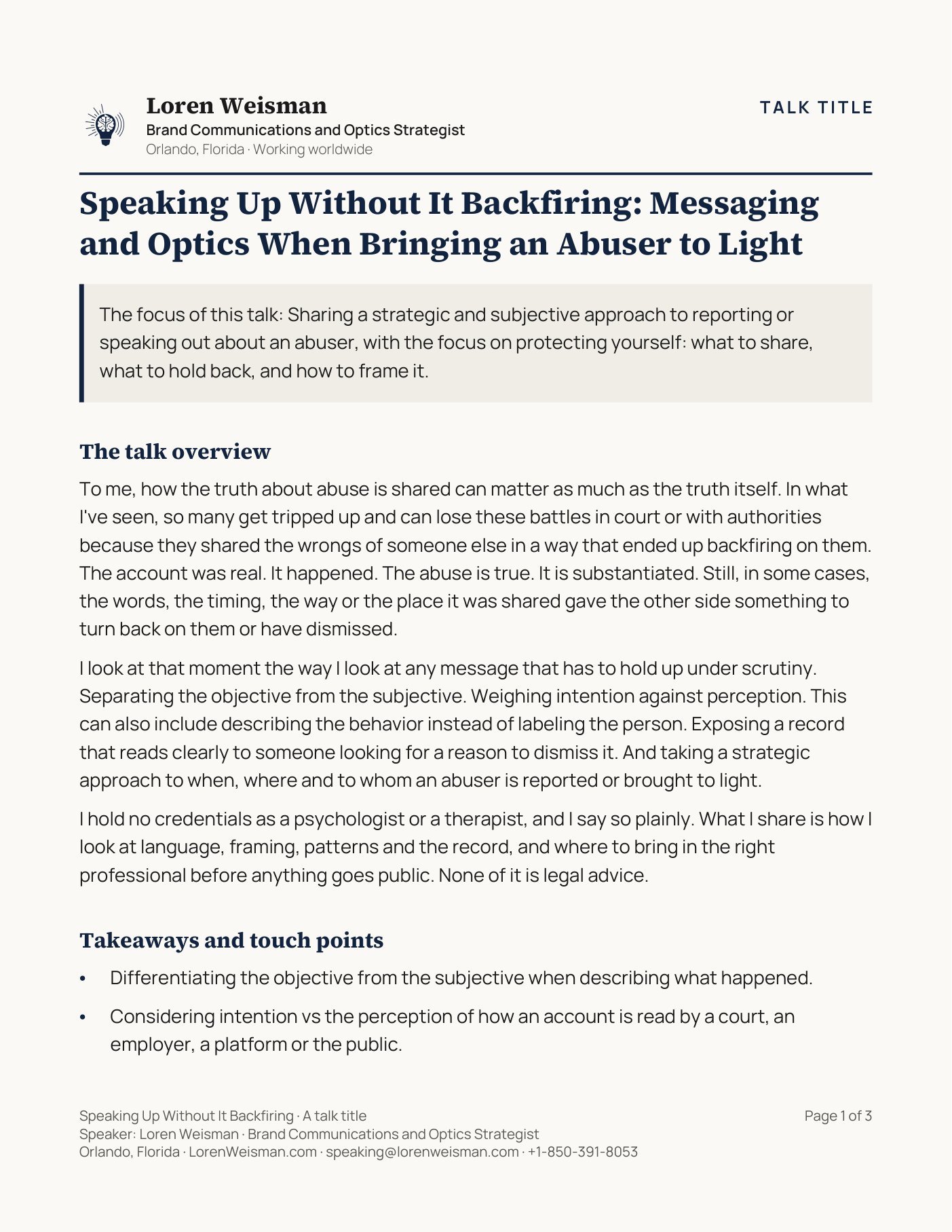
Speaking Up Without It Backfiring talk sheet (PDF, 3 pages) 110 KB
The talk overview, the takeaways and touch points, and the speaker and presenter bio in one file an event organizer, a program committee or a booker can forward. Searchable text and screen reader ready.
Book this talk
Directly, or through a referral partner. Email speaking@lorenweisman.com or call +1-850-391-8053. Run times, what a room needs, the terms and the other talk titles are on the speaking page.
Book Loren WeismanAll talk titles
Speaker and presenter bio
Loren Weisman is a Brand Communications and Optics Strategist based in Orlando, Florida, working worldwide. He helps businesses and individuals build authentic and authoritative brands by aligning messaging, optics and communication.
He works with established experts, and with people who hold real knowledge and experience but lack a clear brand presence. The approach emphasizes transparency and truth, amplifying genuine expertise over hype.
His background includes work as a drummer and producer on 700+ albums, television production credits with ABC, NBC, FOX, CBS and TLC, and consulting roles across a range of industries. He has written five books. Four are published under his own name, including Music Business For Dummies from John Wiley and Sons, The Artist’s Guide to Success in the Music Business from Greenleaf Book Group, and Alphabet Animal Adventures Across America, written with his daughter. The fifth is a 2026 book released under a pen name.
As a speaker he delivers down to earth, educational and applicable presentations. Every talk is tailored to the level of understanding and the size of the audience, from small board rooms to full capacity convention centers. There are no locked in slide decks and no one size fits all presentations.
Loren Weisman is a Brand Communications and Optics Strategist who specializes in illuminating authoritative intelligence and amplifying authentic experts.
Weisman is the host of the brand communications and optics podcast Wait What Really OK.
© 2011 to 2026 Loren Weisman. All Rights Reserved ® ℗
Speaking Up Without It Backfiring: Messaging and Optics When Bringing an Abuser to Light Talk Title
Related reading
- Subjective vs Objective Messaging. Opinions vs facts online.
- Defining messaging tactics from intention to perception and in-between.
- My AI Usage Statement for Brand Communications and Optics Strategist